Table of Contents
- Step 1: Identify the Stain and Gather Your Supplies
- How to Clean Oil Spills on Concrete: Fresh Spill Methods
- The Best Degreaser for Concrete Driveway: Commercial Options
- Pressure Washing Oil Stains: Does It Actually Work?
- Scrubbing, Rinsing, and Neutralizing the Surface
- Troubleshooting Failed Attempts and Old Set-In Stains
- Sealing Your Driveway and Preventing Future Stains
- Conclusion
- Frequently Asked Questions
Last Updated: September 14, 2026
Step 1: Identify the Stain and Gather Your Supplies
A dark patch on your driveway is rarely just one thing. Oil, transmission fluid, and grease each behave differently on concrete, and the stain’s age changes how you attack it.
To remove oil stains from concrete driveway surfaces, first identify what you are dealing with. Fresh oil sits on top; old oil has soaked into the pores and bonded with the concrete.
Here is how to read the stain before you touch it:
- Fresh (under 24 hours): Wet, glossy, still sitting near the surface. These come out easily.
- Set-in (days to weeks): Dark, dry, and matte. The oil has penetrated the porous surface.
- Old and stubborn (months or years): Nearly black, often with a dried crust. These require multiple rounds.
Gather these supplies first: an absorbent material (cat litter, sawdust, or cornmeal), a stiff-bristled brush, dish soap, baking soda, a bucket, and rubber gloves. For tougher jobs, add a commercial degreaser and a pump sprayer.
Test any cleaner on a small, hidden corner of the concrete first. Some degreasers can lighten colored or stamped concrete, and you will not notice until the whole driveway is patchy.
How to Clean Oil Spills on Concrete: Fresh Spill Methods
For a fresh spill, absorb first and clean second. Reaching for water immediately pushes oil deeper into the porous surface.
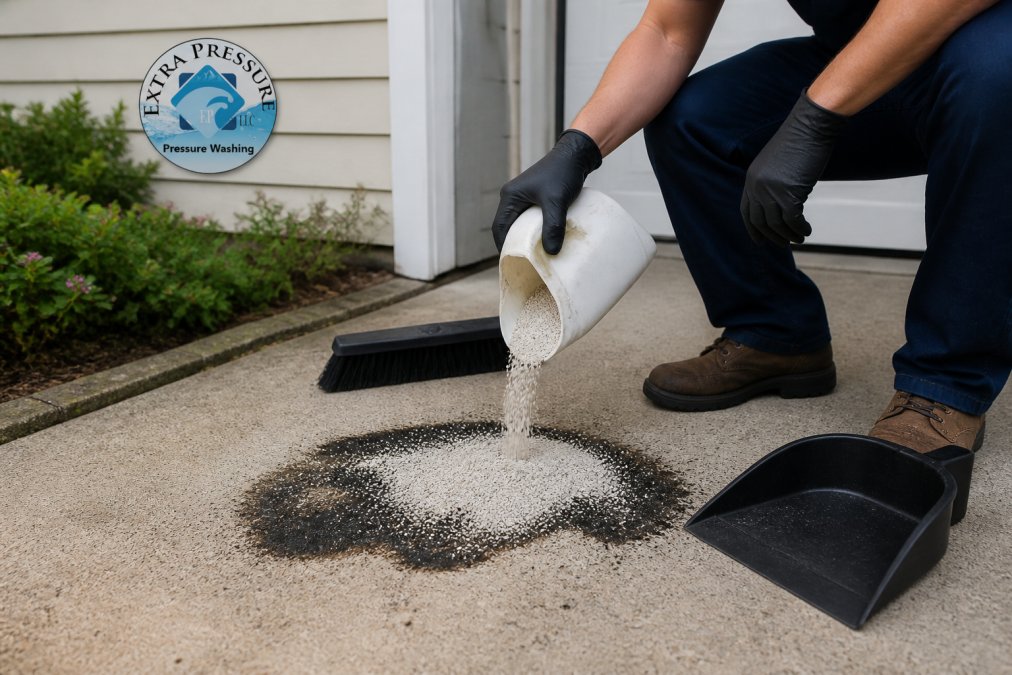
For a spill that happened today, follow this sequence:
- Cover the stain completely with cat litter, sawdust, or cornmeal. Leave it for 30 minutes.
- Sweep it up and check the surface.
- Mix a paste of baking soda and a few drops of dish soap. Apply it thickly.
- Let it sit for 15 minutes, then scrub with a stiff-bristled brush.
- Wipe up the residue and rinse.
Dish soap acts as a surfactant, lowering surface tension so water can lift the oil, while baking soda adds a mild abrasive that breaks the bond without scratching.
For a slightly older spill, swap the paste for a baking soda and water slurry and let it dwell longer, up to an hour, before scrubbing.
The Best Degreaser for Concrete Driveway: Commercial Options
When household remedies stall, a commercial degreaser is next. These rely on stronger surfactants and solvents that emulsify oil into tiny droplets that rinse away instead of soaking back in. The right pick depends on stain age, concrete finish, and how much runoff you can manage.
Here is how the main product classes compare:
| Degreaser Type | Best For | Typical Dilution | Dwell Time | Notes |
|---|---|---|---|---|
| Water-based surfactant | Fresh to moderate stains | Ready-to-use or 1:10 | 10-15 min | Safest for plants, pets, and runoff; may need two passes |
| Citrus solvent (d-limonene) | Set-in stains | Ready-to-use | 15-30 min | Strong odor, biodegradable, can dull some sealers |
| Heavy-duty alkaline (butyl or caustic-based) | Old, baked-in oil | 1:4 to 1:10 | 20-30 min | Wear nitrile gloves and eye protection; corrosive to skin |
| Oxygenated powder | Light surface films | Per label | 15-20 min | Gentle, good for colored concrete |
| Brake cleaner (chlorinated or non-chlorinated) | Small, tough spots | Ready-to-use | Immediate | Spot treatment only; highly flammable; never on sealed concrete |
Apply with a pump sprayer, let it dwell, then agitate with a stiff-bristled brush. Never let degreaser dry on the surface; re-wet if needed. Work in 4-by-4-foot sections so the product never flashes off before you scrub.
Matching chemistry to stain age. Fresh spills respond to water-based surfactants because the oil has not bonded with the concrete’s calcium silicate. Set-in stains need a solvent carrier to re-liquefy the hydrocarbon before the surfactant lifts it. Old, carbonized stains often need an alkaline builder to saponify the oil into soap before rinsing.
Dilution and dwell matter more than brand. Most concentrated degreasers are meant to be diluted; full strength wastes product and leaves more residue. Follow the label ratio, then extend dwell time rather than concentration when a stain resists.
Test on an inconspicuous spot first. Colored, stamped, and exposed-aggregate concrete can be etched or lightened by alkaline and solvent products. Apply a quarter-sized amount, wait the full dwell time, and rinse before doing the whole slab.
Never mix degreasers with bleach or other cleaners. The chemical reaction can release toxic fumes. Use one product at a time and rinse thoroughly between attempts. Chlorinated brake cleaner and alkaline degreasers in particular should never be combined.
EPA Safer Choice product search
Where the runoff goes. After you rinse, the water carries emulsified oil, surfactant, and solvent residue. In most municipalities that water is classified as non-stormwater discharge and cannot legally go down a storm drain. Your options: (1) wet-vac the rinse water before it spreads, (2) push it onto gravel or grass where soil microbes break down the oil, or (3) absorb it with cat litter and dispose of it as household hazardous waste on your community’s collection day. Check your local public works department for the specific rule.
Buy the product class that matches the stain’s age, dilute per the label, and plan your rinse-water disposal before you start. The cleanup after the cleanup is what separates a driveway that stays clean from one that re-stains in a month.
Pressure Washing Oil Stains: Does It Actually Work?
Pressure washing alone does not remove oil stains. It strips the surface layer but can drive oil deeper if you skip the degreaser step first.
Order matters: apply degreaser, let it dwell, scrub, then pressure-wash to rinse. The pressurized water flushes out loosened oil instead of pushing it further in.
A few practical notes from the field:
- Keep the wand moving. Holding it in one spot etches the surface and leaves permanent marks.
- Use a wide fan tip, not a pinpoint nozzle, on concrete.
- Work from the top of the driveway downward so runoff does not re-stain cleaned areas.
For homeowners who want the job done right without the risk of etching or water damage, a licensed and insured professional team can handle the pressure washing and ensure the degreaser is fully rinsed. Extra Pressure LLC. uses state-of-the-art equipment and offers same-day estimates for exactly this kind of work.
Scrubbing, Rinsing, and Neutralizing the Surface
After the degreaser works, scrubbing and rinsing determine whether the stain stays gone.
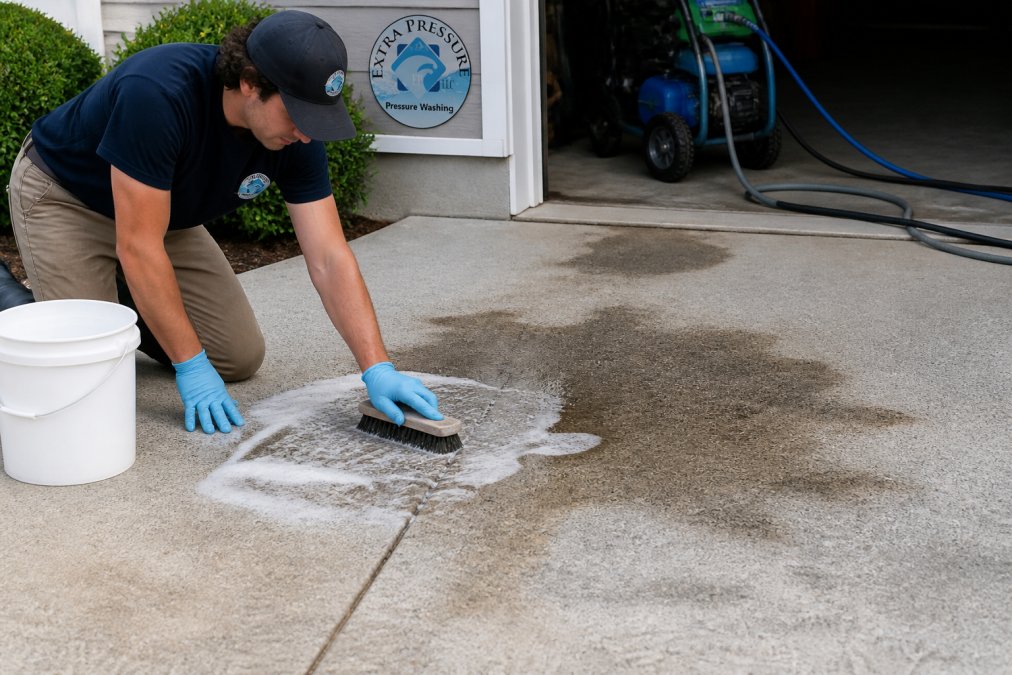
Scrub in circles with a stiff-bristled brush, working cleaner into the pores, then rinse thoroughly. Most DIY attempts fail here: leftover residue traps dirt and re-stains the concrete.
Neutralizing matters for alkaline degreasers. A diluted vinegar and water rinse restores neutral pH; skipping it can leave a hazy film and weaken any later sealer.
Rinse until the water runs clear, then rinse once more. Leftover degreaser residue is the number one reason stains reappear within weeks.
Troubleshooting Failed Attempts and Old Set-In Stains
If your first attempt failed, the stain is likely older or deeper than it looked. Change your method rather than reaching for a stronger chemical.
Common reasons a stain survives:
- Not enough dwell time. Give the degreaser 30 minutes, not 5.
- Wrong product. A water-based degreaser will not touch a years-old hydrocarbon stain.
- No agitation. Chemistry loosens the oil; the brush lifts it out.
- Rinsed too soon. Let the product finish working.
For old set-in stains, try a poultice: mix an absorbent powder with a solvent to form a paste, apply it thickly, cover with plastic, and leave it overnight. The poultice draws the oil up out of the concrete as it dries.
Different finishes need different care. Stamped or colored concrete can fade under harsh solvents, so use gentler water-based options and test first. Smooth, sealed concrete cleans easily but can be damaged by aggressive scrubbing.
If two or three rounds fail, the stain may have penetrated too deep for surface treatment. At that point, professional cleaning or a topical repair is the realistic option.
Sealing Your Driveway and Preventing Future Stains
The most effective way to stop oil stains is to seal the concrete so oil cannot penetrate. This is the step most guides skip, and it determines whether you clean the same stain again next spring.
Why sealing works. Concrete is porous, a network of capillaries formed as the mix cures. Oil molecules are small enough to travel down those capillaries and bond with the paste. A sealer either fills the capillaries (penetrating) or caps them with a film (topical), keeping oil on the surface where a paper towel and dish soap can handle it.
Penetrating vs. topical sealers.
| Sealer Type | How It Works | Finish | Reapply |
|---|---|---|---|
| Penetrating silane/siloxane | Soaks in, chemically bonds with the substrate, repels water and oil | Invisible, matte | Every 3-5 years |
| Acrylic topical | Forms a film on the surface | Glossy or satin | Every 1-2 years |
| Polyurethane topical | Thicker film, high wear resistance | Glossy | Every 2-3 years |
| Epoxy | Two-part coating, very durable | Glossy, can be tinted | Every 5-10 years, but can peel if moisture is present |
For a driveway that sees regular vehicle traffic, a penetrating silane/siloxane sealer is usually the best balance of cost, longevity, and slip resistance. Topical films look sharper but wear faster under tires and can peel at the edges if moisture gets underneath.
Timing after cleaning. Do not seal the same day you degrease. Concrete needs to dry fully, typically 24 to 48 hours in warm, dry weather, longer in humidity. Sealing over damp concrete traps moisture and clouds or fails the sealer. Test by taping a 2-foot square of plastic sheeting to the slab overnight; condensation on the underside means the concrete is still releasing moisture.
Surface prep before sealing. Sweep, rinse, and let dry. Residual degreaser or vinegar interferes with the sealer’s bond. If you used an alkaline degreaser, the diluted vinegar rinse brings pH back to neutral, skipping it is a common reason sealers fail within a year.
Application basics. Apply with a pump sprayer or roller in manageable sections. Most penetrating sealers go on until the surface looks wet and stops absorbing, that is your cue to stop. Over-application pools and dries unevenly; two thin coats beat one heavy coat.
Maintenance habits that extend the seal.
- Fix vehicle leaks promptly, a slow drip will eventually eat through any sealer.
- Keep a bag of cat litter or oil-dry in the garage for quick spill response.
- Clean small drips before they set; a fresh spill on a sealed driveway usually wipes up with a rag.
- Re-test water beading every spring. If water soaks in instead of beading, it is time to reseal.
Watch your runoff. Degreasers and oil residue should never flow straight into storm drains or onto landscaping. Many products are bio-degradable, but that does not make them harmless in large amounts. Redirect rinse water to a gravel or grass area when you can, and check your local public works department for household hazardous waste drop-off options.
When sealing is not the answer. If the concrete is badly spalled, cracked, or has failed previous coatings, sealing only traps moisture and accelerates damage. A topical repair or resurfacing is the realistic path before any sealer goes down.
Sealing is not a one-time job, it is a maintenance cycle. Clean, neutralize, dry fully, seal, and re-test every spring. That cycle is what keeps a driveway looking like the spill never happened.
Conclusion
Oil stains on concrete are stubborn but not permanent. Match your method to the stain’s age and give each product enough dwell time to work.
If you would rather skip the scrubbing, the chemical guesswork, and the risk of etching your driveway, Extra Pressure LLC. can help. As a licensed and insured team, we bring state-of-the-art equipment and specialized soft washing for delicate surfaces, backed by a 100% satisfaction guarantee. We offer same-day estimates and handle residential and commercial exterior cleaning from start to finish.
Schedule an appointment with Extra Pressure LLC. and get your driveway looking like the spill never happened.
Frequently Asked Questions
Are oil stains permanent on concrete?
Oil stains are not always permanent, but concrete’s porous surface allows oil to penetrate deeply if left untreated. Fresh spills are much easier to remove than set-in stains. For old stains, you may need a heavy-duty degreaser, a stiff-bristled brush, and extended dwell time. In severe cases where oil has soaked deep into the slab, a poultice made from baking soda or cat litter and a solvent can draw the oil back to the surface. Multiple treatments are often required for full removal.
Will Dawn dish soap remove oil from concrete?
Dawn and similar dish soaps work well on fresh oil spills because their surfactants break surface tension and help lift the oil. Apply a generous amount directly to the stain, scrub with a stiff-bristled brush, and rinse thoroughly. For set-in stains or larger spills, dish soap alone is not enough. You will likely need a commercial degreaser or a poultice method to pull oil from deeper within the porous surface. Dish soap is best used as a first response within the first few hours.
Is pressure washing enough to remove deep oil stains?
Pressure washing alone rarely removes deep oil stains because water cannot break down hydrocarbons. In fact, blasting a stain with high pressure can push oil further into the concrete. The effective approach is to apply a degreaser first, allow proper dwell time so the chemicals emulsify the oil, scrub the area, and then rinse with a pressure washer. For stubborn stains, repeat the process or use a poultice. Professional pressure washing services can help with large or heavily stained driveways.
What is the strongest degreaser for concrete?
Heavy-duty concrete degreasers containing butyl or d-limonene are among the strongest options for driveway oil stains. These solvents break down grease and oil quickly, but they require careful handling and proper ventilation. For a more environmentally friendly approach, bio-degradable degreasers made from citrus or soy-based solvents also work well with longer dwell times. Always test a small area first and follow the manufacturer’s dilution and safety instructions. For severe stains, a professional-grade degreaser applied by a pressure washing company delivers the best results.
Leave a Reply