Table of Contents
- Mildew, Mold, and Algae: What’s Actually on Your Siding
- What You’ll Need Before You Start
- Best Siding Cleaner for Mold and Mildew
- How to Remove Mildew from Siding: Step-by-Step
- Soft Washing vs Pressure Washing Siding
- Troubleshooting Stubborn Stains and Surface Discoloration
- Environmental Impact of Chemical Runoff
- How to Prevent Mildew on House Siding
Last Updated: August 26, 2026
Mildew on siding degrades your exterior walls, traps moisture, and lowers curb appeal. At Extra Pressure LLC., we see this constantly, and the good news is that most mildew problems are completely fixable with the right approach. This guide covers how to remove mildew from siding safely and effectively, from identifying what you’re dealing with to preventing it from coming back.
The biggest mistake most homeowners make is skipping the diagnostic step entirely and treating everything the same way, which causes surface damage and recurring growth.
Mildew, Mold, and Algae: What’s Actually on Your Siding
Not everything dark on your siding is mildew. The distinction matters because treatment differs.
Mildew is a surface fungus, typically white, gray, or light brown, that sits on top of siding rather than penetrating it. Mold presents as darker black, green, or fuzzy patches and often signals deeper moisture intrusion. Algae is that distinctive green or greenish-black staining that appears most often on north-facing or shaded walls where moisture lingers.
Treating algae with a mildewcide designed for mold, or vice versa, wastes effort. Algae responds well to sodium hypochlorite solutions and oxygen bleach, while mold may require a dedicated fungicide. Look closely at color, texture, and location. Mildew tends to wipe off with light pressure. Mold and algae usually require longer dwell time and more mechanical action.
According to the EPA guidance on mold and moisture in buildings, surface discoloration that covers a large area or reappears quickly after cleaning may indicate an underlying moisture problem worth investigating before treating the exterior surface alone.
What You’ll Need Before You Start
Getting preparation right saves time and prevents damage. Gather everything before mixing a single cleaner.
Safety Gear and Protective Equipment
Exterior cleaning chemicals are hard on skin and eyes. Protective eyewear is non-negotiable when working with sodium hypochlorite or bleach-based solutions. Add chemical-resistant gloves, old clothing you don’t mind staining, and rubber-soled shoes with good grip if working on a ladder. For second-story access, ladder safety is critical, maintain three points of contact, never overreach, and consider a ladder stabilizer. If the affected area is high or extensive, professional soft washing equipment makes a real difference in both safety and outcome.
Tools and Cleaning Solutions
A complete mildew removal setup includes:
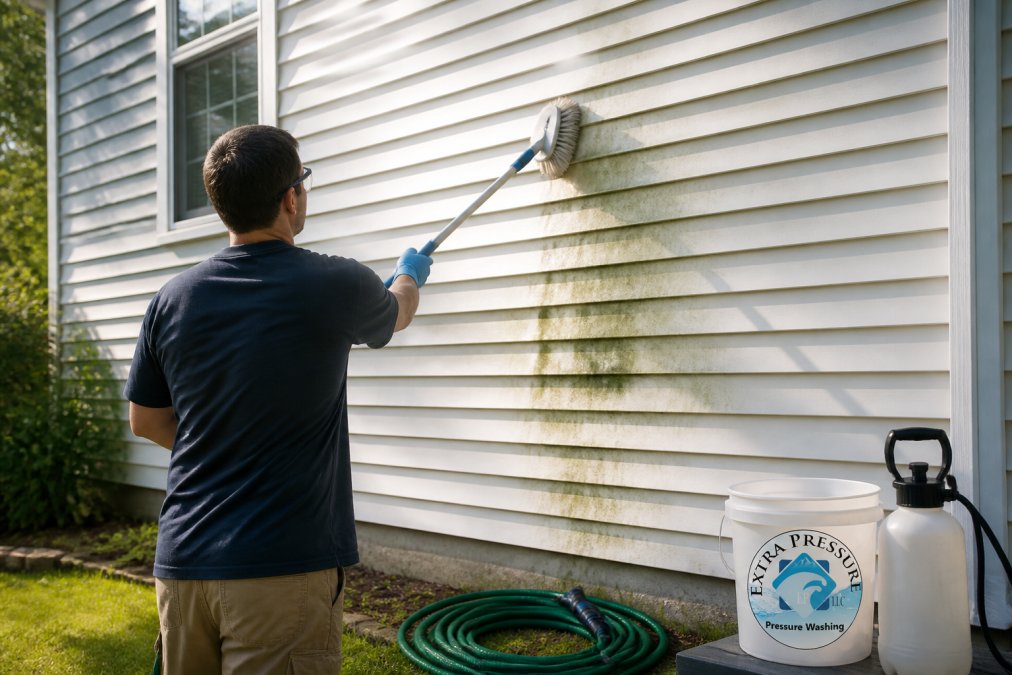
- Long-handled scrub brush with soft to medium bristles
- Garden hose with adjustable nozzle
- Spray bottle for targeted application
- Pump garden sprayer for larger surfaces
- Bucket for mixing solutions
- Pressure washer (optional, with appropriate PSI settings for your siding type)
- Low-pressure nozzle if using a pressure washer
Have your cleaning solution mixed and ready before wetting the siding.
Best Siding Cleaner for Mold and Mildew
The right cleaner depends on your siding material and growth severity.
DIY Cleaning Mixes That Work
Bleach and water solution: Mix one part sodium hypochlorite (standard household bleach) with four parts water. Add a few drops of dish soap to help the solution cling to vertical surfaces. This is the most effective DIY option for mildew and algae on non-porous siding like vinyl.
Oxygen bleach solution: Mix oxygen bleach powder with warm water per the product label. Oxygen bleach is color-safe, biodegradable, and gentler on surrounding plants than chlorine bleach. It’s ideal for painted wood or fiber cement siding where sodium hypochlorite could cause discoloration.
White vinegar solution: Mix undiluted white vinegar in a spray bottle for light mildew on small areas. Vinegar is a mild acid that disrupts mildew growth without harsh chemicals.
Hydrogen peroxide: A 3% hydrogen peroxide solution applied directly to mildew patches is another low-impact option, particularly useful on painted surfaces where bleach would be too aggressive.
Add dish soap to any spray-applied solution. The surfactant helps the liquid stick to vertical siding instead of sheeting off immediately, which dramatically increases dwell time effectiveness.
Commercial Cleaners and Mildewcide Products
Commercial mildewcide and exterior cleaning products offer pre-formulated solutions with built-in surfactants and often include fungicide components that help slow regrowth. When selecting a product, look for biodegradable formulations, especially if you have landscaping close to the house.
How to Remove Mildew from Siding: Step-by-Step
Removing mildew follows a clear sequence. Skipping steps, particularly protection and rinsing, is where most DIY attempts fail.
Protecting Landscaping and Surrounding Plants
This step gets skipped constantly and causes the most collateral damage. Sodium hypochlorite and other cleaning chemicals can burn or kill plants, grass, and shrubs.
Before applying any cleaner: water all plants and grass near the work area thoroughly, cover sensitive plants with plastic sheeting, keep your garden hose nearby to rinse any plants that get direct chemical contact immediately, and after cleaning, rinse the surrounding soil and plant beds with fresh water.
Applying the Cleaner and Dwell Time
Work in sections, top to bottom, to prevent dirty runoff from contaminating cleaned areas.
- Pre-wet the siding section with your garden hose.
- Apply your cleaning solution using a pump sprayer or spray bottle, covering the mildewed area completely.
- Allow the cleaner to dwell for 5 to 10 minutes for most mildew (the EPA). For heavier algae growth, extend to 15 minutes, but do not allow the solution to dry on the surface.
- Scrub with your long-handled scrub brush using circular or overlapping strokes.
- Do not let the solution sit in direct sunlight without re-wetting.
Never mix bleach with ammonia-based cleaners or products containing ammonia. The combination produces toxic chloramine gas. Check labels before combining any cleaning products.
Rinsing and Final Inspection
Thorough rinsing is as important as the cleaning itself. Residual cleaner left on siding can cause discoloration, attract new dirt, and damage materials over time.
- Rinse from top to bottom using a garden hose or pressure washer on a low-pressure setting.
- Flush window frames, trim, and any crevices where cleaner could pool.
- Rinse surrounding landscaping and soil again with fresh water.
- Allow the siding to dry completely, then inspect in good light.
Soft Washing vs Pressure Washing Siding
The choice between soft washing and pressure washing is one of the most consequential decisions in exterior siding maintenance.
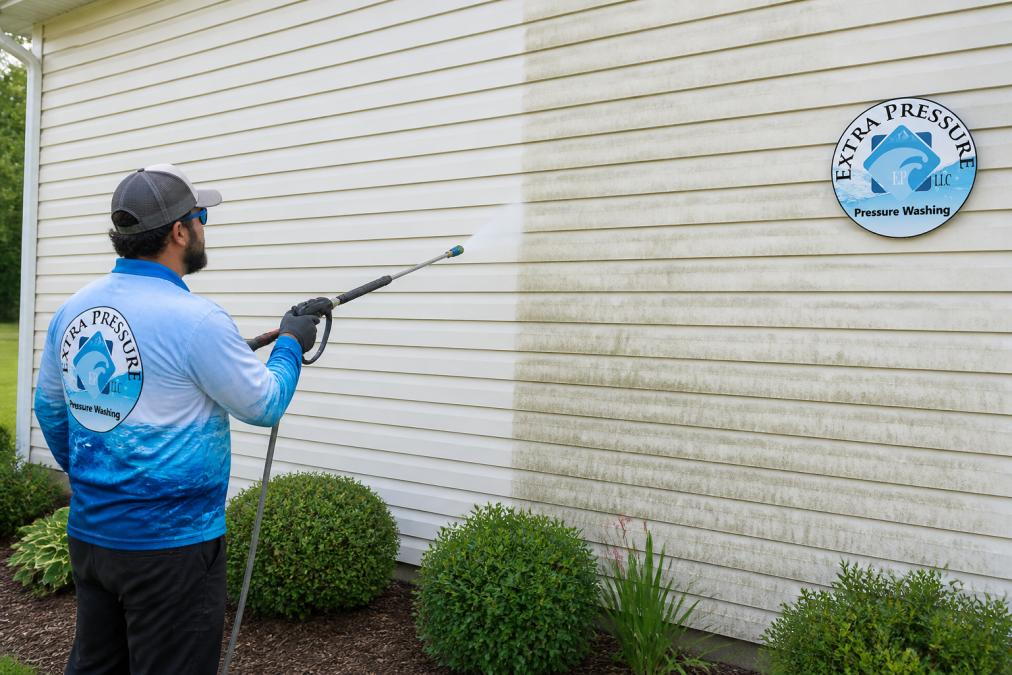
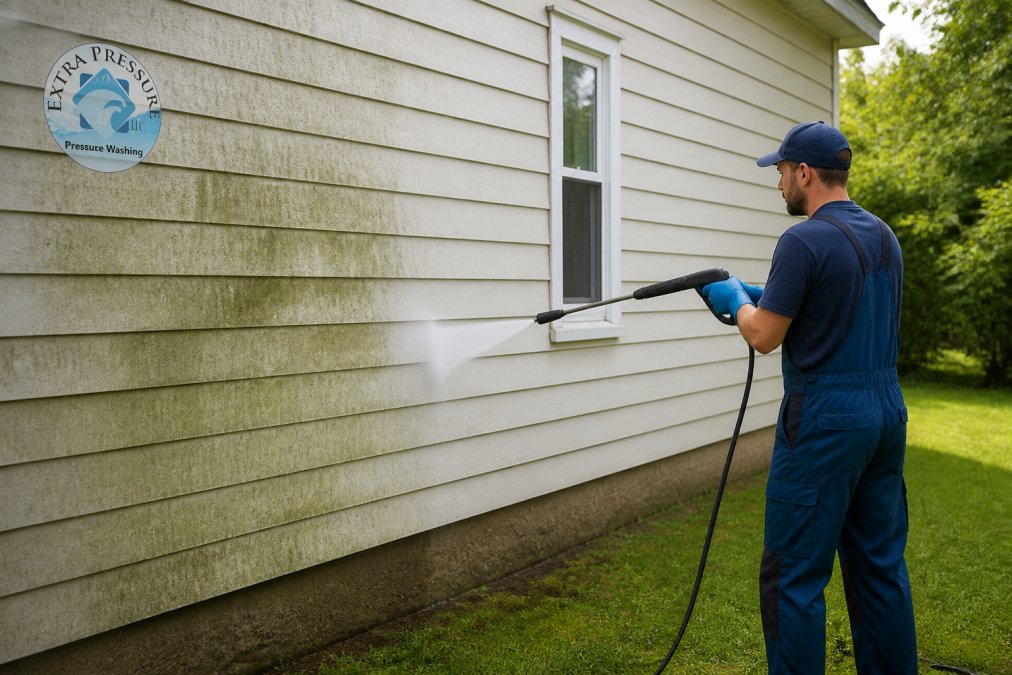
Soft washing uses low water pressure (typically under 500 PSI) combined with cleaning solutions to do the actual cleaning work. The chemistry removes the mildew, algae, and organic matter; the water rinses it away. Soft washing is correct for most residential siding materials, including vinyl, wood, fiber cement, and painted surfaces.
Pressure washing uses high-pressure water (often 1,200 to 3,000+ PSI) to remove surface contaminants mechanically. On siding, particularly vinyl or wood, excessive pressure can force water behind panels, strip paint, etch surfaces, and void manufacturer warranties.
If you’re cleaning siding to remove mildew, soft washing is almost always the right choice. According to guidance from the Vinyl Siding Institute on cleaning and maintenance, manufacturers generally recommend low-pressure washing for vinyl siding to prevent water infiltration and surface damage.
Material-Specific Cleaning Protocols
Different siding materials have meaningfully different tolerances.
| Siding Material | Recommended Method | Cleaning Solution | Avoid |
|---|---|---|---|
| Vinyl siding | Soft wash or low-pressure rinse | Diluted sodium hypochlorite or oxygen bleach | High PSI, abrasive brushes |
| Painted wood | Soft wash only | Oxygen bleach or hydrogen peroxide | Chlorine bleach, high pressure |
| Fiber cement | Soft wash, gentle scrub | Oxygen bleach, biodegradable cleaner | High pressure, wire brushes |
| Cedar/natural wood | Soft wash, light scrub | Oxygen bleach, white vinegar | Sodium hypochlorite at full strength |
| Stucco | Low-pressure soft wash | Mild detergent, oxygen bleach | High pressure (causes pitting) |
| Brick/masonry | Pressure wash acceptable | Diluted bleach solution | Acid-based cleaners on painted brick |
The most common material-specific mistake is using full-strength sodium hypochlorite on cedar or painted wood. It works fast but bleaches the surface, breaks down wood fibers, and strips paint. Oxygen bleach is slower but far safer for organic materials.
Troubleshooting Stubborn Stains and Surface Discoloration
Some stains don’t respond to a single cleaning cycle.
Stain doesn’t lift after two applications: Increase dwell time rather than concentration. Let the solution sit for 20 minutes with the surface kept wet. If the stain still resists, the growth may have penetrated the surface material, particularly on older or weathered siding.
Gray or brown streaks that persist after mildew removal: These are often tannin stains from wood, rust stains from metal fasteners, or oxidation on older vinyl. Tannin stains respond to oxalic acid-based cleaners; rust stains require a dedicated rust remover.
White, chalky residue after cleaning: This is usually efflorescence on masonry or oxidized residue on older vinyl. A mild acid rinse (diluted white vinegar) followed by thorough rinsing often resolves it.
Staining returns within weeks: Rapid regrowth signals an ongoing moisture or shade problem rather than a cleaning failure. Check gutters for blockages, inspect caulking around windows and trim, and evaluate whether nearby trees are keeping the siding perpetually shaded and damp.
Stubborn stains that return quickly after cleaning are almost always a symptom of a moisture management problem, not just a cleaning challenge. Fix the source before repeating the treatment.
Environmental Impact of Chemical Runoff
The chemicals you apply to your siding don’t disappear when you rinse them off. Sodium hypochlorite in high concentrations is toxic to aquatic organisms. When bleach-based runoff reaches storm drains, it can enter local waterways without treatment.
Practical steps to minimize environmental impact: use biodegradable cleaner formulations whenever possible, dilute properly, avoid cleaning before rain, rinse plant beds and soil after every cleaning session, and never pour leftover cleaning solution into storm drains or on bare soil. Switching to oxygen bleach or hydrogen peroxide where the cleaning task allows it is the single most effective change you can make for reducing environmental impact without sacrificing results.
How to Prevent Mildew on House Siding
Cleaning mildew is reactive. Prevention is where the real value is, because mildew that never grows doesn’t need to be removed.
Mildew needs three things to thrive: moisture, shade, and organic matter. Eliminate any one of those, and you break the cycle.
Control moisture at the source. Keep gutters clear so water flows away from the siding face rather than spilling over it. Ensure downspouts direct water at least two meters away from the foundation. Check caulking around windows, doors, and trim annually and replace any that’s cracking or pulling away.
Manage shade and airflow. Trim trees and shrubs that keep siding in constant shade or press against the exterior wall. Good airflow across the siding surface allows it to dry quickly after rain, which is the single most effective passive mildew deterrent.
Remove organic matter regularly. Dirt, pollen, and leaf debris that accumulate on siding provide the food source mildew needs. A simple rinse with a garden hose every few months removes this material before it can feed fungal growth.
Apply a mildewcide treatment after cleaning. Some commercial exterior cleaning products include a residual mildewcide that continues working after the rinse cycle, extending the time between cleanings significantly on problem areas.
Schedule annual exterior cleaning. Regular siding maintenance removes early-stage growth before it establishes, keeps the surface clean of organic matter, and gives you the chance to catch moisture issues like failing caulk or gutter problems before they become expensive repairs.
| Prevention Strategy | What It Targets | How Often |
|---|---|---|
| Gutter cleaning | Moisture overflow onto siding | Twice yearly minimum |
| Caulk inspection and replacement | Water infiltration at seams | Annually |
| Tree and shrub trimming | Shade and debris accumulation | Annually or as needed |
| Siding rinse with garden hose | Organic matter removal | Every 2-3 months |
| Professional soft wash | Established growth, deep cleaning | Annually |
| Mildewcide application | Residual fungal protection | After each cleaning |
The most common mistake homeowners make is waiting until mildew is visibly established before addressing it. By that point, you’re in removal mode rather than prevention mode, and the cleaning effort is significantly greater.
Mildew on siding is a manageable problem, but it has a way of coming back if the underlying conditions aren’t addressed. Extra Pressure LLC. offers licensed and insured soft washing services specifically designed for residential siding, using the right chemistry and pressure settings for each material type. Our same-day estimates mean you’re not waiting around to find out what the job involves. Schedule an appointment with Extra Pressure LLC. and get your exterior cleaned correctly the first time, with results that last.
Frequently Asked Questions
What can I spray on my siding to remove mildew?
A diluted sodium hypochlorite (bleach) solution is an effective spray for killing mildew on siding. Mix one part household bleach with three parts water, then add a small amount of dish soap to help it cling to the surface. For a gentler option, oxygen bleach dissolved in warm water works well on painted or wood siding where chlorine bleach could cause fading. Always test on a hidden area first and follow with a thorough rinse to remove mildew from siding completely.
Is pressure washing safe for all types of siding?
No. High-pressure washing above 1,500 PSI can crack fiber cement, force water behind vinyl panels, strip paint from wood, and damage older or brittle materials. Soft washing at low pressure combined with a cleaning solution is often a safer method for most siding types, especially aged vinyl, wood, and stucco. Brick and concrete can generally tolerate higher pressure settings. Always check the siding manufacturer's guidelines before applying any pressure, and use a low-pressure nozzle when in doubt.
Does Dawn dish soap remove mold spores?
Dawn dish soap alone does not kill mold or mildew spores, but it works well as a surfactant added to bleach or oxygen bleach solutions. It helps the cleaning solution cling to vertical siding surfaces longer, improving dwell time and scrubbing action. For actual mildew removal, you need a fungicide or bleach-based cleaner as the active ingredient. Dawn is a useful additive, not a standalone mildew killer.
How often should I clean my siding to prevent mildew growth?
Most homes benefit from a full exterior cleaning once a year. Properties shaded by trees, located in humid climates, or near standing water may need cleaning more frequently because organic matter and moisture accumulate faster on north-facing or shaded walls. Applying a mildewcide treatment after cleaning can extend the time between cleanings by slowing algae and mildew regrowth. Regular siding maintenance is a reliable way to prevent mildew from returning season after season.
This article was written using GrandRanker
Leave a Reply