Table of Contents
- Why Hiring Insured Pressure Washers Protects Your Biggest Investment
- The Real Risks of Hiring Uninsured Contractors
- Pressure Washing Property Damage Liability: What Happens When Something Goes Wrong
- How to Verify Contractor Insurance Before You Sign Anything
- Professional-Grade Equipment and Detergents: Results You Cannot Rent at a Big Box Store
- Environmental Compliance and Water Reclamation: What Insured Pros Handle for You
- The Bottom Line: Cost-Effectiveness and Peace of Mind
- Frequently Asked Questions
Last Updated: September 13, 2026
Why Hiring Insured Pressure Washers Protects Your Biggest Investment
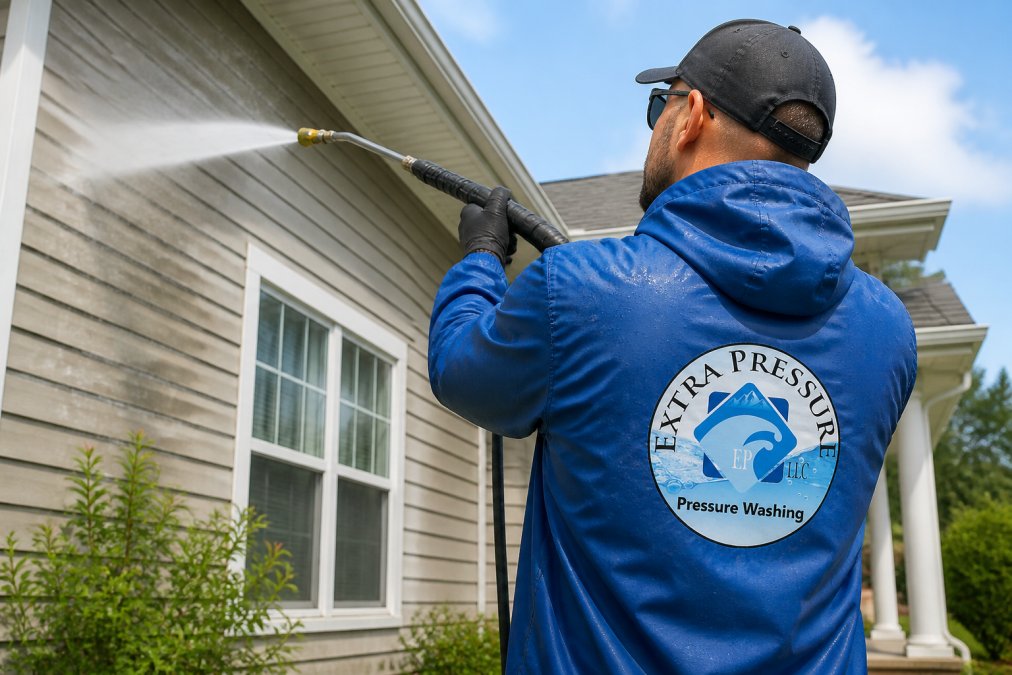
Hiring insured pressure washers is the most effective way to protect your home from financial liability during exterior cleaning.
Your home is likely your largest asset. When a contractor’s equipment damages siding, strips paint, or injures a worker on your property, the financial fallout lands on whoever holds the liability. An uninsured crew leaves that burden with you. An insured one transfers it to a policy built for exactly that scenario.
This guide covers the risks of uninsured contractors, how to verify contractor insurance, and what pressure washing property damage liability looks like in practice.
The Real Risks of Hiring Uninsured Contractors
The biggest risk of hiring an uninsured contractor is that you become the insurer. If a worker is injured on your property, your homeowner’s policy may face a claim and your premiums can rise.
Most homeowners assume a contractor’s insurance is a given. It isn’t. Many small operators work without coverage because policies are expensive and enforcement is inconsistent. When something goes wrong, the homeowner absorbs the cost.
If an uninsured worker is injured on your property, your homeowner’s liability coverage may be the only policy in play. That can mean a claim against you, higher premiums, or in serious cases, a lawsuit. Always ask for proof of coverage before any work starts.
Who Pays When an Uninsured Worker Gets Hurt on Your Property
You do, in most cases. Homeowner’s insurance typically covers injuries to guests and workers on your property, but that’s your coverage being used, not the contractor’s. A single claim can affect your rates for years.
The cleaner path: hire a contractor whose general liability and workers’ compensation policies are active and verifiable, so an injury is handled by their insurer, not yours.
Pressure Washing Property Damage Liability: What Happens When Something Goes Wrong
Pressure washing property damage liability falls on whoever caused the damage. When the contractor is insured, their general liability policy typically covers repairs. When they’re not, you’re negotiating with someone who may have no means to pay, and your only fallback is your own homeowner’s policy.
High-pressure water is unforgiving: it can etch concrete, force water behind siding, strip paint, and destroy window seals. A trained operator knows which surfaces need soft washing and which can handle full pressure. An untrained one learns on your house.
The Two Policies That Actually Matter
Most homeowners hear “insured” and assume one policy covers everything. In practice, two coverages do two jobs:
- General liability (GL) covers third-party property damage and bodily injury, the cracked siding, the broken window, the neighbor’s car parked too close. It does not cover the contractor’s own employees.
- Workers’ compensation covers the contractor’s employees if they’re injured on the job. It pays medical bills and lost wages regardless of fault, and it is the coverage that keeps an injured worker’s claim off your homeowner’s policy.
A contractor can carry one without the other. A sole proprietor with no employees may legally carry only GL. A crew of three without workers’ comp is a red flag in most states. Ask which policies are in force and confirm the employee count they’re meant to cover.
Common Damage Scenarios and Who Covers the Repair Bill
| Damage Scenario | Insured Contractor | Uninsured Contractor |
|---|---|---|
| Siding cracked or water forced behind panels | GL policy covers repair | You pay or negotiate |
| Paint stripped from deck or fence | GL policy covers repair | You pay or negotiate |
| Window seal broken by high-pressure spray | GL policy covers repair | You pay or negotiate |
| Landscaping killed by chemicals | GL policy covers replacement | You pay or negotiate |
| Worker injured on site | Workers’ comp responds | Your homeowner’s policy responds |
| Water intrusion discovered weeks later | GL claim, subject to policy terms | You pay, and may face a mold remediation bill |
Insurance doesn’t just protect the contractor, it protects the surfaces, the plants, and the person holding the wand.
What a Real Claim Looks Like
A common pattern: a contractor’s wand tip catches a window seal and water works behind the frame. Nothing looks wrong for a week, then the drywall below starts to stain. By the time the homeowner connects the dots, the contractor has cashed the check and stopped answering calls.
With an insured contractor, you document the damage with photos and a written description, notify the contractor in writing, and they file a claim with their GL carrier. The adjuster inspects, the policy pays up to the coverage limit, and the contractor’s deductible, not yours, absorbs the first portion. Your homeowner’s policy is never touched, so your premiums don’t move.
With an uninsured contractor, you file a claim on your own homeowner’s policy, and that claim follows you. Most insurers treat a paid liability claim as a rating factor at renewal, with a surcharge that can persist for years. You also absorb your deductible up front, and any damage beyond your policy limit is yours.
Exclusions That Surprise Homeowners
Even a legitimate GL policy has limits worth knowing before work starts:
- Faulty workmanship is often excluded. If the damage is deemed the result of poor technique rather than an accident, the carrier may deny the claim.
- Gradual damage, long-term water intrusion, mold that developed over months, is frequently excluded or capped.
- Intentional acts are never covered.
- Your own property may be treated differently than a third party’s. Read the certificate and ask the contractor’s agent which exclusions apply to exterior cleaning.
A low quote usually means the operator skipped insurance to keep costs down. The savings disappear the moment something breaks.
If the contractor’s GL policy excludes faulty workmanship, and many do, the only reliable protection against a bad soft-wash job is the contractor’s own warranty and reputation. That’s why verification and references go together.
Why This Is a Gap Most Articles Skip
Most “benefits of hiring insured pressure washers” articles stop at “insurance protects you.” They don’t explain that GL and workers’ comp are separate, that exclusions can gut a claim, or that a homeowner’s own policy becomes the de facto insurer when the contractor has none. Those mechanics turn a vague reassurance into a decision framework.
How to Verify Contractor Insurance Before You Sign Anything
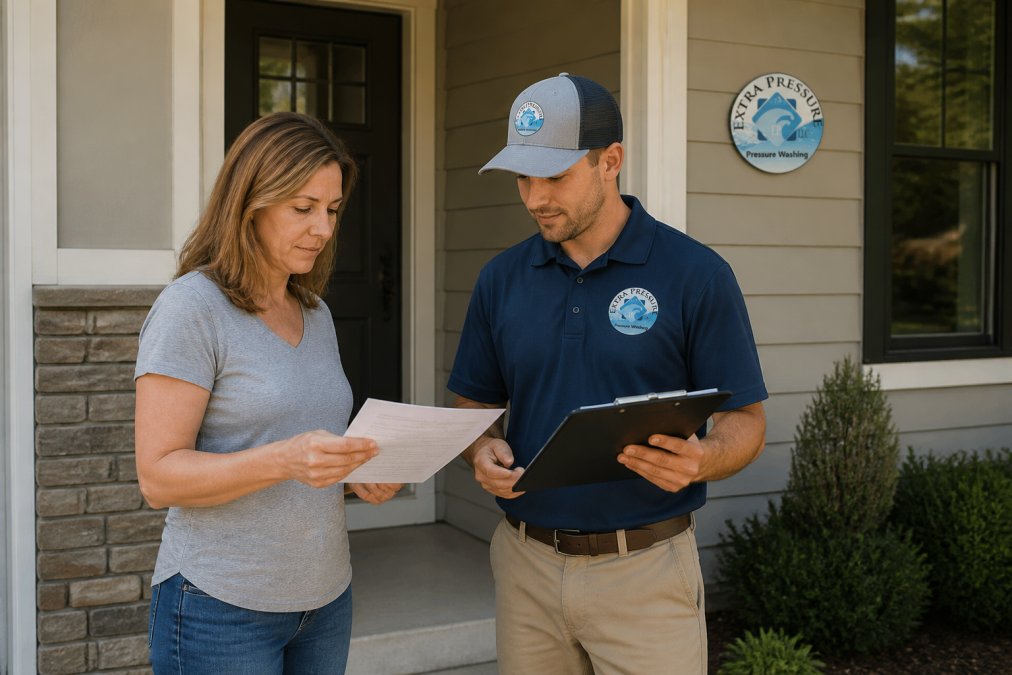
Verifying contractor insurance takes about ten minutes and prevents problems that can cost thousands. Ask for a certificate of insurance, call the insurer to confirm it’s active, and check that the policy covers the specific work.
What a Certificate of Insurance Actually Contains
A certificate of insurance (COI) is a one-page document issued by the contractor’s insurance agent or carrier. It is not the policy itself and grants you no rights under it, but it is the standard proof requested before work begins. A legitimate COI shows:
- Named insured, the legal name of the contractor’s business. It must match the name on the estimate, the contract, and the license.
- Insurer name and NAIC number, the carrier’s identity and its National Association of Insurance Commissioners identifier, which you can look up.
- Policy numbers, separate numbers for general liability and workers’ compensation if both are carried.
- Policy effective and expiration dates, the coverage window. If the expiration date falls before your project’s end date, the coverage may lapse mid-job.
- Coverage limits, typically a per-occurrence limit and an aggregate limit. A common small-contractor GL limit is $1,000,000 per occurrence, but limits vary widely.
- Certificate holder, often the property owner or the entity requesting proof.
- Description of operations, a line describing the work the policy is meant to cover. This is where you want to see pressure washing, soft washing, or exterior cleaning named.
The Verification Checklist
- Request a certificate of insurance before signing anything
- Confirm the named insured matches the company quoting the job
- Confirm the policy is currently active, not expired
- Check that general liability coverage is listed with a per-occurrence limit
- Verify workers’ compensation coverage if the crew has employees
- Call the insurer’s phone number printed on the certificate, not a number the contractor gives you, to confirm the policy is real and in force
- Ask whether the policy covers pressure washing and soft washing specifically
- Confirm the contractor’s license status with your state or local licensing body
- Get the verification in writing before the first worker arrives
How to Spot a Fake or Expired Certificate
Fake and expired COIs exist, and they follow recognizable patterns:
- The name mismatch. The named insured is a different company than the one quoting the job, often a related entity, a former business, or a shell. This is the single most common red flag.
- The expired window. The certificate looks current, but the effective dates have already passed. Check the dates against today’s date, not the date the contractor sent it.
- The wrong phone number. The insurer’s contact number on the certificate routes to the contractor or an accomplice. Always cross-check the carrier’s main number independently.
- The missing description. The “description of operations” line is blank or lists unrelated work like roofing or landscaping. Coverage that doesn’t name exterior cleaning may not respond to a pressure washing claim.
- The photocopy. A scanned, low-resolution, or visibly altered certificate is a warning sign. Ask for a fresh copy sent directly from the agent.
The only way to know for sure is to call the insurer directly using the number printed on the certificate, then independently verify that number belongs to the carrier. That one call separates a bonded and insured professional from someone hoping you won’t check.
What to Do If the Contractor Pushes Back
A legitimate contractor will not hesitate to provide a COI. Excuses, “the agent is out,” “I’ll send it after the deposit,” “my policy is with a different company”, are a signal. There is no legitimate reason a contractor cannot produce a current certificate before work begins. If they can’t, hire someone else.
Photograph the certificate and the contractor’s license plate before work begins. If a dispute arises later, you’ll have a clear record of who was on your property and what coverage they claimed to carry.
Why This Is the Gap Most Articles Miss
Competing articles tell you to “ask for proof of insurance” but rarely explain what the proof contains, how to read the effective dates and limits, or how to detect a forged certificate. That gap is where homeowners lose money. A ten-minute verification is the difference between a covered repair and a claim on your own policy.
Professional-Grade Equipment and Detergents: Results You Cannot Rent at a Big Box Store
Professional-grade equipment and commercial-grade detergents produce results that consumer rentals cannot match. The difference isn’t marketing. It’s pressure control, flow rate, and chemistry.
Rental units run at fixed high pressure with no adjustment for delicate surfaces. Professional rigs let operators dial pressure down for soft washing, switch nozzles for different materials, and apply detergents formulated for mold, organic staining, and oxidized siding.
Insured contractors also carry the training that comes with the equipment. Surface integrity depends on knowing when to use a high-pressure nozzle and when to back off, judgment that keeps siding, trim, and window seals intact.
The equipment matters less than the operator’s judgment about when to use it. Insurance is often a proxy for that judgment, because carriers won’t underwrite operators who damage property repeatedly.
Environmental Compliance and Water Reclamation: What Insured Pros Handle for You
Environmental compliance covers how runoff, detergents, and wastewater are managed during exterior cleaning. Insured professionals typically follow local and state requirements for water reclamation and chemical safety because their coverage depends on it.
Runoff from pressure washing carries dirt, mold spores, detergent residue, and sometimes paint particles, and in many jurisdictions it cannot flow directly into storm drains. Insured contractors plan for containment, use biodegradable detergents where appropriate, and dispose of wastewater per local rules.
Uninsured operators rarely carry this overhead. The cost shows up later, either as a fine against the property owner or as damage to landscaping and drainage.
If you want to understand the rules that apply where you live, check your state environmental agency’s guidance on stormwater and pressure washing runoff.
The Bottom Line: Cost-Effectiveness and Peace of Mind
The cost-effectiveness of hiring insured pressure washers isn’t about the invoice. It’s about what the invoice prevents.
An insured contractor costs more upfront. That premium buys liability coverage, workers’ compensation, environmental compliance, and a paper trail you can rely on if something goes wrong. Uninsured work is cheaper right up until it isn’t.
For homeowners preparing a property for sale, property managers maintaining curb appeal across multiple units, and business owners responsible for sidewalks and storefronts, the calculus is the same. Preventative maintenance through a licensed and insured provider is cheaper than repair.
Extra Pressure LLC. provides licensed and insured residential and commercial pressure washing, soft washing, window cleaning, and gutter maintenance. We offer same-day estimates, use specialized soft washing for delicate surfaces, and back every job with a 100% satisfaction guarantee.
Exterior cleaning goes wrong quietly. A cracked seal, a stripped deck board, or a worker injury doesn’t announce itself until the bill arrives. The fix is choosing a contractor whose coverage is verified before the first drop of water hits your siding. Extra Pressure LLC. brings licensed and insured service, state-of-the-art equipment, specialized soft washing for delicate surfaces, and same-day estimates to every job. Schedule an appointment with Extra Pressure LLC. and protect your property from the first spray to the final rinse.
Frequently Asked Questions
What happens if a pressure washer damages my property?
If the contractor is insured, their general liability policy typically covers repairs to your siding, windows, landscaping, or hardscaping. You file a claim with their insurer, not yours. If they are uninsured, you either pay out of pocket or file a claim on your own homeowners policy, which can raise your premiums. Always ask for a certificate of insurance before work begins so you know who is financially responsible for pressure washing property damage liability.
How do I verify that a pressure washing company is actually insured?
Ask for a certificate of insurance and call the phone number listed on it to confirm the policy is active. The certificate should name the contractor’s business, show general liability coverage, and list workers’ compensation if they have employees. You can also request to be added as an additional insured for the project. A legitimate company will provide this without hesitation. If they dodge the request, walk away.
Can I be held liable if an uninsured contractor gets hurt on my property?
Yes. In most states, if an uninsured worker is injured on your property, your homeowners insurance may be expected to cover their medical bills and lost wages. Some policies exclude injuries to paid contractors, leaving you personally exposed to a lawsuit. This is one of the clearest risks of hiring uninsured contractors. Verifying workers’ compensation coverage before work starts is the simplest way to close that gap.
Is it worth paying more for an insured pressure washing company?
The price difference is usually smaller than homeowners expect, and the coverage gap is enormous. An insured company carries liability insurance, workers’ compensation, and often a workmanship warranty. If a nozzle blast cracks a window or strips paint from siding, their policy handles it. With an uninsured operator, that repair bill lands on you. The cost-effectiveness of hiring insured pressure washers comes down to one avoided claim paying for the premium many times over.
Leave a Reply