Table of Contents
- Why Soft Washing Is Better: A Side-by-Side Comparison
- How Soft Washing Works and Why It Protects Your Surfaces
- How to Remove Mildew from Siding Without Causing Damage
- Is Soft Washing Safe for Roof Shingles?
- How Long Does Soft Washing Last?
- DIY vs. Professional Soft Washing: Cost, Safety, and Results
- Conclusion: Why Soft Washing Is the Smarter Choice
- Frequently Asked Questions
Last Updated: September 11, 2026
Why Soft Washing Is Better: A Side-by-Side Comparison
Soft washing is the exterior cleaning method that uses low pressure combined with specialized cleaning solutions to remove organic growth without damaging surfaces. For most homes, it’s the safer and longer-lasting choice. We understand how the wrong method can strip paint, crack siding, and void warranties, which is why the question of why soft washing is better often comes up.
The core difference comes down to how each method removes dirt. Pressure washing relies on force. Soft washing relies on chemistry and time. One blasts grime away; the other dissolves it at the root.
That distinction matters more than most homeowners realize. Algae, mildew, and lichen don’t just sit on a surface. They embed roots into porous materials like vinyl siding, stucco, and roof shingles. High pressure removes the visible layer but leaves the roots behind, which is why growth returns so quickly. A soft wash treatment kills the organism at the source.
Below, we break down the two methods side by side, cover surface suitability, and explain how long results actually last.
Quick Comparison Table: Soft Washing vs. Pressure Washing
| Factor | Soft Washing | Pressure Washing |
|---|---|---|
| Pressure level | Low, under 500 PSI | High, 1,300 to 4,000 PSI |
| Cleaning method | Sodium hypochlorite and surfactants | Water force alone |
| Best surfaces | Roof shingles, vinyl siding, stucco, wood decks | Concrete driveways, brick, stone |
| Risk of damage | Low when applied correctly | High on delicate surfaces |
| Organic growth removal | Kills algae, mildew, lichen at the root | Removes surface layer only |
| Typical dwell time | 10 to 20 minutes before rinse | Immediate |
How Soft Washing Works and Why It Protects Your Surfaces
A soft wash system applies a diluted cleaning solution at low pressure, usually through a pump sprayer rather than a pressure washer nozzle. The solution contains sodium hypochlorite as the active biocide, plus surfactants that help it cling to vertical surfaces instead of running off.
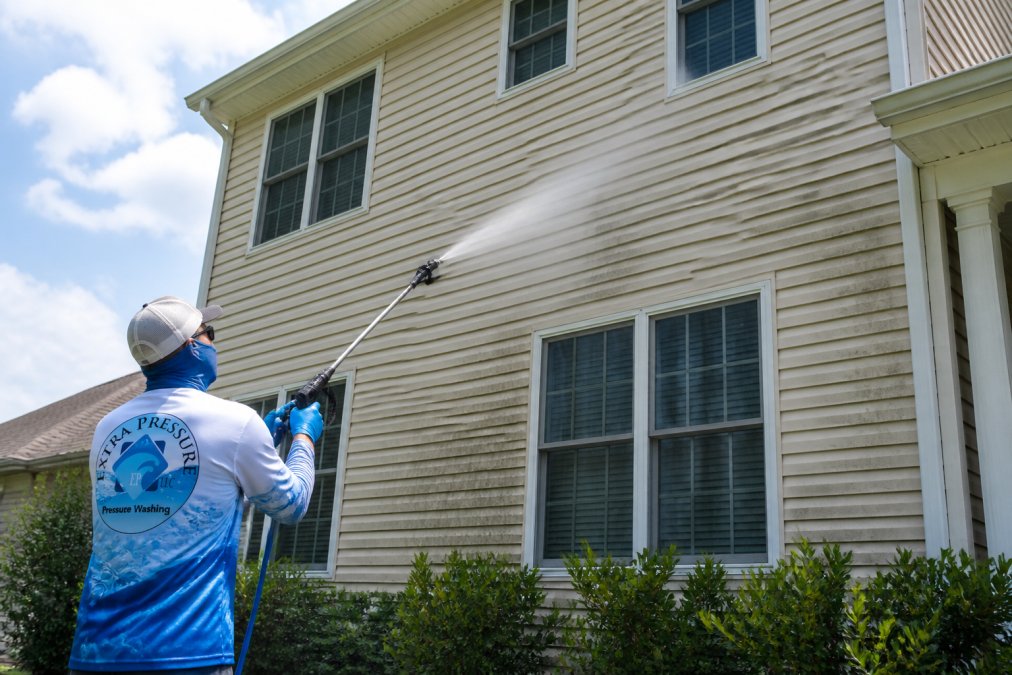
The process follows a predictable sequence:
- Pre-rinse landscaping and surrounding surfaces with fresh water
- Apply the cleaning solution from the bottom of the wall upward
- Let the solution dwell for 10 to 20 minutes
- Rinse with low pressure, working top to bottom
That dwell time is the part most people underestimate. The chemicals need time to break down the cell walls of algae and mildew. Skip it, and you’re back to relying on force.
The EPA’s guidance on safe use of antimicrobial pesticides is worth reviewing if you’re handling sodium hypochlorite yourself. Concentration, protective equipment, and runoff control all matter.
The most common mistake is rinsing too soon. If the solution doesn’t dwell long enough, the growth comes back within weeks instead of months. Give it the full contact time, even when the surface looks clean.
How to Remove Mildew from Siding Without Causing Damage
Removing mildew from siding starts with killing it, not scrubbing it. Mildew is a living organism with roots that penetrate the surface. Scrub the visible layer off and it regenerates from what’s left behind.
Here’s a practical sequence for vinyl or fiber cement siding:
- Mix a diluted sodium hypochlorite solution with a surfactant, following label ratios
- Apply from the bottom up so streaking doesn’t run down clean sections
- Let it dwell 10 to 20 minutes
- Rinse at low pressure, top to bottom
- Repeat on stubborn patches rather than increasing pressure
The mistake to avoid is reaching for the pressure washer when mildew reappears. High pressure on siding can force water behind the panels, which leads to rot and mold inside the wall cavity. It can also strip the finish and leave permanent etch marks.
A soft wash approach removes mildew from siding by addressing the cause. The CDC’s mold cleanup guidance notes that killing mold at the source, rather than surface cleaning, is what prevents recurrence.
Is Soft Washing Safe for Roof Shingles?
Yes, soft washing is the recommended method for asphalt shingle roofs. Roof shingles are one of the most damage-prone surfaces on a home, and high pressure is almost guaranteed to cause problems there.
Asphalt shingles have a granular surface that protects the underlying material. Pressure washing blasts those granules loose, which shortens the roof’s lifespan and can void the manufacturer’s warranty. The Asphalt Roofing Manufacturers Association guidance on roof cleaning specifically cautions against high-pressure methods on shingles.
The black streaking you see on roofs is usually gloeocapsa magma, a type of algae. It feeds on the limestone filler in shingles and spreads in humid climates. Soft washing kills it without disturbing the granules.
Ask any roof cleaning provider what pressure they use. If the answer involves a pressure washer rather than a pump sprayer, that’s a red flag. Roof shingles should never see more than low pressure.
How Long Does Soft Washing Last?
Soft washing typically lasts one to three years on siding and two to four years on roofs, depending on shade, humidity, and tree cover. Because the treatment kills organic growth at the root instead of just removing the surface layer, results hold far longer than pressure washing alone.
Several factors shorten that window:
- Heavy shade that keeps surfaces damp
- Overhanging trees dropping organic debris
- High humidity with poor airflow
- North-facing walls that dry slowly
- Proximity to water, ponds, creeks, and irrigation-heavy landscaping raise ambient moisture
Pressure washing, by contrast, often shows regrowth within a single season because the roots survive the blast.
A seasonal maintenance calendar
Most homeowners treat exterior cleaning as a one-time event. It isn’t. Organic growth is a cycle, and staying ahead of it is cheaper than chasing it. Here’s a practical schedule that works in most climates:
Spring (March-May)
- Walk the property after the last freeze and note any green or black streaking on north-facing walls and roof planes
- Rinse pollen and tree debris off siding and decks before it bakes on
- Inspect roof valleys and shaded slopes for early gloeocapsa magma spotting
- Schedule a soft wash if growth is visible, spring treatment kills spores before summer humidity accelerates spread
Summer (June-August)
- Check for mildew on shaded siding and under eaves, where airflow is poor
- Rinse landscaping beds and foundation plantings after any treatment to dilute runoff
- Watch for lichen on stucco and stone, which spreads fastest in warm, humid conditions
Fall (September-November)
- Clear leaves and organic debris from roof surfaces and gutters, debris holds moisture against shingles and feeds growth
- Trim tree limbs back from the roofline where possible
- This is the best window for a full soft wash in most regions: growth is slowing, humidity is dropping, and the surface will stay clean through winter
Winter (December-February)
- Inspect after storms for new staining, especially on north-facing surfaces that stay damp
- Avoid treating in freezing temperatures, most soft wash solutions lose effectiveness and runoff control becomes difficult
- Plan the spring treatment now so you’re on the schedule before the season rush
How to tell it’s time for a re-treatment
You don’t need to wait for full regrowth. Early signals that a light maintenance treatment will save you a full restoration later:
- Faint dark streaking returning to roof planes
- A green or gray tint on shaded siding that wasn’t there last season
- Mildew smell near doors and windows on humid days
- Chalking or dulling of painted surfaces under the growth
A light treatment every 18 to 24 months keeps growth from ever fully reestablishing. That’s cheaper than waiting for a full restoration, and it protects the surface underneath, paint, stain, and shingle granules all last longer when organic growth isn’t allowed to sit on them.
Mark your calendar for a fall soft wash and a spring inspection. Two touchpoints a year is enough to keep most homes ahead of regrowth without paying for a full restoration every time.
DIY vs. Professional Soft Washing: Cost, Safety, and Results
DIY soft washing is possible for a single-story home with basic siding, but the risks climb fast on roofs, two-story walls, and delicate surfaces. The chemicals involved require proper dilution, protective gear, and careful runoff management. What most guides skip is the actual math, what you’d spend to do it yourself versus what a professional service includes, so here’s the breakdown.
What a DIY soft wash setup actually requires
A workable homeowner setup is not just a pump sprayer and a jug of bleach. At minimum you need:
- A 12-volt or manual pump sprayer rated for sodium hypochlorite (standard garden sprayers corrode within a season)
- Sodium hypochlorite, typically sold as pool shock or a dedicated soft wash mix, not household laundry bleach, which is weaker and often has additives
- A surfactant designed for exterior cleaning so the solution clings to vertical surfaces
- PPE: chemical-resistant gloves, splash goggles, and a respirator rated for chlorine vapor
- A garden hose and nozzle for pre-rinse and final rinse
- Plastic sheeting or a tarp to protect plants and sensitive surfaces
Add it up and the equipment alone is a real outlay, and the chemicals are consumables you’ll rebuy every season. The bigger hidden cost is time: a single-story ranch with light growth is a half-day job for a first-timer. A two-story colonial with heavy algae on the north side is a full weekend, and if the mix ratio is wrong, you’ll be redoing it.
What drives professional pricing
Professional soft washing quotes are not arbitrary. The main cost drivers are:
- Square footage of the surface, measured wall area, not lot size
- Surface type, roofs and stucco take longer dwell times and more careful rinse control than vinyl siding
- Height and access, two-story walls, steep roof pitches, and tight side yards all add labor
- Level of growth, light dust and pollen is a quick treatment; heavy lichen or gloeocapsa magma may need a second application
- Landscaping protection, beds, shrubs, and lawns near the work zone require pre-soak and rinse, which adds time
Because those variables swing so widely, any honest provider will want to see the property or at least photos before quoting. A phone estimate based on square footage alone is a guess.
The real trade-off
| Consideration | DIY | Professional |
|---|---|---|
| Upfront equipment cost | Out-of-pocket for sprayer, chemicals, PPE | Included in service |
| Chemical handling risk | High without training | Managed by trained technicians |
| Roof and two-story access | Dangerous, ladder falls are a leading home injury | Handled with proper equipment and insurance |
| Runoff and plant protection | Easy to get wrong; one bad rinse can kill a bed | Planned in advance with pre-soak and rinse |
| Time investment | Half-day to full weekend per application | Same-day service for most homes |
| Likely result | Uneven coverage, may recur quickly | Even coverage, longer-lasting |
| Recourse if something goes wrong | None | Licensing and insurance back the work |
What most guides miss is the plant damage angle. Sodium hypochlorite runoff kills landscaping fast if it isn’t pre-soaked and rinsed. A professional crew pre-treats beds and controls runoff as part of the job, that’s not an upsell, it’s standard practice.
DIY makes sense for a single-story home with light growth and a homeowner comfortable handling diluted sodium hypochlorite. For roofs, two-story walls, stucco, or anything near valuable landscaping, the equipment cost, safety risk, and redo potential usually tip the math toward hiring a pro.
Pricing for professional soft washing depends on square footage, surface type, and access, so it’s best to get a written estimate rather than guess. Extra Pressure LLC. offers same-day estimates and carries licensing and insurance, which matters if anything goes wrong on your property.
Conclusion: Why Soft Washing Is the Smarter Choice
The wrong cleaning method can cost you a roof, a paint job, or a season of regrowth. Soft washing removes organic growth at the root while protecting the surfaces underneath, which is why it’s the better choice for siding, roofs, stucco, and wood.
Extra Pressure LLC. specializes in soft washing for delicate surfaces, backed by licensed and insured service, state-of-the-art equipment, and a 100% satisfaction guarantee. From window washing to full exterior restoration, our team restores curb appeal without the risk of surface damage.
Schedule an appointment with Extra Pressure LLC. and get a same-day estimate for a cleaner, longer-lasting exterior.
Frequently Asked Questions
How often should a house be soft washed?
For most homes, a soft wash every 12 to 24 months keeps siding, roofs, and gutters free of algae, mildew, and lichen. Homes surrounded by trees or in humid climates may need annual service. Regular soft washing also prevents organic growth from staining surfaces and extends the life of paint and shingles.
Is soft washing safe for roof shingles?
Yes. Soft washing uses low pressure (under 500 PSI) and specialized cleaning solutions to kill algae and mildew without loosening shingle granules. High-pressure washing can void roof warranties and strip protective layers. Professional soft washing is the recommended method for asphalt shingles, tile, and metal roofs.
How long does soft washing last?
Soft washing typically keeps surfaces clean for 12 to 24 months, depending on weather and tree coverage. The cleaning solution kills mold and algae at the root, so regrowth is slower than with pressure washing alone. Scheduling annual or bi-annual maintenance prevents heavy buildup and keeps curb appeal high.
Can soft washing damage siding or shingles?
No, when performed correctly. Soft washing relies on biodegradable cleaning solutions and gentle water pressure (like a garden hose) to remove organic growth. It is safe for vinyl siding, stucco, wood, and asphalt shingles. Pressure washing, by contrast, can crack siding, strip paint, and force water behind walls.