
Table of Contents
- What Is Pure Water Window Cleaning and Why It Works
- How Pure Water Cleans Windows: From Tank to Glass
- Water-Fed Pole Window Cleaning: Reaching New Heights Safely
- Pure Water vs Traditional Window Cleaning: Which Delivers Better Results?
- The Practical Benefits: Time, Safety, and Surface Care
- Limitations, First-Clean Expectations, and Water Use
- Conclusion: Is Pure Water Window Cleaning Right for Your Property?
- Frequently Asked Questions
Last Updated: October 7, 2026
What Is Pure Water Window Cleaning and Why It Works
Pure water window cleaning is a method that uses filtered, mineral-free water and a telescopic pole to wash glass, frames, and sills without detergents. At Extra Pressure LLC, we rely on this approach because the water itself does the work: it lifts dirt, then dries without leaving spots.
The key is water purity. Ordinary tap water carries dissolved minerals, and when that water evaporates, those minerals stay behind as white residue. Strip them out first, and the glass dries clean on its own.
The Science Behind Spot-Free Results
Water spots are dried minerals. Remove the minerals, and there’s nothing left to spot.
Pure water is aggressive toward dirt in a useful way. With no dissolved solids in it, the water pulls minerals and grime off the glass and into suspension. When it dries, it evaporates completely and leaves no film. That’s the entire trick behind a spot-free finish, and it’s why the process works as well on frames and sills as it does on glass.
A spot-free finish isn’t a product you apply. It’s the result of removing everything from the water before it touches the glass.
How Pure Water Cleans Windows: From Tank to Glass
Water travels through a multi-stage purification system before it ever reaches a window. Each stage removes a different class of contaminant, and skipping one undermines the next. The goal is water with essentially zero total dissolved solids (TDS), because anything left in the water is what dries on the glass as a spot.
The Three-Stage Purification Process
- Sediment filtration catches larger particles: grit, rust, and organic matter that would clog later stages. A typical sediment cartridge is rated in microns and is the cheapest stage to replace, so it protects the more expensive membranes downstream.
- Reverse osmosis (RO) forces water through a semi-permeable membrane that rejects most dissolved solids, including the calcium and magnesium responsible for hard-water spotting. RO is the workhorse stage and typically removes the large majority of dissolved solids in a single pass. It also produces a stream of reject water that carries the concentrated minerals away.
- Deionization (DI) polishes the water through ion-exchange resin, stripping the remaining charged particles until the water reads at or near zero TDS. DI resin is the final quality gate; once it exhausts, TDS climbs and spotting returns.
Reading TDS and Knowing When Filters Need Attention
A TDS meter measures total dissolved solids in parts per million (ppm). Most practitioners treat a reading of 0 ppm as the target for spot-free work, and many will not put water on glass above roughly 10 ppm. The exact cutoff varies with the mineral mix and the surface, but the principle is consistent: lower is safer.
A common pattern is to check TDS at three points:
- At the tap, to establish the starting load the system has to remove.
- After RO, to confirm the membrane is still rejecting solids.
- After DI, to confirm the resin is still polishing to zero.
When the post-DI reading starts creeping up, the resin is exhausting and needs replacing. When the post-RO reading rises, the membrane may be fouled, damaged, or past its service life. Catching both early is what separates a spot-free finish from a callback.
Filter maintenance is the difference between a spot-free finish and a callback. Check TDS readings regularly, and replace resin or membranes before performance drops, not after a customer notices streaks. Keep a log of readings so you can see a trend rather than reacting to a single bad number.
Spot-free results are a water-quality outcome, not a technique. If the water reads zero TDS at the brush, the glass dries clean; if it does not, no amount of scrubbing will fix it.
Water-Fed Pole Window Cleaning: Reaching New Heights Safely

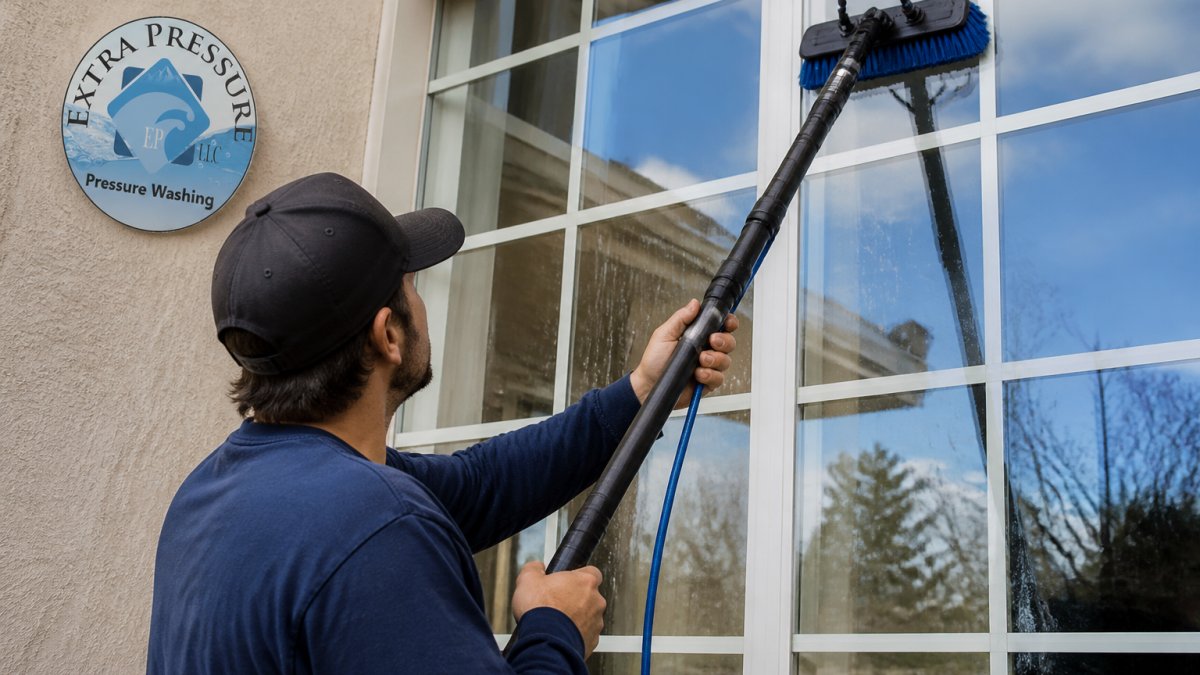
A water-fed pole system lets a cleaner reach upper-storey windows from the ground. The pole extends to the glass, water flows through a brush head at the tip, and the operator scrubs and rinses without ever leaving the driveway.
That changes the safety math entirely. Ladder use is the leading source of serious injury in exterior cleaning work, and fall risk climbs with every foot of height. Ground-based cleaning removes the ladder from most jobs, which protects the cleaner and reduces the chance of property damage from a ladder slipping against siding or gutters.
The brush head does double duty. Its bristles agitate dirt and grime loose, while the water flow rinses the glass and flushes debris away. For upper-storey windows, facades, and conservatories, this is often the only practical method.
Pure Water vs Traditional Window Cleaning: Which Delivers Better Results?
Pure water vs traditional window cleaning comes down to residue, access, and suitability. Traditional methods use a squeegee and detergent, and detergent leaves a film unless it is rinsed perfectly. Pure water leaves nothing behind because there is nothing in it to leave. But the honest answer is that each method wins in different situations, and a good provider uses both.
| Factor | Pure Water Method | Traditional Method |
|---|---|---|
| Finish | Spot-free when TDS is at zero; no detergent film | Clean when rinsed well; detergent film if rinsing is imperfect |
| Access | Ground-based with telescopic pole; reaches upper stories | Ladder or access equipment for upper stories |
| Fall risk | Low, cleaner stays on the ground | Higher with ladder use |
| Speed on exteriors | Fast on large glass and multi-story facades | Slower; setup and repositioning add time |
| Frames and sills | Cleaned in the same pass | Often wiped separately |
| Chemicals | Chemical-free cleaning | Detergent required |
| Interiors | Not suitable for most interior glass | Standard method for interiors |
| Tight spaces | Pole and brush may not fit | Hand tools reach where a pole cannot |
| Cost drivers | Equipment, water, and filter upkeep; efficient on volume | Labor-heavy; ladder setup adds time |
Where Each Method Wins
Pure water wins on exterior glass, frames, sills, and facades, especially on two- and three-story homes where ladder work is slow and risky. It also wins on recurring maintenance, because the mineral-free rinse keeps glass cleaner between visits.
Traditional cleaning still has a place: interior windows, tight spaces where a pole will not fit, and one-off jobs where the customer wants a hand-finished look on a single pane. Many providers run both methods on the same property, using pure water outside and traditional tools inside.
What Actually Drives the Cost
Quotes are not driven by the method alone. The main factors are property size, number of panes, access (sloped ground, obstacles, height), soil level, and cleaning frequency. A heavily soiled first clean takes longer than a maintenance visit, and a recurring schedule spreads the cost over the year. Rather than quoting a flat rate, a provider should walk the property and price the actual work.
Do not assume pure water is always cheaper or always faster. On a single ground-floor pane, traditional hand cleaning can be quicker. On a three-story facade, pure water usually wins on both time and safety.
Homeowners and property managers with two- or three-story exteriors, delicate landscaping, or recurring maintenance needs who want spot-free results without ladder risk.
The Practical Benefits: Time, Safety, and Surface Care
Three benefits show up on every job: faster cleaning, less fall risk, and gentler treatment of surfaces.
Reduced Ladder Use and Fall Risk
Ground-based cleaning eliminates most ladder setups. No climbing, no repositioning, no leaning. For two- and three-story homes, that’s the single biggest safety gain in the trade.
Cleaning Frames, Sills, and Facades
The brush head scrubs more than glass. Window frames, window sills, and surrounding facades get cleaned in the same motion, which removes the dirt that would otherwise wash down onto freshly cleaned glass in the next rain.
Skipping frames and sills is a common mistake. Dirt left on the frame runs onto the glass at the first rain, and the customer sees streaks you already cleaned.
Limitations, First-Clean Expectations, and Water Use
Pure water window cleaning has real limits, and honest providers will say so.
The first clean takes longer. Years of built-up grime, hard water deposits, and residue from prior detergent use can require extra passes. A first clean restores the glass; subsequent visits maintain it, and cleaning frequency of every four to eight weeks keeps results consistent.
Water use is another trade-off. The system consumes water to rinse thoroughly, though the process is chemical-free and the runoff carries no detergent into landscaping. For properties with delicate plantings, that matters.
Interior windows aren’t a fit for the pole method. Those still need traditional hand cleaning, which is why a complete service covers both approaches.
Conclusion: Is Pure Water Window Cleaning Right for Your Property?
For most exterior windows, the answer is yes. The method delivers a spot-free finish, reaches upper-storey windows safely from the ground, and cleans frames and sills in the same pass. The main caveats are first-clean time and interior glass, both of which are manageable with the right provider.
Extra Pressure LLC provides licensed and insured window cleaning and soft washing for homes and businesses, with same-day estimates and state-of-the-art equipment. Our team handles exterior glass, frames, and sills with pure water methods, and we back every job with a 100% satisfaction guarantee. Schedule an appointment and see the difference a mineral-free finish makes.
Frequently Asked Questions
What is the special water that window cleaners use?
Window cleaners use pure water, which is tap water that has been filtered through sediment filters, reverse osmosis, and deionisation resin to remove minerals and impurities. The result is water with a TDS (total dissolved solids) reading near zero. Because there are no minerals left to dry on the glass, the water evaporates without leaving spots or streaks, giving a spot-free finish.
Does pure water window cleaning leave streaks or spots?
No. Pure water window cleaning is designed to leave a spot-free and streak-free finish. The water contains no minerals, so when it dries, nothing remains on the glass. The brush head agitates dirt and grime, and the final rinse with pure water carries everything away. As long as the water quality is maintained and the technician rinses thoroughly, you will not see water spots or residue.
Is pure water safe for windows and frames?
Yes, pure water is safe for window glass, frames, and sills. It is chemical-free, so it will not damage paint, stain wood, or corrode metal. It also cleans frames and sills effectively without the need for detergents. However, very old or already damaged frames may need gentle handling, and a professional will assess the surface before cleaning.
Can pure water window cleaning be used on interior windows?
Pure water window cleaning is primarily designed for exterior windows because the water-fed pole system reaches high areas from the ground. Interior windows are typically cleaned with traditional methods like squeegees and cloths, since bringing hoses and poles inside is impractical. Some providers offer interior cleaning as a separate service, but the pure water method is best suited for exterior glass, frames, and sills.