Table of Contents
- What Insured Pressure Washing Services Actually Cover
- How to Verify Pressure Washing Insurance Before You Hire
- Reading a Pressure Washing Insurance Certificate
- Questions to Ask a Pressure Washing Company
- Pressure Washing Service Damage Protection: Real Scenarios
- What Insurance Does Not Cover for Homeowners
- The Complete Contractor-Vetting Checklist Beyond Insurance
- Frequently Asked Questions
Last Updated: October 6, 2026
What Insured Pressure Washing Services Actually Cover
Hiring insured pressure washing services means the company carries liability and workers’ compensation coverage that protects you, not just them. If a wand scars your siding or a worker gets hurt on your property, that policy is the difference between a quick repair and a legal fight.
At Extra Pressure LLC., we carry coverage on every job we run. An uninsured crew can leave you holding the bill for damage, injuries, and lawsuits, so here’s what to check before anyone touches your home.
Insurance protects you, not just the contractor. If a crew is uninsured and something goes wrong, your homeowners policy often becomes the backup payer.
General Liability and Property Damage
General liability coverage pays when a contractor accidentally damages your property: a cracked window, a gouged deck board, or siding peeled loose by too much pressure.
It also handles third-party claims, like a neighbor’s car splattered with runoff or a passerby slipping on a wet sidewalk.
What most people miss is the policy limit. A policy with a low cap may not cover a serious repair.
Workers’ Compensation and Bodily Injury
Workers’ compensation covers the crew if someone gets hurt on your property.
If a worker falls from a ladder cleaning your second-story gutters, that worker or their health insurer could come after you for medical bills and lost wages without workers’ comp.
Bodily injury coverage handles injuries to other people. It pays for medical care and, if it comes to it, legal expenses.
A licensed contractor with both coverages removes that risk from your shoulders entirely.
How to Verify Pressure Washing Insurance Before You Hire
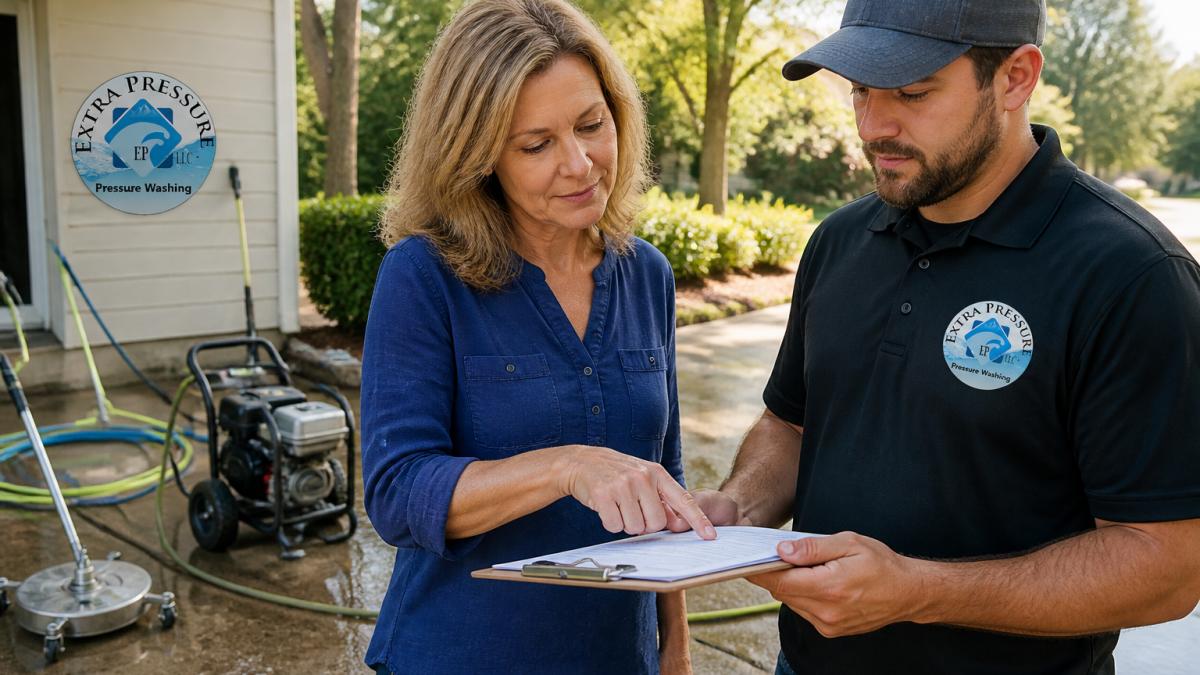
You verify pressure washing insurance by requesting a certificate of insurance from the contractor, then confirming it with the insurance provider. Never take a verbal “we’re insured” as proof.
Step-by-Step Verification Process
Follow these steps before you sign anything or pay a deposit:
- Ask for the certificate of insurance (COI). This is a one-page summary of the contractor’s active policies.
- Check the policy dates. An expired policy covers nothing. Confirm it’s current.
- Confirm the coverage types. Look for general liability and workers’ compensation.
- Note the policy limits. Make sure they’re high enough to cover realistic damage to your property.
- Call the insurance provider. Use the number on the certificate, not one the contractor gives you, to confirm the policy is real and active.
- Get your own copy. Keep the COI on file until the job is done and paid.
That fifth step is the one people skip, but a quick call to the insurer settles it in minutes.
Reading a Pressure Washing Insurance Certificate
A pressure washing insurance certificate lists the insured business name, policy numbers, coverage types, policy limits, and effective dates. Read it like a checklist.
Here’s what to look for on the page:
- Insured name: It should match the company you’re hiring, not a different business.
- Policy effective and expiration dates: The coverage must be active on your job date.
- Coverage types: General liability and workers’ compensation should both appear.
If any field is blank, mismatched, or expired, pause. Ask the contractor to send an updated certificate before you move forward.
A certificate with an expired date or a mismatched business name is a red flag. If the contractor can’t produce a current one, do not let the crew start work.
Questions to Ask a Pressure Washing Company
Ask these questions before you book. A reputable company answers without hesitation.
- Are you licensed and insured, and can I see the certificate?
- What are your general liability policy limits?
- Do you carry workers’ compensation for your crew?
- What’s your process for protecting siding, windows, and landscaping?
- Will you provide a written estimate and a clear service scope?
- What happens if something gets damaged during the job?
That last question separates the pros from the pretenders: a good company has a written plan for accidental damage.
For delicate surfaces like painted siding or older window frames, ask whether they use soft washing instead of high pressure, which lowers the risk of surface damage.
Pressure Washing Service Damage Protection: Real Scenarios
Pressure washing service damage protection is the practical reason insurance matters.
Picture a crew blasting a driveway next to a freshly painted garage door, peeling the paint with overspray.
Or a worker who slips on a wet walkway and breaks a wrist. Workers’ compensation covers their care and lost wages; without it, the injury can land on your homeowners policy.
Siding, Windows, and Landscaping Risks
The most common damage claims come from a few predictable spots, and each one has a different failure mechanism:
- Siding: Too much pressure forces water behind panels. The visible damage may be small, but trapped moisture can cause rot or mold months later. Vinyl can crack; wood can splinter; fiber cement can pit.
- Windows: Seals fail under a direct, high-pressure stream, and older glazing can crack. Water forced past a failed seal can fog the glass or reach interior finishes.
- Landscaping: Harsh chemicals or runoff can kill plants and strip grass. Overspray onto mulch beds is a frequent claim because the damage shows up over days, not minutes.
This is why method matters as much as insurance. A company that uses soft washing for delicate surfaces and the right pressure for concrete reduces the odds of a claim in the first place.
How Coverage Limits Shape What You Actually Recover
A policy is only as useful as its limit. General liability policies carry a per-occurrence limit, the most the insurer pays for any single claim, and an aggregate limit, the cap across the whole policy period.
A small operator may carry a minimum-limit policy that looks fine until a real repair shows up.
That is why the limit matters as much as the coverage type.
Match the coverage to the job, not to a generic checklist. A larger home, taller elevation, or delicate surface raises the realistic claim size, so a higher per-occurrence limit is worth asking about before work starts.
Job-Specific Risk Factors to Weigh
Before you hire, weigh the factors that raise or lower your exposure:
- Building height: Second-story and taller work raises fall risk for workers and overspray risk for neighbors.
- Surface type: Painted wood, stucco, and older masonry are more fragile than concrete.
- Water access and drainage: Poor drainage can send runoff toward a neighbor’s property or a storm drain.
The more of these factors apply to your property, the more a verified, adequately limited policy is worth insisting on.
What Insurance Does Not Cover for Homeowners
Contractor insurance does not cover everything. Knowing the gaps helps you avoid surprises when something goes wrong.
Here is what a contractor’s policy typically will not do for you:
- It will not fix pre-existing damage. If your siding was already cracked or your deck was already soft, that is not a covered claim. The insurer covers new damage caused by the work, not the condition that existed before the crew arrived.
- It will not cover your own negligence. If you left a car window open and it got sprayed, or you moved a fragile item into the work zone after being asked to clear it, that is on you.
- It will not replace your homeowners policy. Your policy still handles your own property and your own liability. The contractor’s policy is a separate layer that responds to the contractor’s actions.
When Your Own Insurance May Come Into Play
A contractor’s policy is the first line of defense, but your homeowners policy can still matter:
- If the contractor is uninsured. Your policy may respond to damage or an injury on your property, but filing a claim can affect your premium and your claims history.
- If the contractor’s limit is exhausted. Once the per-occurrence limit is paid out, the remaining cost can fall to you, and your policy may be the next layer.
- If a worker is injured and the contractor has no workers’ compensation. The injured worker or their health insurer may look to you, and your homeowners liability coverage may be drawn in.
Verifying the contractor’s coverage before the job is cheaper and simpler than sorting it out afterward. For larger jobs, a quick call to your own insurer to confirm how your policy treats contractor work is reasonable.
How to Handle an Incident or Disputed Claim
If damage happens, move quickly and document everything:
- Stop the work if it is still in progress. Further damage makes the claim harder to sort out.
- Photograph and video the damage from multiple angles, including wide shots that show the location and close-ups that show the detail.
- Do not repair or discard anything until the contractor and, if needed, the insurer have seen it. Repairing first can erase the evidence a claim depends on.
- Notify the contractor in writing the same day. Email or text creates a timestamp and a record.
- Request the insurer and policy information in writing, including the carrier name, policy number, and claims contact.
- File the claim with the contractor’s insurer if the contractor will not. You can often report a claim directly as the affected property owner.
- Keep a written log of every call, email, and visit, with dates and names.
If the contractor disputes the claim or stalls, the certificate you saved at hiring becomes the tool that moves things forward. That is the payoff of verifying coverage up front.
Do not accept a verbal promise to ‘take care of it’ in place of a written claim. Get the insurer’s name and policy number in writing before you agree to anything.
The takeaway: insurance is a safety net for accidents, not a warranty on your whole property.
The Complete Contractor-Vetting Checklist Beyond Insurance
Insurance is step one. Use this checklist to vet any pressure-washing contractor before you hire.
- Licensed contractor: Confirm any required local license or registration.
- Current insurance: General liability and workers’ compensation, verified with the provider.
- Written estimate: A clear price, no vague ranges.
Run every contractor through this list. It takes ten minutes and saves you from expensive mistakes.
At Extra Pressure LLC., we’re licensed and insured, and we provide same-day estimates so you can move fast. Our team uses specialized soft washing for delicate surfaces and state-of-the-art equipment for residential cleaning and commercial pressure washing alike.
Frequently Asked Questions
Should a power washing company have insurance?
Yes. A pressure washing company should carry general liability insurance and workers’ compensation coverage. General liability protects your property if the contractor damages siding, windows, or landscaping. Workers’ compensation covers medical bills and lost wages if a worker gets injured on your property. Without these policies, you could be held responsible for repair costs or medical expenses. Always request a certificate of insurance before work begins, and verify it directly with the insurance provider.
How can I verify a pressure washing company’s insurance?
Ask the contractor for a certificate of insurance. Check that the policy is current, the coverage limits are adequate, and the business name matches. Then call the insurance provider listed on the certificate to confirm the policy is active and has not been canceled. Some providers also offer online verification portals. If the contractor hesitates or cannot provide documentation, treat that as a red flag. A legitimate insured pressure washing service will share this information without pushback.
Does homeowners insurance cover damage caused by a pressure washing company?
It depends. If the contractor is uninsured and damages your property, your homeowners policy may cover the repair, but you will likely pay a deductible and could see a premium increase. If the contractor has active general liability insurance, their policy should handle the claim. That is why verifying coverage before work starts matters. Your policy may also exclude damage from negligent contractors, leaving you with out-of-pocket repair costs.
Can pressure washing damage siding, windows, or landscaping?
Yes. Too much pressure can strip paint, crack vinyl siding, force water behind window seals, and destroy plants. Soft washing uses low pressure and specialized solutions to clean delicate surfaces safely. Ask the contractor about their process for your specific materials. A professional insured pressure washing service will assess your siding, windows, and landscaping before starting and adjust pressure and methods accordingly to prevent damage.
Hiring the wrong crew can turn a simple cleaning job into a costly repair bill. Extra Pressure LLC. removes that risk with licensed and insured service, specialized soft washing for delicate surfaces, and same-day estimates across our service area. Get started with Extra Pressure LLC. and protect your property while restoring its curb appeal.