
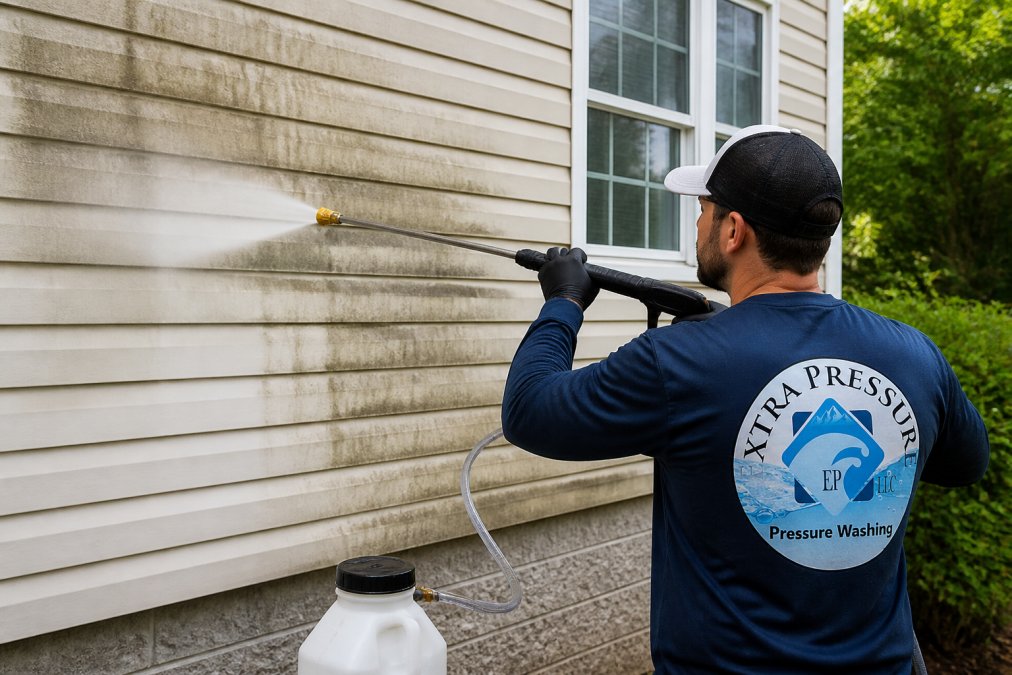
Table of Contents
- Why Bleach Works on Siding and Roofs
- Sodium Hypochlorite House Wash Ratio: Getting the Mix Right
- How to Remove Mildew From Siding Without Damaging It
- Soft Wash vs Pressure Wash: Which Method Fits Your Surface?
- Best Surfactants for Soft Washing (And Why They Matter)
- Safety Gear and Plant Protection Before You Spray
- Frequently Asked Questions
Last Updated: September 26, 2026
Why Bleach Works on Siding and Roofs
Yes, you can soft wash a house with bleach, and it is the standard method professionals use on siding and roofs. The bleach does not scrub stains away. It kills the living organisms causing them.
Those black streaks on your roof and green film on your siding are not dirt. They are algae, mildew, and mold feeding on moisture and organic material. According to the U.S. Environmental Protection Agency’s mold guidance, mold and mildew need only moisture and a food source to grow, which is why shaded north walls and roof valleys stay stained year after year.
Sodium hypochlorite is the active ingredient that destroys that growth at the root. Once the organism dies, rain rinses the dead residue away. No scrubbing required.
This matters because pressure alone cannot fix the problem. Blasting organic growth with high pressure strips the surface and leaves the roots behind, so the stains return within months.
Sodium Hypochlorite House Wash Ratio: Getting the Mix Right
The most common soft wash mix is a 1:10 ratio of 12.5% sodium hypochlorite to water for general siding, adjusted stronger for heavy growth and weaker for delicate surfaces. Getting this mix right is the difference between a clean house and a damaged one.
Here is how the dilution typically scales:
- Light growth on siding: about 1 part bleach to 10 parts water
- Heavy algae or black streaks: closer to 1 part bleach to 4 parts water
- Roof shingles: weaker, often 1 part bleach to 8-12 parts water
- Delicate surfaces: weakest mix, tested in a hidden spot first
A common mistake is eyeballing the pour. Small changes in concentration swing the result hard. Too weak and the growth survives.
Why 12.5% Bleach Beats Store-Bought Clorox
Store bleach usually sits around 6% sodium hypochlorite. Soft wash pros buy 12.5% because it carries roughly double the cleaning power per gallon, so you use less product and haul fewer jugs.
Never mix bleach with ammonia or acid-based cleaners. The combination releases toxic chlorine gas. If you are unsure what is already on a surface, rinse it thoroughly before applying any bleach mix.
How to Remove Mildew From Siding Without Damaging It
To remove mildew from siding without damage, apply a diluted bleach mix at low pressure, let it dwell, then rinse. The chemical does the work, not force.
Here is the step-by-step process:
- Wet down plants and surrounding ground before you start.
- Mix your sodium hypochlorite solution at the right ratio for the surface.
- Apply from the bottom up with a soft wash pump or downstream injector.
- Let it dwell for several minutes so the bleach kills the growth.
- Rinse from the top down at low pressure.
- Re-wet plants to wash off any overspray.
Soft Wash vs Pressure Wash: Which Method Fits Your Surface?
Soft wash vs pressure wash comes down to the surface. Soft washing uses low pressure and chemicals for delicate materials. Pressure washing uses high pressure and water for hard, durable surfaces.
| Surface | Best Method | Why |
|---|---|---|
| Vinyl siding | Soft wash | High pressure can crack panels and force water behind them |
| Roof shingles | Soft wash | Pressure strips granules and voids warranties |
| Painted wood | Soft wash | Pressure chips paint and etches soft grain |
| Concrete driveways | Pressure wash | Hard enough to handle high PSI |
| Brick and stone | Pressure wash | Durable, but test a small area first |
| Gutters and fascia | Soft wash | Removes mildew without bending metal |
Best Surfactants for Soft Washing (And Why They Matter)
The best surfactants for soft washing are biodegradable blends that help the bleach mix stick to the surface and break down organic growth faster. Plain bleach runs off a wall in seconds. A surfactant keeps it in contact long enough to work.
Surfactants do three jobs:
- They help the solution cling to vertical surfaces
- They break the surface tension so the mix soaks into growth
- They lift dead residue so rain rinses it clean
Add surfactant to your mix, not to your rinse water. A little goes a long way, and too much leaves a slippery film on driveways and walkways.
Flushing Your Equipment After Every Job
Bleach is corrosive to the tools that apply it. Pumps, seals, wands, and injectors all degrade faster when sodium hypochlorite sits inside them between jobs.
- Dump the leftover mix into a labeled container, never down a drain or onto the lawn at full strength.
- Run fresh water through the pump, hose, and wand for at least two to three minutes until the discharge runs clear and no longer smells of chlorine.
- Flush the downstream injector separately, it is the smallest orifice in the system and the first place bleach residue clogs.
- Dry the wand and gun with a rag, and store them out of direct sun.
- Check seals and O-rings monthly. A weeping seal is a warning sign that bleach has already started eating the rubber.
What to Do If Something Goes Wrong
Streaking or uneven results on siding. This usually means the mix was too weak, the dwell time was too short, or the surface dried before you rinsed. Re-wet the area, apply a slightly stronger mix, and keep it wet until you rinse. Do not scrub, agitation drives bleach into seams and behind panels.
The difference between a professional soft wash and a homeowner disaster is rarely the bleach itself, it is the prep, the dwell time, and knowing how to neutralize a mistake before it becomes permanent damage.
That is also where equipment maintenance comes in. Bleach corrodes pumps and seals fast. Rinse your gear with fresh water after every job.
Safety Gear and Plant Protection Before You Spray
Before you spray anything, suit up and cover your landscaping. Bleach mist drifts, and it kills plants on contact.
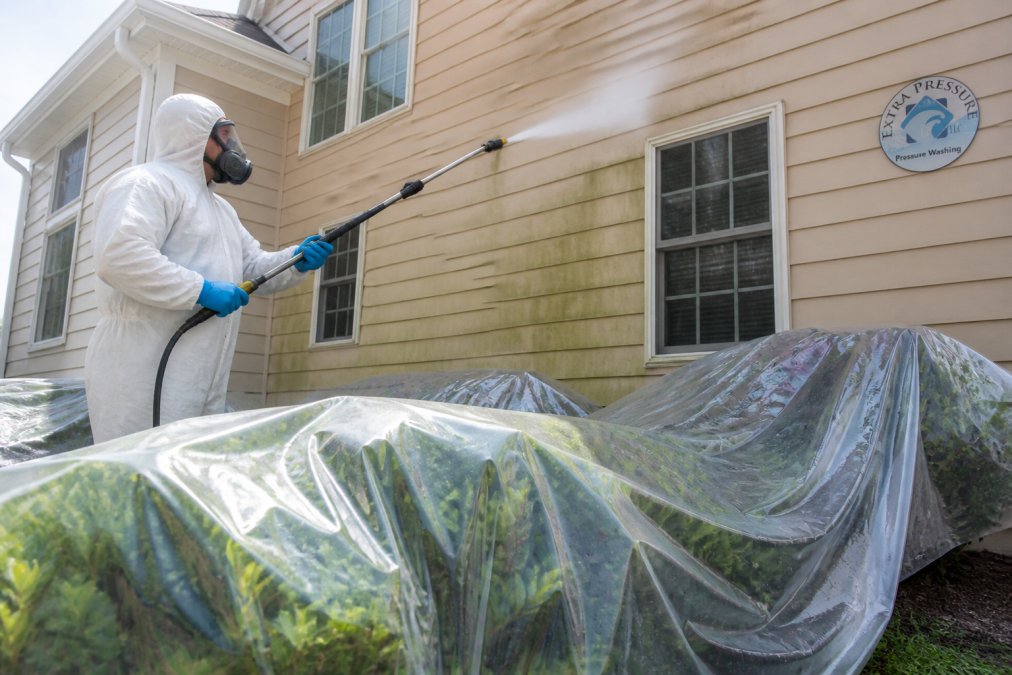
Wear the right gear every time:
- Respirator rated for chemical mist (a simple dust mask will not stop chlorine vapor)
- Chemical-resistant gloves, nitrile or PVC, not latex
- Eye protection, sealed goggles, not open safety glasses
- Long sleeves and pants, no bare skin
- Rubber boots to keep your feet dry
Which Plants Are Most at Risk
Not every plant reacts the same way. Sodium hypochlorite burns foliage on contact and can be absorbed through roots if runoff pools at the base of a plant. The most vulnerable categories are:
- Thin-leafed annuals and bedding plants (impatiens, petunias, coleus), foliage can brown within hours
- Vegetable gardens, anything you plan to eat should be treated as off-limits during application
- New transplants and seedlings, shallow roots and tender leaves have no tolerance
- Broadleaf evergreens (boxwood, camellia, rhododendron), leaves scorch and hold the damage visibly for months
Pre-Treat, Cover, and Rinse
- Saturate the soil and foliage around the house with plain water before you start. Wet plants absorb less bleach because the leaf surface is already coated.
- Cover sensitive beds with plastic sheeting, weighted at the edges so wind does not flip it.
- Shield metal fixtures, light fixtures, mailboxes, aluminum gutters, and AC condensers. Bleach oxidizes bare aluminum and dulls painted metal fast.
- Spray on a calm day. Anything above a light breeze carries mist onto cars, windows, and neighboring property.
- Rinse everything again with fresh water immediately after you finish the last pass, not an hour later.
Neutralizing Bleach on Plants and Surfaces
If overspray does hit something it should not, act within minutes. Sodium thiosulfate is the standard neutralizer used in the water-treatment and pool industries, and it works on bleach the same way, it converts the active hypochlorite into harmless chloride. A diluted solution sprayed onto affected foliage or siding stops the burn from spreading.
Never let bleach runoff pool at the base of a plant or flow into a storm drain. Most municipal storm systems discharge directly to creeks, streams, and lakes without treatment, so anything that enters a drain enters the local watershed. The EPA’s guidance on pesticide and chemical runoff explains why keeping chemicals out of storm drains protects local waterways.
Managing Runoff
Direct runoff onto grass or gravel where it can dilute and break down, never straight into a drain. A few practical habits make a real difference:
- Work in sections so you are not flooding one area with rinse water
- Use a squeegee or push broom to spread puddles instead of letting them run to the curb
- If your property slopes toward a storm drain, block the path with sandbags or a temporary berm
- On properties near creeks, ponds, or wetlands, plan the job around a dry forecast so runoff has time to dissipate before the next rain
Frequently Asked Questions
Is sodium hypochlorite the same as household bleach?
They are chemically related but not the same strength. Household bleach is typically 5% to 6% sodium hypochlorite, while the bleach used for soft washing a house is usually 10% to 12.5%. That higher concentration cleans exterior surfaces faster and more thoroughly, but it also means you must dilute it properly and wear full protective gear. Never pour pool shock or industrial bleach directly onto siding without mixing it first.
How do you protect plants when soft washing with bleach?
Pre-wet all plants and grass with plain water before you start, then cover delicate shrubs with plastic sheeting. After spraying, rinse every plant again with fresh water to wash away any overspray. Work in sections and avoid spraying on windy days. If you hire a professional soft washing service, ask specifically about their plant protection protocol before they begin.
Can you power wash your house with bleach instead of soft washing?
You can add bleach to a pressure washer, but the risk of damage goes up sharply. High pressure forces water behind siding panels, strips paint, and etches wood. Soft washing uses low pressure, under 500 PSI, to apply the same cleaning solution safely. For vinyl, stucco, painted wood, and roof shingles, soft washing is the safer choice.
How long should the bleach solution sit on the siding before rinsing?
Dwell time matters. Most exterior surfaces need 10 to 15 minutes of contact time for the bleach to kill mold, mildew, and algae. In hot weather, work in smaller sections so the solution does not dry out before you rinse. If it dries, the bleach stops working and can leave streaks. Always rinse from the bottom up to avoid streaking.