
Table of Contents
- What Does Professional Gutter Cleaning Cost?
- Professional Gutter Cleaning vs. DIY: Which Makes Financial Sense?
- How Often to Clean Gutters: Impact on Total Cost
- The Real Cost of Neglected Gutters: Water Damage and Foundation Repair
- Gutter Guard Cost and Benefits: Long-Term Investment Analysis
- Breaking Even: When Professional Gutter Cleaning Pays for Itself
- Frequently Asked Questions
Last Updated: October 12, 2026
What Does Professional Gutter Cleaning Cost?
Professional gutter cleaning costs vary based on home size, gutter length, and accessibility. Most homeowners spend between a few hundred to over a thousand dollars annually for professional service, depending on how often they need cleaning and their property’s complexity.
The primary cost driver is linear footage. A typical single-story home with 150-200 linear feet of gutters costs less than a two-story home with 250+ linear feet. Additional factors include the number of stories, roof pitch, and whether downspouts need clearing.
A professional service visit typically includes debris removal from gutters and downspouts, flushing the system to check water flow, and minor repairs like reseating loose sections. Many providers offer same-day estimates so you can understand exact costs before committing.
When requesting estimates, ask whether the quote includes downspout cleaning and flushing. Some providers charge extra for these, while others include them as standard. Clarifying scope upfront prevents surprise charges.
Professional Gutter Cleaning vs. DIY: Which Makes Financial Sense?
The choice between DIY gutter cleaning and professional service depends on your time, safety tolerance, and long-term costs. This isn’t just about the immediate price, it’s about what you’re actually paying for and whether the value justifies the expense.
DIY cleaning requires equipment: a sturdy ladder, work gloves, a scoop or small shovel, and often a pressure washer or garden hose. While these tools may seem cheap individually, they add up. More importantly, DIY work demands your time.
A typical cleaning takes 3-6 hours depending on home size and gutter condition. That’s a full weekend day or multiple evenings. For many homeowners, the time cost alone makes professional service more valuable than the upfront savings.
DIY cleaning also risks incomplete work. Homeowners often miss downspout blockages or fail to flush the system properly, leaving debris that causes problems later. Missed issues can lead to water damage that costs thousands to repair.
Professional Service: What You’re Paying For
When you hire a professional, you’re paying for expertise, safety, and accountability. Licensed and insured services carry liability insurance that protects your property. They use proper safety equipment, understand how to identify potential problems, and guarantee their work.
Professional teams complete the job in 1-2 hours versus your weekend. They have commercial-grade equipment that clears debris more thoroughly than consumer tools. Many professionals also offer complementary services like soft washing to clean debris and buildup from your home’s exterior, which can prevent future gutter and drainage issues.
The real value isn’t just the cleaning itself. It’s the peace of mind that the job is done right, safely, and with accountability if something goes wrong.
How Often to Clean Gutters: Impact on Total Cost
How often you need gutter cleaning directly affects your annual cost. Most homes benefit from cleaning twice yearly: once in late spring after pollen season and once in fall after leaves drop. Homes surrounded by trees may need three to four cleanings per year.
If you clean only once annually, you risk water overflow during heavy rains between cleanings. Clogged gutters can’t handle the volume, and water spills over the edge, pooling near your foundation.
Regular cleaning prevents this cascade of problems. Twice-yearly service keeps gutters functioning properly year-round and reduces the likelihood of emergency repairs. Think of it like oil changes in your car: small regular maintenance costs far less than engine damage from neglect.
Skipping a seasonal cleaning to save money often backfires. Gutters that overflow during heavy rain can cause foundation settling, basement leaks, and landscape erosion. These repairs typically cost 10-50 times more than a single professional cleaning.
The Real Cost of Neglected Gutters: Water Damage and Foundation Repair
Neglected gutters create a cascade of expensive problems. Water that overflows from clogged gutters pools around your foundation. Over months and years, this water seeps into soil, causing the foundation to settle unevenly.
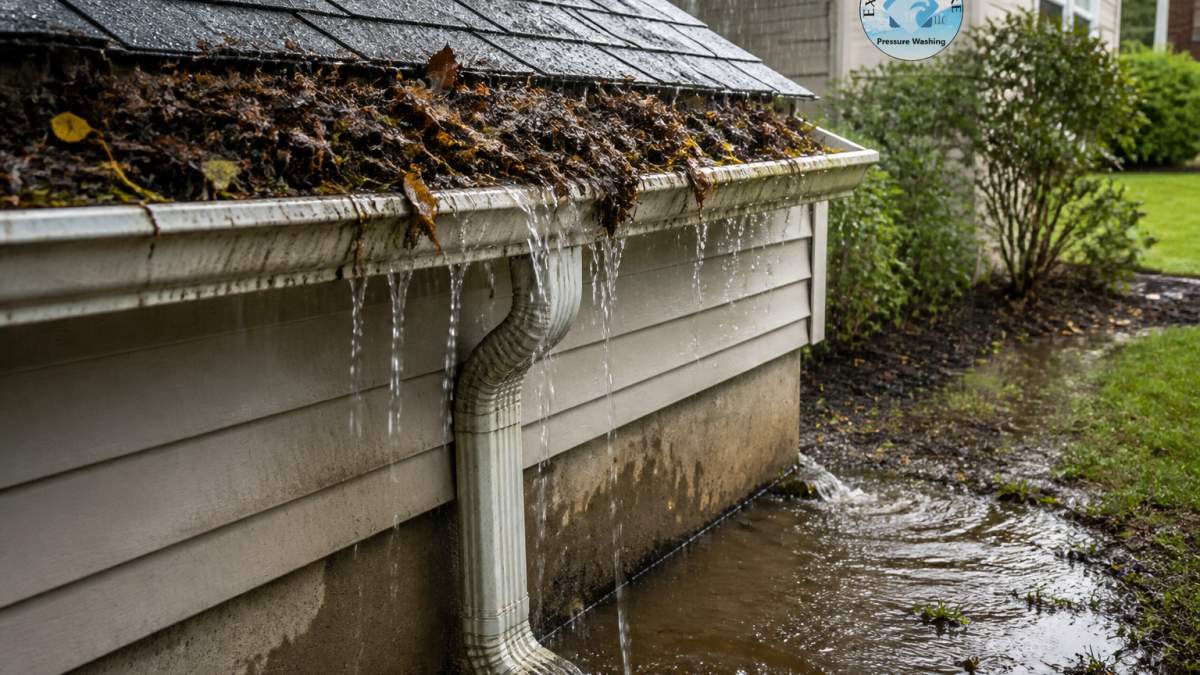
Foundation repairs range from several thousand dollars for minor cracks to over $100,000 for serious settling. Basement waterproofing adds another $5,000-$15,000.
Water damage also affects your roof. Beyond structural damage, water stains and algae growth on your home’s exterior can also accumulate over time; professional window washing services can help restore your home’s appearance after water damage has been addressed.
The math is clear: professional gutter cleaning prevents damage that costs exponentially more to repair. A few hundred dollars in annual cleaning protects tens of thousands in potential repairs.
Gutter Guard Cost and Benefits: Long-Term Investment Analysis
Gutter guards are covers that span the top of the gutter trough and let water in while keeping leaves, pine needles, and most large debris out. They range from simple perforated screens and mesh inserts to reverse-curve and micro-mesh systems, and installed cost commonly runs from roughly $3 to $10 per linear foot for basic screens up to $15 to $30+ per linear foot for premium micro-mesh systems.
The appeal is obvious: if debris cannot enter the trough, you do not need to scoop it out. The reality is more nuanced. Every guard style still accumulates debris on top of the surface or at the water-entry points, and that material has to be brushed or blown off.
A Three-Way Lifetime Cost Comparison
A single visit price tells you almost nothing about which option is cheapest over time. The honest comparison is a multi-year total that includes equipment, labor hours, service frequency, installation, ongoing maintenance, and repair exposure. The table below uses illustrative mid-range figures so you can substitute your own quotes.
| Cost Category | DIY Cleaning | Recurring Professional Cleaning | Guards + Occasional Cleaning |
|---|---|---|---|
| Upfront equipment or installation | $150-$400 (ladder, gloves, scoop, hose, bucket) | $0 | $1,500-$4,000 installed |
| Per-visit or per-year service cost | $0 cash, 3-6 hours of your time per cleaning | $150-$400 per visit | $100-$250 per year for surface clearing |
| Cleanings per year (moderate tree cover) | 2 | 2 | 1 |
| 5-year cash cost | $150-$400 | $1,500-$4,000 | $2,000-$5,250 |
| 10-year cash cost | $150-$400 plus replacement tools | $3,000-$8,000 | $2,500-$6,500 |
| Labor hours over 10 years | 60-120 hours of your own time | 0 | 10-20 hours of your own time |
| Repair exposure | Higher, missed clogs and ladder risk | Low, pros spot problems early | Medium, guards can hide trough problems |
The crossover point is what matters. If your installed guard cost is $2,500 and it cuts your professional cleaning bill from $500 a year to $150 a year, you save $350 annually and break even in a little over seven years.
What Guards Do Not Fix
Guards do not correct a gutter that is pitched the wrong way, sagging at a hanger, or undersized for the roof area draining to it. They also do not stop water from sheeting over the edge during a cloudburst if the downspouts are undersized. In fact, a poorly fitted guard can trap moisture against the fascia and accelerate rot, and a micro-mesh that clogs with shingle grit can be harder to clean than an open trough. Budget for at least one inspection a year even with guards, and expect to replace cheap plastic screens every few seasons.
Gutter guards make financial sense when your current cleaning frequency is high (three or more visits a year), your local labor rate is above average, and you plan to stay in the home long enough to clear a five-to-ten-year payback. For lightly wooded lots with two cleanings a year, the math usually favors paying for service instead of buying hardware.
Breaking Even: When Professional Gutter Cleaning Pays for Itself
“Break-even” gets thrown around loosely in gutter content, so it is worth defining. There are two separate break-evens a homeowner should calculate: the cash break-even (when avoided repair costs exceed what you paid for service) and the personal break-even (when the value of your time and the safety risk you are avoiding exceeds the cash you would have saved by doing it yourself). They rarely land in the same place.
The Cash Break-Even
Start with your annual professional cleaning cost. A typical two-visit schedule on a 200-linear-foot home runs roughly $300 to $800 a year depending on your market and access. Now estimate the probability-weighted cost of the damage that neglect would cause. You do not need a precise number, you need a defensible range.
A common pattern practitioners describe is that a single preventable water-intrusion event, whether it is a cracked foundation wall, a rotted fascia run, or a flooded basement corner, lands somewhere between a few thousand dollars and tens of thousands of dollars once you include diagnosis, repair, and any interior remediation.
The Personal Break-Even
This is where most homeowners actually decide. Put a dollar value on your own time. If you bill out at $40 an hour and a DIY cleaning takes four hours including setup, cleanup, and a trip to the hardware store, that is $160 of your time per cleaning, or $320 a year for two cleanings.
Now layer in risk. Ladder falls are one of the most common serious home-injury mechanisms, and the medical and lost-work costs of a single fall dwarf any realistic cleaning savings. If you have a two-story home, a steep roof pitch, gutters that require reaching over a roof edge, nearby power lines, or any mobility or balance limitation, the personal break-even tips toward hiring almost immediately.
A Quick Calculator You Can Run
Use these five inputs and multiply them out:
- Linear feet of gutter. Under 150 feet is small, 150-250 is average, over 250 is large.
- Stories and access. One story with flat ground is easy; two or more stories, steep pitch, or obstructions raise both the pro quote and your DIY risk.
- Debris load. No overhanging trees means one to two cleanings a year; heavy pine or oak cover means three to four.
- Local labor rate. Urban and high-cost markets quote meaningfully higher than rural ones for the same job.
- Your hourly value and risk tolerance. This is the input most homeowners skip and the one that usually decides the question.
Multiply linear feet by your local per-foot rate to sanity-check a quote, multiply cleanings per year by the per-visit price to get your annual service cost, and compare that to the value of your time plus a conservative allowance for injury and damage risk. If the service cost is within a few hundred dollars of your DIY cost, the professional option is almost always the better deal once you price in accountability and insurance.
Do not treat insurance as a backstop for gutter neglect. Many policies exclude damage a reasonable homeowner could have prevented through routine maintenance, and a denied water-damage claim leaves you paying the full repair out of pocket.
Frequently Asked Questions
Is professional gutter cleaning worth the cost?
Professional gutter cleaning becomes worth the cost when you factor in safety risks, time investment, and damage prevention. A single water damage claim from foundation issues or roof rot can cost thousands, far exceeding years of professional cleaning service. For homeowners with two-story homes, accessibility challenges, or limited mobility, professional service eliminates ladder safety risks entirely. The value depends on your home’s gutter length, how many stories it has, and your area’s debris load, but most homeowners break even within 2-3 years.
How much does professional gutter cleaning typically cost?
Professional gutter cleaning cost varies based on home size, gutter length, number of stories, and accessibility. Pricing typically accounts for labor time, debris removal, downspout cleaning, and service visit overhead. For accurate pricing specific to your property, request a written estimate from a licensed service provider who can assess your exact gutter length and home configuration. Many providers offer same-day estimates at no charge.
How often should gutters be cleaned to avoid water damage?
Most homeowners should clean gutters twice annually, spring and fall, to prevent clogged gutters and overflow issues. Homes surrounded by trees may need three to four cleanings per year. Regular seasonal cleaning maintains proper water flow away from your roof and foundation, preventing overflow that leads to water damage and foundation issues. The frequency directly impacts your total annual cost and long-term home protection.
Are gutter guards worth installing despite the upfront cost?
Gutter guards reduce cleaning frequency and debris removal needs, lowering your annual maintenance cost over time. While gutter guard cost and benefits depend on your home’s exposure to leaves and debris, they typically pay for themselves within 3-5 years through reduced service visits. Guards work best in areas with moderate tree coverage; heavily wooded properties may still need occasional professional cleaning. Calculate your current annual cleaning cost and compare it against guard installation pricing to determine your break-even point.