Table of Contents
- Why Eco-Friendly Pressure Washing Matters for Your Driveway
- Solution 1: Biodegradable Pressure Washer Detergent
- Solution 2: Pressure Washing Your Driveway Without Chemicals
- Solution 3: Soft Washing for Delicate Driveway Surfaces
- Solution 4: Natural Recipes to Remove Oil Stains From Your Driveway
- Solution 5: Pressure Washer Runoff Management That Protects Waterways
- Matching Eco-Friendly Cleaners to Concrete, Pavers, and Asphalt
- Conclusion: Choosing the Right Eco-Friendly Pressure Washing Solution
- Frequently Asked Questions
Last Updated: October 19, 2026
Why Eco-Friendly Pressure Washing Matters for Your Driveway
Driveway cleaning affects more than curb appeal, it affects what runs into your soil, storm drains, and nearby waterways. Eco-friendly pressure washing is a practical decision, not a marketing label: the right low-impact method cleans just as well without harmful residues.
High pressure blasts away grime fast, but it also drives dirty water, detergent, and dislodged material toward storm drains, which typically empty into streams and rivers untreated.
Eco-friendly pressure washing cleans exterior hard surfaces with methods and products that limit water waste, avoid toxic chemicals, and keep contaminated runoff out of storm drains and waterways, pairing controlled pressure with biodegradable cleaners and, ideally, water reclamation.
Below, we break down five driveway solutions and how to match each to concrete, pavers, and asphalt, surface compatibility and runoff control matter as much as pressure.
Solution 1: Biodegradable Pressure Washer Detergent
Start here for ordinary dirt, grime, and organic growth. A biodegradable pressure washer detergent breaks down naturally in soil and water, doing less harm than solvent-based cleaners.
The method matters as much as the product:
- Clear the surface of debris, toys, and vehicles.
- Pre-wet the driveway with low-pressure water so detergent does not dry on the surface.
- Apply the detergent at the label’s dilution ratio using a downstream injector or pump sprayer.
- Let it dwell for the time the label states, usually a few minutes, without letting it dry.
- Scrub stubborn areas with a stiff brush.
- Rinse with low-pressure water, working from the top of the slope down.
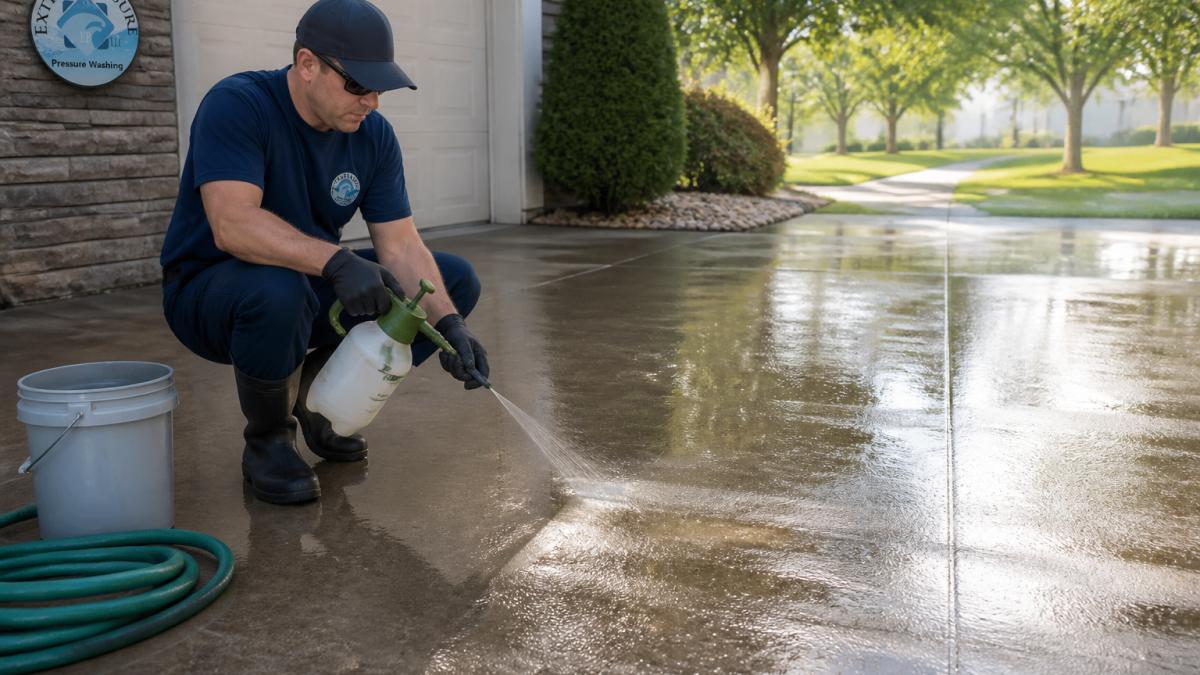
Apply detergent in the shade or early morning. Sun-dried detergent leaves streaks on concrete that are harder to remove than the original grime.
A common mistake is mixing or over-concentrating detergents, more is not better, and it pushes more residue into your runoff.
Solution 2: Pressure Washing Your Driveway Without Chemicals
Pressure washing a driveway without chemicals works best on light soil and loose grime, where water pressure alone lifts dirt. It is the lowest-impact option, nothing but water reaches your soil and drains. But “chemical-free” is not “damage-free”; the difference comes down to pressure, flow, and technique.
What water-only cleaning can and cannot remove
Water alone is effective on:
- Dust, pollen, and atmospheric fallout
- Light organic film and fresh bird droppings
- Loose sand, grit, and winter road residue
Water alone struggles with:
- Oil and grease (oil is hydrophobic, water beads off it)
- Rust stains (iron oxide bonds to concrete and needs a chemical reaction to lift)
- Set-in algae and mold (the organism anchors to the surface and regrows if not killed)
Cranking up pressure to compensate is how homeowners strip sealant, pit concrete, and dislodge paver joint sand. The fix is a targeted treatment (Solutions 1, 3, and 4), not more force.
Pressure and technique by surface
Use this as a starting framework, then test a small hidden area first:
| Surface | Typical pressure range | Nozzle | Technique notes |
|---|---|---|---|
| Poured concrete (unsealed) | Moderate, roughly 2,000-2,500 PSI | 25° or 40° fan tip | Keep the wand moving; never dwell in one spot |
| Sealed concrete | Low, roughly 1,200-1,500 PSI | 40° fan tip | Sealant can lift at higher pressure |
| Asphalt | Low, roughly 1,200-1,500 PSI | 40° fan tip | Heat softens asphalt; clean in cool hours |
| Pavers | Low, roughly 1,000-1,500 PSI | 40° fan tip | High pressure displaces joint sand |
| Brick and mortar | Soft wash only | , | See Solution 3 |
These are working ranges, not manufacturer specifications, confirm against your machine’s manual. Pitted, spalled, or failing-sealant surfaces need lower pressure, not more.
Step-by-step water-only method
- Clear the surface of debris, toys, vehicles, and planters.
- Pre-wet the driveway with low-pressure water so loosened dirt does not re-settle into dry pores.
- Start at the top of the slope and work downhill so dirty water flows away from cleaned areas.
- Use overlapping passes, roughly half the fan width per pass, and keep the wand at a consistent distance (typically 12-18 inches) and angle.
- Rinse as you go so loosened dirt does not dry back onto the surface.
- Inspect for remaining stains and switch to a targeted treatment rather than increasing pressure.
Clean in the shade or early morning. Direct sun dries the surface faster than you can work, and partially cleaned concrete can show lap marks where dirty water dried before rinsing.
Never use a 0° pinpoint tip on a driveway. It concentrates the entire stream into a coin-sized area and can etch concrete or gouge asphalt in seconds, damage that shows up as a permanent rough patch.
When to stop and switch methods
If a stain does not lift after two passes at the correct pressure, stop. More pressure will not remove oil, rust, or established algae, it only damages the surface. Move to a biodegradable detergent (Solution 1), soft washing (Solution 3), or a stain-specific treatment (Solution 4).
Solution 3: Soft Washing for Delicate Driveway Surfaces
Soft washing suits pavers, stamped concrete, and older masonry with fragile mortar joints.
High pressure on pavers dislodges joint sand and loosens stones; on older brick and mortar, it erodes joints over time. Soft washing relies on the cleaning agent and dwell time, not force.
The trade-off is patience: soft washing takes longer per square foot, and you must let the solution work before rinsing, but that protects the surface.
Never point a high-pressure stream at mortar joints, wood, or painted surfaces. The damage often shows up weeks later as crumbling joints or peeling paint, and it is expensive to repair.
Solution 4: Natural Recipes to Remove Oil Stains From Your Driveway
To remove oil stains naturally, absorb the fresh oil first, then lift the residue with a simple household mix. Oil, rust, tire marks, and organic growth each need their own approach.
Stain-to-solution quick reference
| Stain | First move | Natural treatment | Dwell time |
|---|---|---|---|
| Fresh oil | Absorb with cat litter or sand | Baking soda + dish soap paste | 15-30 minutes |
| Set-in oil | Scrub with stiff brush | Baking soda + dish soap paste, repeat | 30-60 minutes |
| Rust | Test hidden spot | White vinegar (full strength) | 10-15 minutes |
| Tire marks | Scrub with stiff brush | Dish soap + hot water | 5-10 minutes |
| Algae and mold | Scrub with stiff brush | Soft-wash solution (see Solution 3) | Per label |
| Mildew film | Scrub with stiff brush | Oxygen bleach (sodium percarbonate) | 15-30 minutes |
Ratios and dwell times below are starting points, always test a small hidden area first and follow product label directions, which override general guidance.
Oil stains: the absorption-first method
Oil is hydrophobic, so water-based cleaners bead off it. The sequence is absorb, lift, then rinse.
- Absorb fresh oil. Cover the spot with cat litter, sand, or cornstarch and let it sit 15-30 minutes, then sweep it up. For a fresh spill, this step removes more oil than any cleaner will.
- Grind in a dry absorbent. Sprinkle baking soda or cornstarch over the stain and work it in with a stiff brush. This pulls oil out of the pore structure.
- Make a paste. Mix roughly 3 parts baking soda to 1 part dish soap, adding water a teaspoon at a time until it forms a thick paste. A tablespoon of paste covers roughly a 6-inch spot.
- Apply and dwell. Spread the paste over the stain and let it sit 15-30 minutes for a fresh spot, 30-60 minutes for a set-in one. Do not let it dry completely, mist with water if it starts to crack.
- Scrub and rinse. Scrub with a stiff brush, then rinse with low-pressure water. Repeat once if the stain is still visible.
For large or old oil stains, a poultice, baking soda or diatomaceous earth mixed with water into a thick paste, covered with plastic, draws oil out over several hours, deeper than surface scrubbing.
Rust stains: mild acid, short dwell
Rust is iron oxide bonded to concrete. White vinegar (acetic acid) can break that bond, but it can etch or discolor some surfaces if left too long.
- Test on a hidden spot first, vinegar can dull sealed concrete and some pavers.
- Apply full-strength white vinegar to the stain with a spray bottle or sponge.
- Let it dwell 10-15 minutes, no longer on a first attempt.
- Scrub with a stiff brush and rinse thoroughly with low-pressure water.
- Repeat if needed, but rinse between applications so acid does not concentrate in the pores.
Do not use vinegar on limestone, marble, or unsealed natural stone, the acid reacts with calcium carbonate and can pit the surface.
Tire marks and rubber scuffs
Tire marks are rubber pressed into the surface, not a chemical stain. A stiff brush and hot dish soap solution (roughly 1 tablespoon per gallon of water) lifts fresh marks; let set-in marks dwell 5-10 minutes before scrubbing. Avoid solvent-based tire cleaners on sealed driveways, they strip the seal coat.
Organic growth: kill it, don’t just scrub it
Algae, mold, and mildew regrow if you only scrub the visible film. A soft-wash solution (see Solution 3) kills the organism at the root; scrubbing alone leaves the root structure in the pores.
Match the treatment to the stain. Oil needs absorption, rust needs a short mild-acid dwell, tire marks need soap and friction, and organic growth needs a solution that kills it at the root. One cleaner will not solve all four, and using the wrong one can etch or discolor the surface.
Never mix vinegar or any acid with bleach or an oxygen-bleach product. Acid plus bleach releases chlorine gas. Rinse the surface thoroughly between different treatments and never combine them in the same container.
What to skip
Some “natural” remedies are poor choices for driveways. Cola and sugary drinks leave sticky residue that attracts dirt; lemon juice is acidic like vinegar but more variable in strength. Never combine cleaners in one bucket, apply one treatment at a time, rinse, and reassess.
Solution 5: Pressure Washer Runoff Management That Protects Waterways
Pressure washer runoff management is the step almost everyone skips, and it decides whether your job is truly low-impact. Wash water carries oil, dirt, detergent, and metals; in many areas, letting it flow into a storm drain violates local wastewater rules, since storm drains usually lead to waterways without treatment.
A practical approach:
- Block the path to storm drains with sandbags or a berm.
- Collect dirty water with a wet vacuum or a containment mat where possible.
- Dispose of collected water through a sanitary sewer cleanout or as your local rules direct.
Check your local wastewater authority’s guidance before you start, since rules vary by municipality. For larger jobs or uncertain containment, a licensed professional has the equipment and knows local requirements.
Matching Eco-Friendly Cleaners to Concrete, Pavers, and Asphalt
Surface compatibility is where most cleaning mistakes happen. The right cleaner on the wrong surface can etch, stain, or strip it.
| Surface | Best Method | Watch Out For |
|---|---|---|
| Concrete | Detergent plus moderate pressure | Etching from too much pressure |
| Pavers | Soft washing, low pressure | Dislodged joint sand |
| Asphalt | Low pressure, mild detergent | Stripping sealant |
| Sealed surfaces | Mild detergent, low pressure | Damaging the seal coat |
| Brick and mortar | Soft washing only | Eroded joints |
Concrete is forgiving and handles moderate pressure. Pavers and asphalt are not: asphalt softens in heat and loses sealant under high pressure, so keep pressure low with mild detergent. Sealed driveways need gentle cleaning, and brick and older masonry should get soft washing only.
Conclusion: Choosing the Right Eco-Friendly Pressure Washing Solution
The right choice comes down to your surface and stains, not raw pressure. Biodegradable detergent handles everyday grime, chemical-free washing suits light soil, soft washing protects delicate surfaces, natural recipes tackle oil, and runoff management keeps the job responsible.
If you want the job done right the first time, with the right method for your surface and runoff handled properly, Extra Pressure offers licensed and insured pressure washing and specialized soft washing. We provide same-day estimates and use state-of-the-art equipment that safely restores your property’s curb appeal and prevents damage.
Frequently Asked Questions
What is the most eco-friendly way to clean a driveway?
The lowest-impact approach combines low-pressure washing with a biodegradable detergent and careful runoff control. Start with a plain water rinse to lift loose dirt, apply a diluted biodegradable cleaner, let it dwell for 5 to 10 minutes, then rinse at low pressure. For organic growth like algae or mold, a soft wash mix of water and a small amount of sodium hypochlorite, followed by thorough rinsing, often works better than harsh solvents. Eco-friendly pressure washing also means keeping runoff out of storm drains and using only as much water as the job requires.
Are biodegradable detergents safe for plants and pets?
Biodegradable pressure washer detergent breaks down over time, but ‘biodegradable’ does not mean harmless on contact. Most formulas can still irritate paws or damage landscaping if sprayed directly. Pre-wet plants around the driveway, cover them with plastic sheeting during the wash, and rinse afterward. Keep pets and children off the surface until it is fully dry. Choose detergents labeled for outdoor use and follow the dilution ratio on the bottle rather than pouring concentrate straight onto concrete.
Can vinegar or baking soda remove driveway stains?
Yes, for some stains. A baking soda paste works well on fresh oil spots: cover the stain, let it sit for 30 minutes, then scrub and rinse. White vinegar diluted with water can lift light rust film and mineral deposits, but it is acidic and can etch unsealed concrete if left too long, so rinse thoroughly. Neither replaces a detergent for heavy algae or tire marks. For set-in oil, apply a degreaser or a poultice and give it dwell time before rinsing at low pressure.
How do I keep pressure washing runoff out of storm drains?
Block the path to the drain before you start. Use sandbags, berms, or a rubber drain cover to divert water, then collect it with a wet vacuum or pump it to a grassy area where it can filter into soil. Sweep up loose debris and absorbent material first so it never enters the flow. Many municipalities treat driveway runoff as wastewater and restrict what can reach storm drains, so check local rules before washing. For large jobs or heavy stains, a professional with containment equipment is the safer choice.