Table of Contents
- Start With a Vetting Checklist Before You Call Anyone
- Step 1: Search for Local Pressure Washing Providers the Right Way
- Step 2: Confirm Pressure Washing Company Insurance and Licensing
- Step 3: Read Reviews and Ratings Like a Skeptic
- Step 4: Match the Cleaning Method to Your Surface
- Step 5: Compare Pressure Washing Estimates Line by Line
- Questions to Ask a Pressure Washing Company Before You Book
- Red Flags and Service Guarantees to Watch For
- Frequently Asked Questions
Last Updated: October 18, 2026
Start With a Vetting Checklist Before You Call Anyone
Finding a reliable local pressure washing company starts with a short checklist, not a phone call. Extra Pressure LLC uses this same checklist when we talk to homeowners: license, insurance, method, estimate, guarantee. Get those five answers in writing and you avoid most bad hires.
Here is the checklist we recommend printing before you call anyone:
- License number and business name match
- Proof of liability insurance and workers’ comp
- Written estimate with line items
- Cleaning method matched to your surface
- Guarantee and callback policy in writing
That is the whole game. Everything below explains how to work through each item.
A pressure washing company is a business that cleans exterior surfaces using pressurized water, detergents, and surface-specific equipment. The good ones know when to turn the pressure down. The bad ones don’t.
Step 1: Search for Local Pressure Washing Providers the Right Way
Searching well means looking past the ads. Many homeowners find their contractor through a mix of map results, neighbor referrals, and local Facebook groups.
Try these sources in order:
- Ask two neighbors whose driveways or siding look clean.
- Search “pressure washing near me” and read the map results.
- Check the service area listed on each provider’s site.
- Look for photos of recent jobs in your area.
What most guides miss: a company that lists a wide service area may still be based far away. Ask how long the drive is to your address. Local crews show up faster and answer callbacks sooner.
Also confirm the company handles your property type. Residential services and commercial services are often priced and staffed differently.
Step 2: Confirm Pressure Washing Company Insurance and Licensing
Pressure washing company insurance and licensing are the two items you must verify before work begins. Ask for a certificate of insurance sent directly from the insurer, not a photo of a document.
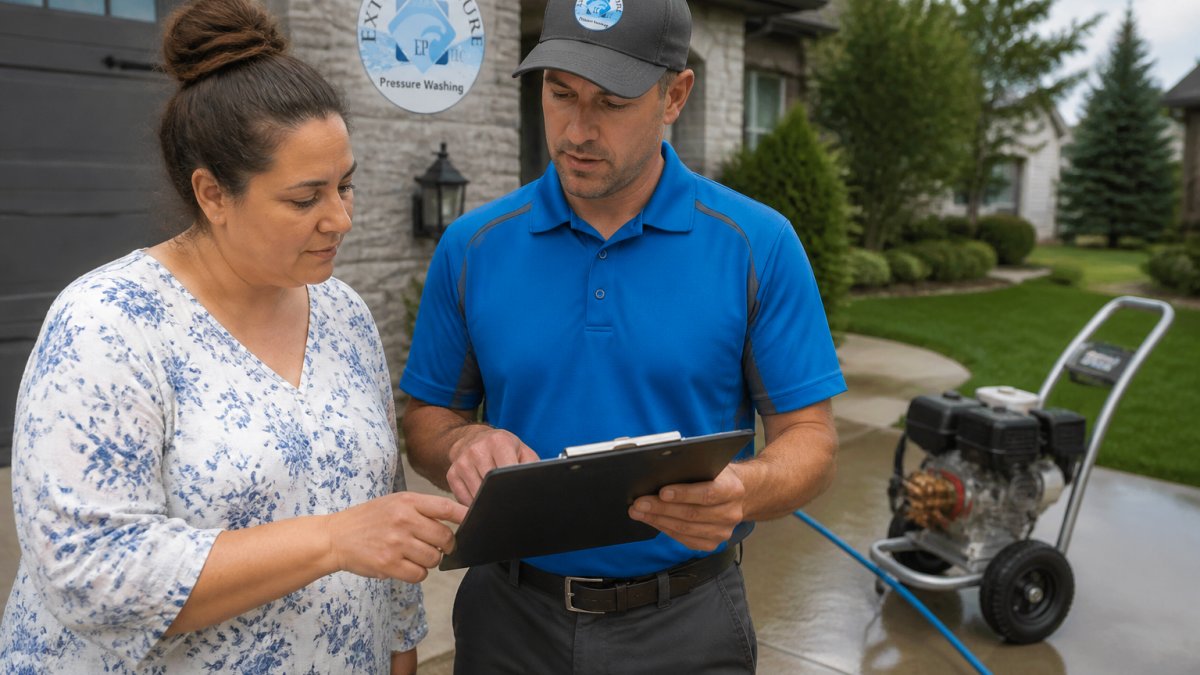
Why it matters: if an uninsured crew damages your siding or injures someone on your property, the claim can land on your homeowner’s policy. That is a risk you should not accept.
Check these three things:
- General liability insurance covers property damage.
- Workers’ compensation covers crew injuries.
- State or local licensing depends on your area, so ask what the company holds.
A common mistake is accepting a verbal “we’re insured” without a certificate. If the crew damages a window and has no coverage, you may pay for the repair yourself.
Step 3: Read Reviews and Ratings Like a Skeptic
Reviews are useful, but only when you read them the right way. Most guides tell you to “check the stars” and stop there. That is not enough. The goal is to separate a genuinely reliable crew from one that has learned to game a rating.
Start with the middle ratings. Five-star reviews tell you people were happy. One-star reviews tell you someone was angry. Three-star reviews often tell you the most about how a company handles problems, whether the owner replied, whether a fix was offered, and whether the customer felt heard.
Then check for these signals:
- Reviews that mention a specific service, like driveway cleaning, house washing, or roof soft washing
- Photos posted by customers showing before and after results on a surface like yours
- Owner responses that stay calm, acknowledge the issue, and offer a concrete fix
- Reviews spread over months and years, not bunched into a single week
- A review count that is plausible for the company’s age and crew size
Spotting reviews that do not add up. A cluster of five-star reviews posted within a few days, each one or two sentences long and light on detail, is a pattern worth questioning.
Recency matters as much as volume. A company with 200 reviews but none in the last year may have changed owners, lost its best crew, or stopped answering callbacks. Weight the last six to twelve months more heavily than the older history.
Ask for references, not just reviews. Reviews are public and curated; references are private and specific. A single question tells you more than any star rating: “Did they show up when they said, finish when they said, and would you hire them again?” Most homeowners are happy to answer.
Ask the reference one follow-up: “Was there anything you wish they had done differently?” The answer is where the real information lives, nobody’s job is perfect, and a company whose customers can name a small flaw and still recommend them is usually a safe hire.
Customer reviews and ratings are a good filter, but they are not proof. A company with a strong reputation still needs to show you insurance and a written estimate. Treat reviews as the first screen, references as the second, and paperwork as the final check.
Step 4: Match the Cleaning Method to Your Surface
Cleaning method matters more than price. Water pressure that is fine on concrete can ruin paint, wood, or stucco.
Here is how the main methods map to common surfaces:
| Surface | Best Method | Why |
|---|---|---|
| Concrete driveway | High-pressure washing | Concrete handles strong water pressure |
| Vinyl siding | Low-pressure with detergent | High pressure can force water behind panels |
| Stucco | Soft washing | Stucco chips and cracks under high pressure |
| Wood deck | Low pressure, gentle detergent | Wood fibers splinter and strip |
| Roof shingles | Soft washing | High pressure lifts granules and voids warranties |
| Painted surfaces | Low pressure, test patch first | Paint can peel or blister |
Soft washing is a low-pressure method that relies on detergents to kill mold, mildew, and algae, then rinses everything away. It is the safer choice for delicate exterior surfaces.
Ask any provider which method they plan to use on each surface. If the answer is “we blast everything the same way,” keep looking.
This is also where damage prevention gets decided. A crew that talks about water pressure settings, nozzle tips, and pre-treating plants knows what it is doing.
Step 5: Compare Pressure Washing Estimates Line by Line
Pressure washing estimates should be written, itemized, and specific. A single number on a napkin tells you almost nothing, and it makes two bids impossible to compare, because you cannot tell what each one actually includes.
Ask each provider to break the quote into these parts:
- Surface to be cleaned, named specifically (e.g., “two-car concrete driveway,” not “driveway”)
- Cleaning method and detergent used on each surface
- Square footage or linear footage being priced
- Setup, plant protection, and water access
- Gutter cleaning, window washing, or roof treatment add-ons, priced separately
- Total price, payment terms, and deposit amount
- Guarantee and callback policy in writing
Normalize the scope before you compare price. The most common mistake is comparing totals when the scopes differ. One quote may look cheaper only because it skips the driveway apron, leaves out gutter brightening, or prices a single pass instead of a pre-treat and rinse. Build a one-page scope sheet listing every surface and add-on you want, send the same sheet to each provider, and ask them to price against it. Now the totals are comparable.
Understand what drives the price. Pressure washing pricing generally moves with square footage, surface type, access (fences, steep grades, tight side yards), how much organic growth has built up, and whether the job needs soft washing versus high pressure. A two-story house wash costs more than a single-story because of reach and setup. A heavily stained roof costs more than a lightly dusted one because it needs more dwell time and detergent.
Watch for these quote traps:
- A price given over the phone without seeing the property, which often grows on arrival
- A deposit request for the full amount upfront
- Add-ons bundled into the total so you cannot see what you are paying for
- A “per square foot” rate that quietly excludes setup, travel, or plant protection
The lowest bid is rarely the best value. A quote that includes surface protection, the right method, and a written guarantee usually costs a little more and saves you a repair bill later. Compare scope first, price second.
Finally, get the final number and scope in writing before anyone starts. A written, itemized estimate is the document you point to if a surface is missed or an add-on appears on the invoice. If a provider will not put the scope in writing, that is your answer.
Questions to Ask a Pressure Washing Company Before You Book
Ask these questions before you book, and write down the answers. A pressure washing service checklist is only useful if you actually use it.
- Are you licensed and insured, and can you send the certificate?
- Which cleaning method will you use on each surface?
- Do you protect plants, outlets, and light fixtures?
- Will you do a test patch on painted or older surfaces?
- Is the estimate written and itemized?
- What happens if something gets damaged?
- How do you handle callbacks if mold returns?
- Can you provide references from jobs in my area?
The last question matters most for anyone dealing with repeat mold. Organic growth comes back when the cause, often shade and moisture, is not addressed. A good provider will explain what to expect and how often to clean.
Red Flags and Service Guarantees to Watch For
Red flags are easy to spot once you know them. Walk away from any provider who does these things:
- Quotes a price without seeing the property
- Refuses to show insurance
- Demands full cash payment upfront
- Cannot name the cleaning method
- Has no written guarantee
- Pressures you to book on the spot
On the other side, look for a clear service guarantee. A written promise to return and fix a missed spot or a returning stain is worth more than a low price.
At Extra Pressure LLC, we are licensed and insured, offer same-day estimates, and use specialized soft washing for delicate surfaces. We also handle window washing and gutter maintenance so one crew covers the whole exterior.
Frequently Asked Questions
Should a pressure washing company be licensed and insured?
Yes. Ask for a certificate of insurance showing general liability coverage, and confirm the policy is current by calling the insurer if needed. Licensing rules vary by state and municipality, so ask whether the company holds the required local business license and any industry certification. A legitimate pressure washing company will share these documents without hesitation. If a provider dodges the question or promises to send proof later, treat that as a warning sign and keep looking.
How can I compare pressure washing estimates fairly?
Ask every provider to quote the same scope in writing: which surfaces, square footage, cleaning method, detergent use, and whether gutter or window work is included. Pressure washing estimates that only list a lump sum make comparison impossible. Check whether the quote covers plant protection, water access, and cleanup. A lower number often reflects a smaller scope, not a better deal. Request a written estimate before any work begins so there are no surprise charges when the crew arrives.
What is the difference between pressure washing and soft washing?
Pressure washing uses high water pressure to strip dirt from hard surfaces like concrete driveways and sidewalks. Soft washing uses low pressure with cleaning detergents to treat mold, algae, and grime on delicate surfaces such as stucco, siding, and roofs. Using full pressure on stucco or older siding can crack the surface or force water behind it. Ask which method the company plans to use on each surface, and confirm they adjust water pressure and nozzles rather than applying one setting everywhere.
What should I ask before hiring a pressure washing company?
Ask for proof of insurance and licensing, the cleaning method planned for each surface, how they protect landscaping and windows, and whether they provide a written estimate and service guarantee. Confirm who will be on site, whether the crew is employees or subcontractors, and how they handle water access. Also ask about scheduling and same-day or next-day availability if you have a deadline. A pressure washing service checklist with these questions keeps the conversation on track and makes comparing providers straightforward.
Hiring the wrong crew can cost you far more than the cleaning itself. Extra Pressure LLC makes the choice simple: licensed and insured work, same-day estimates, soft washing that protects delicate surfaces, and a 100% satisfaction guarantee. Schedule an appointment and get your exterior cleaned by a team that treats your property like its own.