
Table of Contents
- How to Safely Remove Green Algae from Concrete Patio: What You Need to Know First
- What You’ll Need: Safety Gear, Tools, and Cleaner Options
- The Best Cleaner for Algae on Concrete: Matching the Solution to the Surface
- How to Clean a Concrete Patio Without a Pressure Washer: Step-by-Step
- Pressure Washing a Concrete Patio Safely: When and How to Do It Right
- How to Prevent Algae from Growing on Concrete: Long-Term Habits
- Common Mistakes That Spread Algae or Damage Concrete
- When to Call a Professional for Algae Removal
- Frequently Asked Questions
Last Updated: October 15, 2026
How to Safely Remove Green Algae from Concrete Patio: What You Need to Know First
Green algae turns a concrete patio slick and ugly fast. The good news: you can remove green algae from concrete without harsh chemicals or costly equipment. The same three-step method works almost every time: identify the growth, pick the right cleaner, then scrub and rinse.
This guide walks you through each step. You’ll also learn when to skip the DIY route and call a pro.
Identify Green Algae, Mold, Mildew, and Lichen on Concrete
Green algae is a thin, slimy film that grows on damp concrete. It looks like green paint smeared across the surface.
Mold and mildew are darker, often black or gray, and grow in fuzzy patches. Lichen is crusty and comes in gray, green, or yellow tones.
Here’s how to tell them apart:
- Green algae: Slick, green film. Wipes off with a finger.
- Mold/mildew: Black or gray spots. Grows in circles.
- Lichen: Crusty, raised patches. Hard to scrape off.
Algae is the easiest to remove. Lichen takes more scrubbing and a stronger cleaner.
Why Damp Surface and Shaded Area Conditions Feed Growth
Algae needs three things: moisture, shade, and a rough surface. Your concrete patio delivers all three.
Concrete is porous. Tiny pits and cracks hold water long after rain stops. A shaded area blocks sunlight that would dry the surface.
North-facing patios and spots under trees are the worst offenders.
The fix is simple: dry the surface faster and clean it more often.
What You’ll Need: Safety Gear, Tools, and Cleaner Options
Safety comes before scrubbing. Algae cleaners can irritate skin and eyes, and bleach damages plants.
Gather this gear first:
- Rubber gloves and eye protection
- Old clothes and closed-toe shoes
- Stiff-bristle brush or deck brush
For cleaner options, you have three main choices:
| Cleaner | Best For | Dwell Time | Watch Out For |
|---|---|---|---|
| Diluted white vinegar | Light algae, eco-friendly clean | 30-60 min | Weak on heavy growth |
| Mold-and-algae cleaner | Most patios, textured concrete | 10-15 min | Read label for dilution |
| Diluted bleach | Tough stains, shaded slabs | 10-15 min | Kills plants, stains fabric |
Always read the product label. It gives exact dilution ratios and safety steps for that cleaner.
Never mix bleach with vinegar or ammonia. The combo releases toxic gas. Pick one cleaner and stick with it.
The Best Cleaner for Algae on Concrete: Matching the Solution to the Surface
The best cleaner for algae on concrete depends on three things: how porous the surface is, how heavy the growth is, and what’s growing nearby. A smooth, sealed slab and a pebbled, unsealed walkway need different approaches, and the wrong pick can etch the concrete or kill the landscaping.
Use this decision guide before you buy or mix anything:
| Surface type | Best first choice | Avoid | Why |
|---|---|---|---|
| Smooth, sealed concrete | Diluted white vinegar (1:1 with water) or a label-diluted mold-and-algae cleaner | Full-strength bleach | Sealer blocks deep penetration, so a mild mix is enough |
| Smooth, unsealed concrete | Label-diluted mold-and-algae cleaner | Vinegar alone on heavy growth | Pores hold spores; a surfactant cleaner lifts them |
| Textured, broomed, or pebbled concrete | Mold-and-algae cleaner applied with a pump sprayer, then brushed | Pressure washing above 1,500 PSI | Texture traps algae in the valleys; force chips the peaks |
| Colored, stamped, or acid-stained concrete | Manufacturer-approved cleaner only | Bleach, TSP, or anything with a pH above 10 | Dyes and stains can bleach or streak |
| Cracked or spalling concrete | Mild cleaner plus hand scrubbing | Pressure washing | Water forced into cracks widens them and feeds freeze-thaw damage |
Dilution and dwell time, by product type. Always follow the label first, it overrides any general ratio. When the label is vague, these are common starting points:
- White vinegar (5% acetic acid): 1 part vinegar to 1 part water for light film; full strength for moderate growth. Dwell 30-60 minutes. Reapply if it dries before you scrub.
- Oxygen-bleach (sodium percarbonate) powders: mix per label, typically 1/4 to 1/2 cup per gallon of warm water. Dwell 15-20 minutes. Safe around most plants when rinsed.
- Sodium hypochlorite cleaners: dilute per label, often 1 part cleaner to 3-10 parts water. Dwell 10-15 minutes. Do not let it dry on the surface.
Runoff and disposal. Whatever you use ends up somewhere. On a patio, that “somewhere” is usually a lawn, a planting bed, or a storm drain that leads to a local waterway. A few rules keep the job legal and the plants alive:
- Never let wash water run into a storm drain. Storm drains in most municipalities discharge untreated to creeks, rivers, or lakes.
- Divert rinse water onto a grassy area only if the cleaner is labeled safe for turf, and only in a thin sheet, not a concentrated puddle.
- For bleach-based products, neutralize or heavily dilute before it reaches soil, and keep it off vegetable gardens.
Never mix bleach with vinegar, ammonia, or any acid-based cleaner. The reaction releases chlorine gas. Pick one product, rinse it fully, and wait 24 hours before switching chemistries.
When to skip the DIY mix entirely. If the label on a store-bought cleaner already gives a dilution, use that instead of a home recipe. Pre-mixed sprays cost more per square foot but remove the guesswork and the risk of over-concentrating. For delicate or expensive surfaces, stamped, stained, or sealed within the last year, a manufacturer-approved cleaner or a soft-wash professional is the safer call.
How to Clean a Concrete Patio Without a Pressure Washer: Step-by-Step
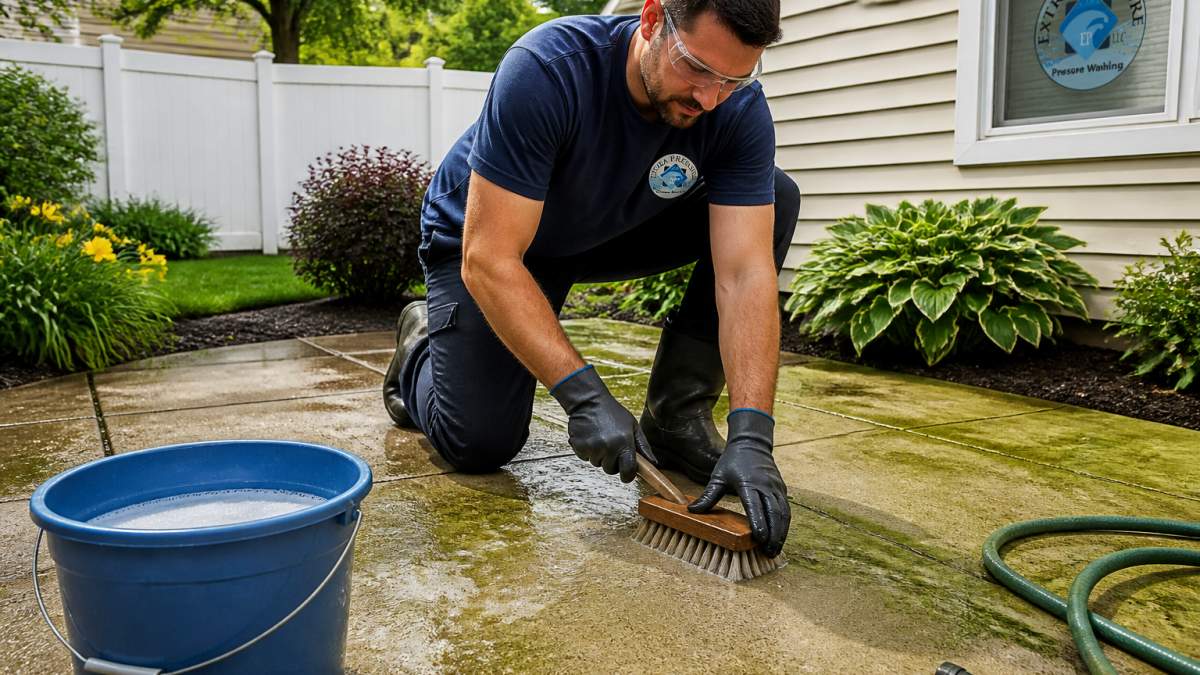
You can clean a concrete patio without a pressure washer using a brush, a cleaner, and some elbow grease. Here’s the full process.
Total Time: 2-3 hours for an average patio
Difficulty: Beginner
- Clear the patio. Move furniture, pots, and grills. Sweep off loose dirt and leaves.
- Protect plants. Cover nearby plants with plastic sheeting. Wet down the soil around them.
- Pre-treat the surface. Spray your cleaner on the algae. Let it sit for the dwell time on the label, usually 10-15 minutes.
- Scrub with a stiff-bristle brush. Work in small sections. Push the brush into cracks and textured areas.
- Rinse and wash away. Use a garden hose to rinse the loosened algae. Start at the top and work downhill.
- Check for missed spots. Re-treat any green patches and scrub again.
- Let it dry. Sunlight finishes the job. Keep the surface dry for 24 hours.
Scrub on a cloudy day, not in full sun. Cleaners dry out too fast in direct heat, so they stop working before they kill the algae.
Pressure Washing a Concrete Patio Safely: When and How to Do It Right
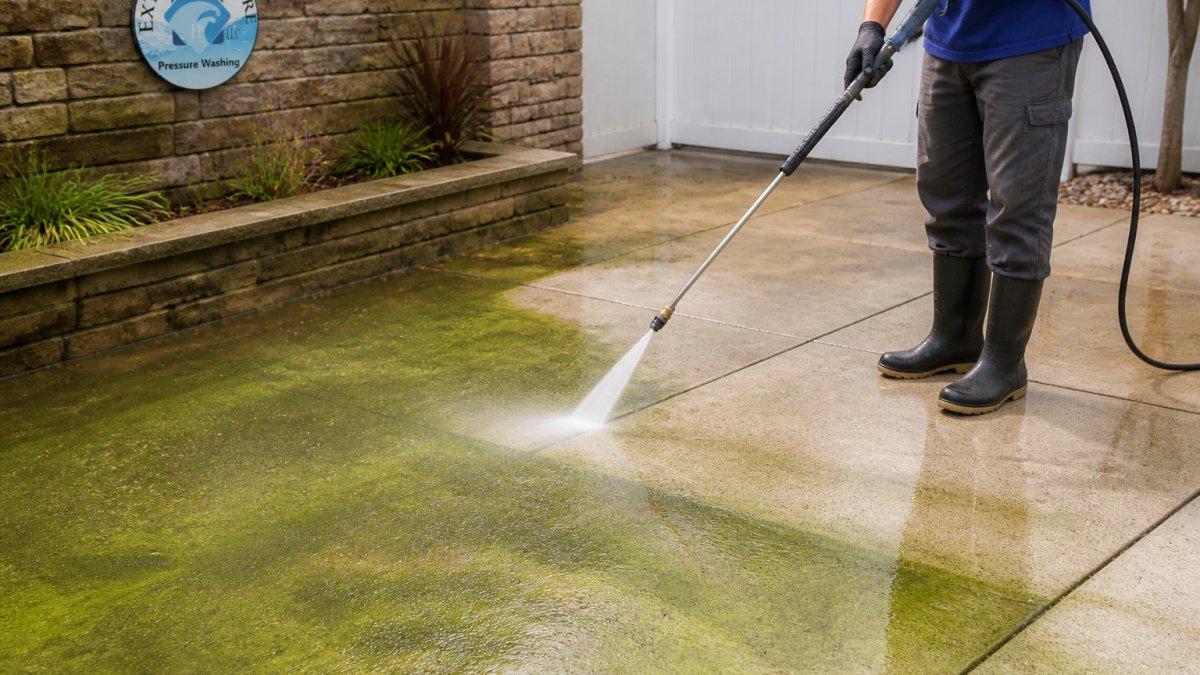
Pressure washing a concrete patio safely means using the right nozzle and keeping the wand moving.
Follow these rules:
- Use a 25-degree or 40-degree nozzle, never a 0-degree tip
- Keep the wand 12-18 inches from the surface
- Move in smooth, overlapping passes
A surface cleaner attachment helps a lot. It spreads the pressure evenly and cuts streaks.
Pressure washing works best on flat, smooth slabs. Skip it on pebbled or cracked concrete.
For stubborn algae, combine methods: pre-treat with cleaner, scrub the edges, then pressure wash the open areas.
How to Prevent Algae from Growing on Concrete: Long-Term Habits
Fix the water first. Most recurring algae traces back to a drainage issue, not a cleaning failure.
- Regrade soil away from the slab. Soil should slope away from the patio at roughly a 1-inch drop per foot for the first 6 feet. Flat or negative grade keeps the slab edge wet after every rain.
- Clear gutter downspouts. A downspout that dumps within 3 feet of the patio saturates the soil under the slab. Add a 4- to 6-foot extension or a splash block to move water away.
- Address low spots. Puddles that sit more than 24 hours after rain are the single biggest driver of regrowth. Fill low spots with a patching compound or have the slab mudjacked if it has settled.
Manage shade. Algae does not need full sun to die, it needs the surface to dry.
- Trim tree branches so the patio gets direct sun for at least 2-3 hours daily, ideally midday.
- If the patio is permanently shaded (north-facing, under a deck, or beneath a dense canopy), accept that cleaning will be a recurring task and lean on a sealer plus a quarterly maintenance rinse.
- Consider a lighter-colored concrete stain or a reflective coating on deeply shaded slabs. Lighter surfaces dry faster and stay cooler.
Seal the surface. A penetrating silane or siloxane sealer fills the pores so water beads instead of soaking in.
- Seal new concrete after it cures, typically 28 days, and reseal every 3-5 years, or sooner if water stops beading.
- Test before resealing: drip a cup of water on the slab. If it soaks in within a minute, it’s time.
- Avoid film-forming acrylic sealers on shaded patios. They can trap moisture underneath and peel.
Build a maintenance schedule. A 10-minute routine beats a 3-hour deep clean every time.
- Weekly: sweep or leaf-blow the patio. Leaves and debris hold moisture against the surface.
- Monthly during wet seasons: rinse with a garden hose and let it dry in the sun. No cleaner needed.
- Quarterly: spot-treat any new green film with diluted vinegar before it spreads.
Dry concrete doesn’t grow algae. Fix drainage, open up shade, seal the pores, and stick to a weekly sweep plus a monthly rinse, that combination prevents regrowth better than any cleaner.
Common Mistakes That Spread Algae or Damage Concrete
The biggest mistake is over-wetting the surface. Drenching the patio with water spreads algae spores to clean areas.
Other common errors:
- Scrubbing dry cleaner into the surface. This pushes algae into the pores. Always pre-wet and pre-treat.
- Using too much pressure. High PSI etches concrete and leaves permanent marks.
- Skipping the rinse. Leftover cleaner residue attracts new growth.
One more mistake: cleaning only the visible green spots. Algae spreads under furniture and along edges. Treat the whole patio, not just the ugly parts.
When to Call a Professional for Algae Removal
Call a professional when the growth covers a large area, keeps coming back, or sits on a delicate surface.
Signs it’s time to hire help:
- Algae returns within weeks of cleaning
- The patio is large or hard to reach
- You have textured, pebbled, or cracked concrete
Professional removal uses the right mix of soft washing and surface cleaning. That’s the difference between a quick fix and a lasting result.
Extra Pressure LLC. is licensed and insured. We offer same-day estimates and specialized soft washing for delicate surfaces.
Frequently Asked Questions
Can white vinegar remove green algae from a concrete patio?
Yes, diluted white vinegar can remove light green algae from concrete. Mix one part white vinegar with one part water, spray the patio, and let it sit for 10 to 15 minutes before scrubbing with a stiff-bristle brush and rinsing. Vinegar is a mild acid, so test a small area first and avoid using it on limestone or unsealed concrete where it may etch the surface. For heavy growth, a dedicated mold-and-algae cleaner will work faster.
Is bleach safe to use on a concrete patio?
Bleach, or sodium hypochlorite, kills algae and mold on concrete, but it needs careful handling. Dilute it according to the label, usually around 1 part bleach to 10 parts water, and never mix it with vinegar or ammonia. Protect plants by pre-wetting them and covering them, keep pets and children away until the surface is dry, and rinse thoroughly. Bleach can lighten colored concrete and damage nearby grass, so test a hidden spot first.
Can pressure washing damage a concrete patio?
Pressure washing can damage concrete if you use too much pressure or hold the nozzle too close. For most patios, a pressure setting around 1,500 to 2,000 PSI with a 25-degree nozzle is enough. Keep the wand moving, work at a consistent distance, and avoid blasting cracks or textured surfaces directly. For older, cracked, or pebbled concrete, a soft-wash approach or a low-pressure surface cleaner is safer than a high-pressure stream.
How do you keep green algae from coming back on concrete?
Prevent algae by reducing moisture and shade on the patio. Trim tree branches to let sunlight reach the surface, improve drainage so water doesn’t pool, and sweep or rinse the patio regularly to remove dirt and organic debris. Apply a concrete sealer every few years to block moisture. In persistently damp or shaded areas, a follow-up treatment with a mold-and-algae cleaner two to three times a year keeps growth from returning.
Algae on your patio is a moisture problem, not a cleaning problem. Fix the shade and drainage, clean with the right method, and the green film stays gone. If the job feels too big, or the growth keeps returning, Extra Pressure LLC. can handle it. We bring licensed and insured service, same-day estimates, and specialized soft washing that protects your concrete and landscaping. Schedule an appointment and get your patio back to looking its best.