
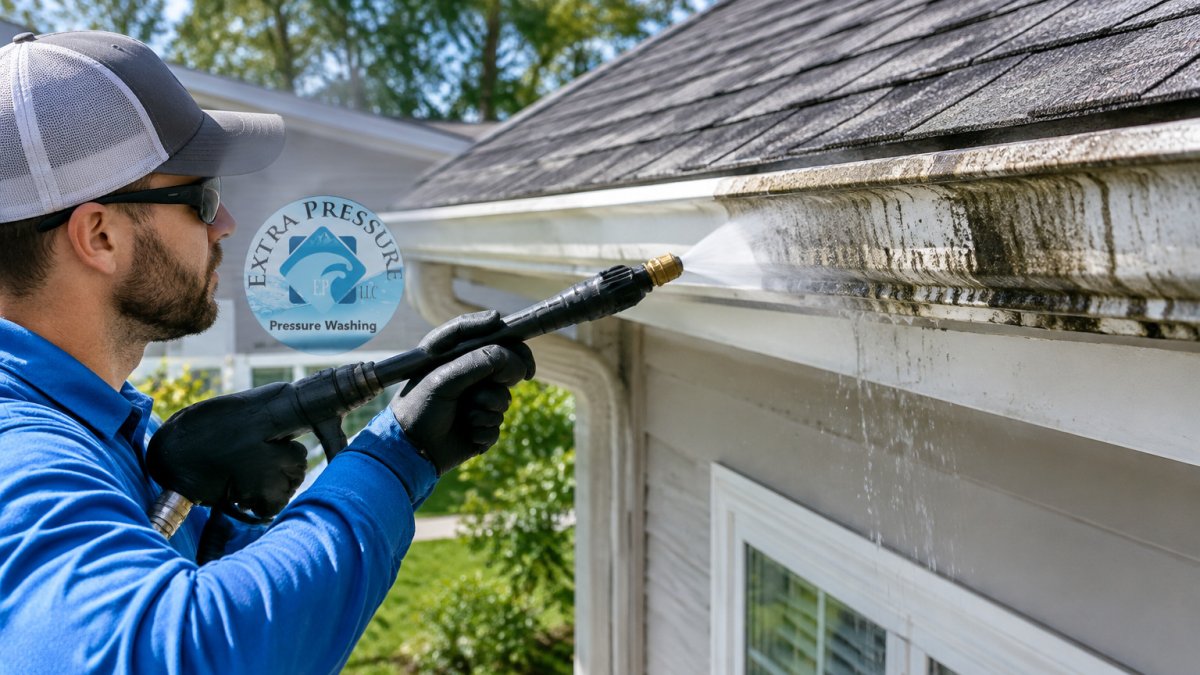
Quick Summary
To remove black streaks from gutters, start by testing whether the stain is surface dirt or oxidation: plain water lifts dirt, but a dark mark that stays is likely bonded organic matter. Then apply a pH-balanced, gutter-specific cleaner at the label ratio, let it dwell about 10 minutes, brush gently, and rinse at low pressure.
- Plain water and a cloth tell you if the stain is dirt or oxidation.
- Mix the gutter cleaner at the label ratio, roughly 2:1 to 3:1 water to cleaner.
- Let the cleaner dwell about 10 minutes, or 3 to 5 minutes on hot metal.
- Work in 10 to 15 foot sections so the cleaner never dries before rinsing.
- High-pressure washing can strip the protective paint layer and speed up oxidation.
Table of Contents
- What Causes Black Streaks, or Tiger Stripes, on Gutters
- Surface Dirt Versus Oxidation Staining: Which One You Have
- How to Clean Gutters Without a Ladder
- Choosing the Best Gutter Cleaner for Tiger Stripes
- Step-by-Step: Applying Cleaner, Dwell Time, Brushing and Rinsing
- Safety, Dilution and Protecting Your Finish
- What Gutter Whitening Costs and When to Call a Professional
- Booking Your Gutter Cleaning With Extra Pressure LLC.
- Frequently Asked Questions
What Causes Black Streaks, or Tiger Stripes, on Gutters
If you have dark streaks running down your aluminum gutters, you are not alone. If you have also seen similar dark streaks on your roof, you can learn how to safely remove black streaks from a roof. Homeowners in Fannin, Union, Gilmer, Pickens, Murray, Polk, Bradley and Cherokee counties see them often, and most people assume the gutters are simply dirty. Usually they are not, so knowing how to remove black streaks starts with understanding the cause.
The dark marks are often called tiger stripes. According to Clean Pro Gutter Cleaning (Clean Pro Gutter Cleaning Guide), black streaks form when organic matter electrostatically bonds to the gutter surface and reacts with oxidation. That bond is why a quick rinse does nothing.
Here is what usually feeds the problem:
- Leaves and pine needles that sit in the gutter and break down
- Moisture that stays on the surface for long periods
- Oxidation on aluminum and other metal finishes
- Runoff from roofing materials that carries organic residue
The fix depends on matching the cleaner to the type of staining. A pH-balanced, gutter-specific detergent is the usual starting point, rather than a standard household soap. Professionals also reach for these products because they are built to break that electrostatic bond.
Watch out: pressure washing at the wrong force can strip the protective paint layer on aluminum gutters. That makes the metal oxidize faster and brings the streaks back sooner.
Surface Dirt Versus Oxidation Staining: Which One You Have
Before you buy anything, figure out what you are dealing with, because the right method to remove black streaks depends on the cause. Surface dirt rinses off easily with water and a little detergent. Oxidation staining does not. It stays put after a hose rinse and often looks like a dark, layered film.
A simple test helps:
- Wet a small patch with plain water and wipe it with a cloth
- If the color lifts, you are probably dealing with dirt or debris
- If the dark mark stays, it is likely oxidation or bonded organic matter
Oxidation stains tend to sit on the gutter exterior, especially on the sun-facing side and along the seams. They often look worse after rain. If the streaks come back within weeks of cleaning, the cause is likely the metal finish, not the dirt on top of it.
How to Clean Gutters Without a Ladder
Many homeowners want to avoid climbing a ladder, and the good news is that much of the streak work can be done from the ground. Use a long-handled soft brush or a telescoping wand to reach the lower gutter run. Apply the cleaner from the ground, let it dwell, and rinse with a garden hose set to low pressure.
Ladder-free methods have limits. Upper gutters on a two-story home are hard to reach without a pole system, and working on a ladder is where most home injuries happen. If the gutters are high or the roof pitch is steep, a professional with the right equipment is the safer call.
Choosing the Best Gutter Cleaner for Tiger Stripes
Not every cleaner works the same way. Look for a product made for gutters and rated for aluminum or the metal your gutters are made from. Products such as are designed for the electrostatic bonds that cause tiger striping, according to J. Racenstein Co. (J. Racenstein Co. gutter cleaner product information).
Check the label for:
- Compatibility with your gutter material
- Recommended dilution ratio
- Dwell time before rinsing
- Whether it is pH-balanced
Avoid harsh household bleach on painted or coated gutters. Bleach can discolor finishes and damage plants nearby.
Step-by-Step: Applying Cleaner, Dwell Time, Brushing and Rinsing
This is the core process, and the details matter more than the product you buy. Work in sections of roughly 10 to 15 feet so the cleaner never dries before you rinse. Pick a shaded side of the house or an overcast day; cleaner flashing dry on warm metal is the most common reason streaks come back.
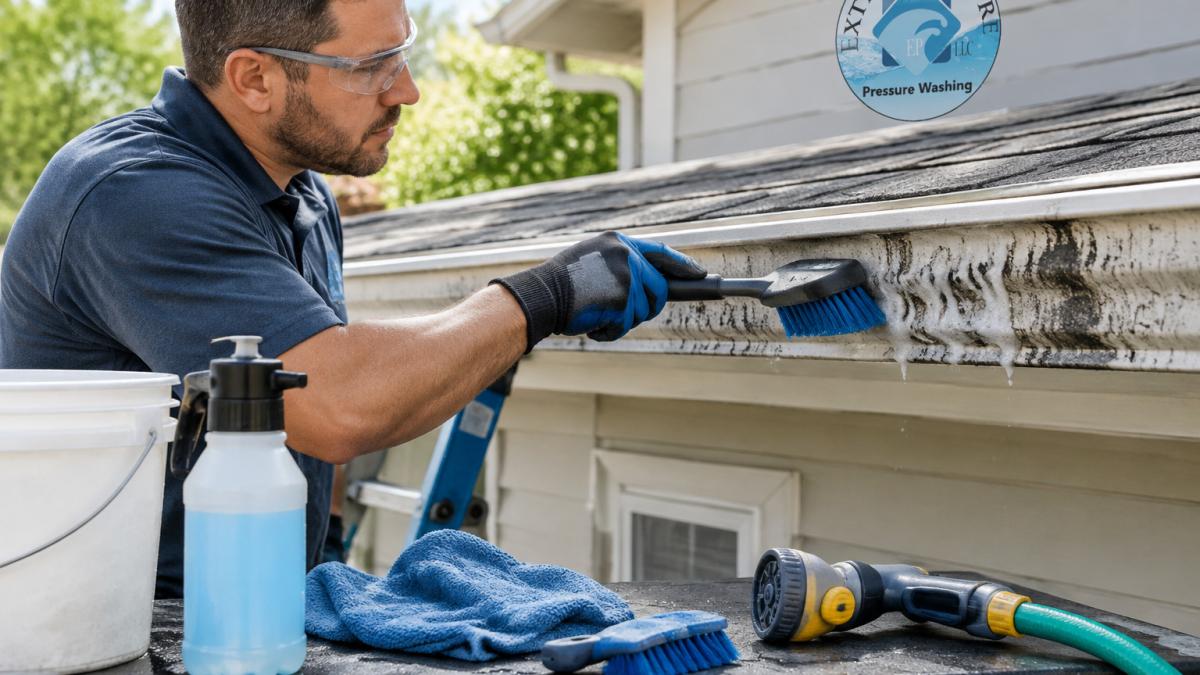
- Pre-rinse and test. Rinse the gutter run with plain water to knock off loose debris. Before you treat the whole run, test a small hidden area, such as the back of a downspout or a section under an eave, to confirm the cleaner does not dull or discolor the finish.
- Mix at the label ratio. Follow the dilution on the product label exactly. A common professional starting point is roughly 2:1 to 3:1 water to cleaner, per J. Racenstein Co. (dilution guidance from J. Racenstein Co.). Mix only what you will use in one session, and never top off a sprayer with a second chemical.
- Apply from the bottom up. Spray or brush the solution onto the streaked face of the gutter, working from the lower edge upward so drips do not dry a clean line through untreated grime. Coat the full streaked area, including the seam lines where staining concentrates.
- Let it dwell, but watch the clock. Industry practice commonly lands around 10 minutes of dwell time so the cleaner can break the bond, according to a best-practice discussion among pressure washing professionals (pressure washing community best-practice discussion). On hot, sunny metal, cut that to 3 to 5 minutes and re-wet the surface with a light mist rather than letting it dry.
- Agitate with a soft brush. Use a soft-bristle brush, and many pros favor a 10-inch truck wash brush for stubborn spots, as noted by the Window Cleaning Resource Community (Window Cleaning Resource Community equipment advice). Work in short strokes along the gutter face, not in circles, and keep the brush wet.
- Wipe loosened residue. Follow the brush with a clean cloth or sponge to lift the loosened film before it re-dries. Rinse the cloth often in a bucket of plain water.
- Rinse low and thoroughly. Rinse with a garden hose at low pressure, working top down so dirty water does not run back over cleaned sections. Rinse the siding, windows, and ground below as you go.
If streaks remain after one pass, repeat the full cycle once rather than scrubbing harder. Aggressive scrubbing scratches the finish and gives oxidation a place to start.
Finish-specific notes. Painted aluminum is the most common gutter material and the most forgiving if you keep pressure low and the cleaner pH-balanced. Vinyl gutters tolerate most gutter-specific detergents but can stain if a strong cleaner sits too long, so keep dwell times short. Factory-finished or coated aluminum should never see an abrasive pad or a stiff brush. On any material, test a small area first and rinse it fully before committing to the whole run.
Watch out: never mix cleaners or add a second chemical to the same spot, and rinse fully between products. Mixing a bleach-based cleaner with an acid-based one can release dangerous gas.
The core process comes down to a few stages, each with a timing or ratio the article specifies.
| Step | What to do | Time or ratio |
|---|---|---|
| Pre-rinse and test | Rinse loose debris and test a hidden area | Test before full run |
| Mix | Dilute at the label ratio | About 2:1 to 3:1 water to cleaner |
| Apply | Spray or brush from the bottom up | Work in 10 to 15 ft sections |
| Dwell | Let cleaner sit before brushing | About 10 min; 3 to 5 min on hot metal |
| Agitate | Brush with a soft-bristle brush | Short strokes, keep brush wet |
| Wipe | Lift loosened residue with a cloth | Rinse cloth often |
| Rinse | Rinse top down at low pressure | Repeat full cycle once if needed |
Safety, Dilution and Protecting Your Finish
Most gutter-streak guides skip the part that actually hurts people: the ladder and the chemicals. Treat this section as the checklist you run before you touch a sprayer.
Protective equipment. Wear chemical-splash goggles or safety glasses, not just sunglasses, because cleaner sprayed overhead drips back down. Use waterproof nitrile or rubber gloves rather than thin disposable gloves, which tear on gutter edges.
Ladder safety. Set the ladder on firm, level ground and use the 4-to-1 rule: for every 4 feet of height to the gutter, the base sits 1 foot out from the wall. Keep three points of contact, never overreach sideways, and have a second person foot the ladder or hold it steady. Do not clean gutters in wind, rain, or while alone on a two-story home. Most ladder injuries happen on short moves near the top, not on the climb.
Chemical handling. Dilute the product exactly as the label says. Stronger is not better; an overly concentrated mix can etch metal, leave a sticky residue that attracts dirt, and burn foliage.
Protecting plants and surfaces. Wet down shrubs, grass, and nearby siding with plain water before you start, then rinse them again after the final rinse. Cover or move cars, grills, and patio furniture.
Protecting the finish. Soft washing, which pairs low pressure with a matched cleaning solution, is a gentler approach for delicate surfaces than high-pressure blasting. For a gentler, targeted approach to other exterior stains, see how to remove oil stains from a concrete driveway.
Interior versus exterior. This entire process is for the outside face of the gutter, the tiger stripes. Cleaning the channel inside is a separate job with its own risks, including standing water, debris weight, and hidden sharp fasteners.
What Gutter Whitening Costs and When to Call a Professional
Costs vary by home size, gutter length, and how stubborn the streaks are, so this article does not quote a fixed price. To weigh whether paying for cleaning makes sense for your home, read the homeowner’s guide on whether gutter cleaning is worth the cost. For current pricing, contact Extra Pressure LLC. for a quote.
Call a professional when the gutters are high, the roof is steep, the streaks are heavy, or you have had mold return several times. Those jobs carry real fall risk and often need a more thorough approach.
Booking Your Gutter Cleaning With Extra Pressure LLC.
If you would rather skip the ladder and the trial-and-error, Extra Pressure LLC. offers licensed and insured gutter maintenance, along with soft washing and same-day estimates. We offer specialized soft washing for delicate surfaces. You can request a gutter cleaning estimate and get a clear plan before any work begins.
Frequently Asked Questions
What takes black streaks off of gutters?
Black streaks, often called tiger stripes, are caused by organic matter bonding electrostatically to oxidized gutter surfaces. Standard soap rarely lifts them. A pH-balanced gutter-specific cleaner, diluted according to label directions (commonly around 2:1 to 3:1 water to cleaner), applied and allowed to dwell for about 10 minutes, then gently scrubbed with a soft brush and rinsed with low-pressure water, is the approach most professionals use. Stubborn stains may need a repeat treatment.
Why do gutters get black streaks?
Tiger stripes form when rainwater carries organic debris such as leaves, pollen and dirt across aluminum or painted gutter surfaces. Over time the organic matter bonds to the surface and oxidation sets in, leaving dark vertical streaks. Gutters in shaded areas under trees tend to develop them faster because they stay damp longer. Regular cleaning reduces buildup before it bonds.
Can I use household cleaners to remove gutter oxidation?
Household cleaners often fail on tiger stripes because they are not formulated to break down the electrostatic bond between organic matter and oxidized metal. Some, including abrasive scrubbers, can also dull or scratch painted finishes. Products designed for gutter oxidation, used at the correct dilution and followed by a gentle rinse, are a safer and more reliable choice.
Are black streaks on gutters permanent?
In most cases, no. Black streaks are surface staining rather than permanent damage, and proper technique with a matched cleaner can remove or substantially lighten them. Streaks that persist after repeated treatment may indicate deeper oxidation or finish wear, and a professional assessment can determine whether the stain can be fully removed or whether the surface needs further restoration.
