
Last Updated: November 4, 2026
Quick Summary
Professional window cleaning often removes hard water stains, but only if they are surface deposits rather than etching. Pros dry-test the glass, then use pure-water rinses and mineral-dissolving acids in a controlled sequence. Etched glass usually cannot be restored.
- Hard water stains are mineral deposits left when water evaporates on glass.
- Routine window washing often misses mineral deposits that bond to the glass.
- Pros dry-test a hidden corner first to confirm the spots are not etching.
- Final rinses use pure water, often targeting under 10 ppm TDS.
- Acid is never allowed to dry on the glass, as it can etch surfaces.
Table of Contents
- What Causes Hard Water Stains on Glass
- Why Standard Window Washing Often Misses Mineral Deposits
- What Do Professional Window Cleaners Use on Hard Water Stains
- Can Hard Water Stains Be Permanent on Glass
- Hard Water Stain Removal Cost: What Affects the Price
- How to Remove Hard Water Stains From Windows Yourself
- Booking Professional Stain Removal and Preventing Repeat Buildup
- Frequently Asked Questions
What Causes Hard Water Stains on Glass
Hard water stains are white or cloudy spots left on glass when water evaporates and leaves minerals behind. The minerals that cause them, mostly calcium and magnesium, come from the water supply itself. Homes with hard water see these spots more often on windows, shower doors and outdoor glass.
Here is what happens. Water sprays or runs across the glass, then dries in the sun or wind. The water goes away, but the minerals stay on the surface. Over time, these deposits build into a film that is hard to see through.
Many homeowners ask whether these spots are dirt. They are not. Regular soap and water usually cannot lift them, which is why the glass can look dull even after a good wash.
Why Standard Window Washing Often Misses Mineral Deposits
Routine window washing removes dust, pollen, and grime. It does not always remove mineral deposits. Standard service visits often cover basic cleaning only, and mineral removal is a separate task.
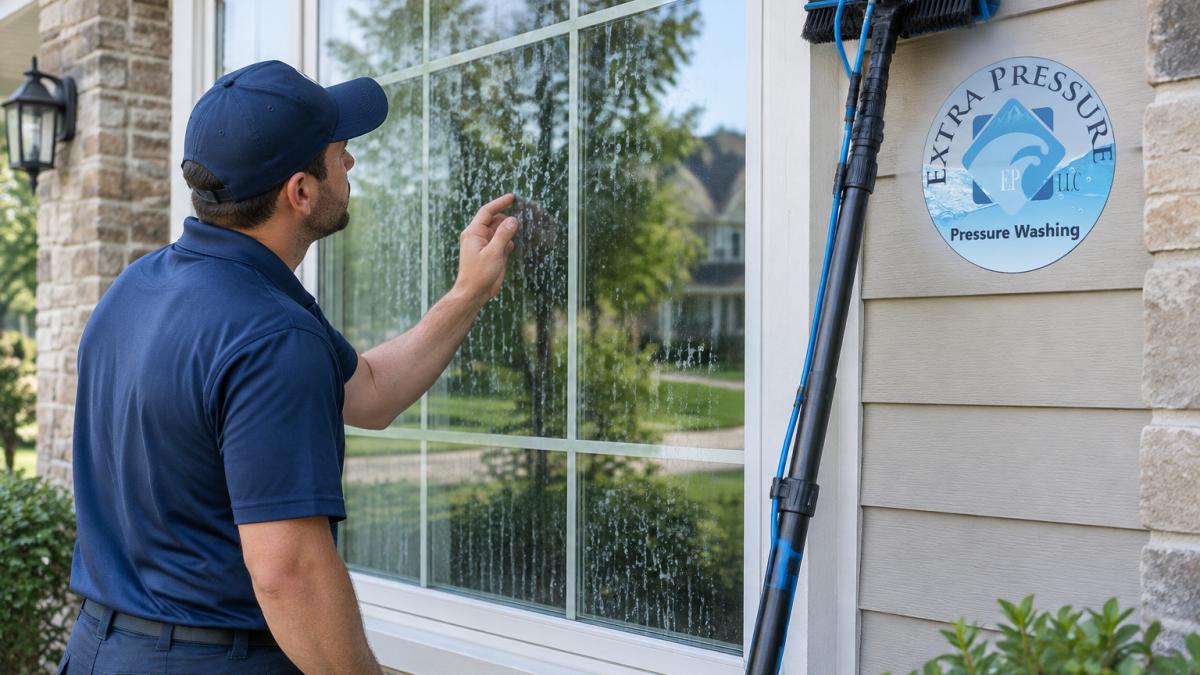
A standard wash can leave spots behind even when the glass looks clean from a distance.
- Routine washing removes loose dirt and film
- Mineral deposits bond to the glass surface
- Extra products or methods are often needed to lift them
What Do Professional Window Cleaners Use on Hard Water Stains
Mineral removal is a multi-step process, not a single spray-and-wipe. The products and sequence matter, because the wrong order can drive dissolved minerals back into the glass or leave an acid residue that etches over time.
- Dry-test the glass. A small hidden corner is cleaned first to confirm the spots are surface deposits and not etching. If the spot does not lift, the job stops there, no chemical will fix etched glass.
- Pre-rinse with pure water. Tap water is never used for the final rinse because it reintroduces the same calcium and magnesium that caused the stain. Professionals use deionized or reverse-osmosis water, often measured with a TDS (total dissolved solids) meter. A common target is under 10 ppm TDS for the final rinse; many window cleaners aim for 0-5 ppm.
- Apply a mineral-dissolving acid. Common professional products include phosphoric-acid-based removers, sulfamic-acid blends, and citric-acid gels. Consumer-adjacent brands such as Diamond Magic and Bio-Clean appear in many service trucks, but the active ingredient and concentration vary, always ask which acid is being used and at what dilution.
- Control dwell time. Acid is left on the glass only long enough to soften the deposit, typically a few minutes, and is never allowed to dry. Dried acid concentrates and can etch or stain the glass and surrounding frames.
- Agitate with the right pad. A non-scratch white pad or a fine-grade abrasive is used with light pressure. Steel wool, green scouring pads, and razor blades are avoided on coated or tempered glass because they leave micro-scratches that trap future minerals.
- Rinse and squeegee with pure water. The final rinse must be pure water, followed by a squeegee or microfiber dry, so no mineral film is left behind.
Acid-based removers can damage anodized aluminum frames, painted trim, and some sealants, so surrounding surfaces should be protected.
Ask any provider whether the quote includes a pure-water final rinse, which helps a wash stay clean between visits.
The professional process follows a fixed sequence, and each step has a specific purpose.
| Step | What to do | Key detail |
|---|---|---|
| Dry-test the glass | Clean a small hidden corner first | Confirms deposits versus etching |
| Pre-rinse with pure water | Use deionized or reverse-osmosis water | Target under 10 ppm TDS |
| Apply mineral-dissolving acid | Use phosphoric, sulfamic or citric acid | Ask which acid and dilution |
| Control dwell time | Leave acid only a few minutes | Never let it dry |
| Agitate with the right pad | Use non-scratch white pad | Avoid steel wool and razor blades |
| Rinse and squeegee | Final rinse with pure water | Follow with squeegee or microfiber dry |
Can Hard Water Stains Be Permanent on Glass
In most cases, no. Hard water stains are usually removable because the minerals sit on top of the glass rather than soaking into it. The key question is whether the glass is only spotted or actually etched.
Surface Deposits Versus Glass Etching
Surface deposits are mineral films that sit on the glass. They can usually be removed with the right products and technique.
Etching is different. It means the glass surface itself has been physically damaged by long exposure to minerals and acids. Etched glass cannot be cleaned back to clear. Once etching is deep, the glass usually needs replacement.
A simple test helps. Clean a small area with an appropriate product. If the spot lifts, it was a deposit. If it stays and the glass feels rough or looks frosted, etching may be present.
Hard Water Stain Removal Cost: What Affects the Price
Pricing depends on how bad the buildup is, how many windows need work, and how hard the glass is to reach. Single-story homes usually cost less than multi-story jobs that need taller equipment.
Other factors include:
- Severity of the mineral buildup
- Number of windows and total square footage
- Glass type and condition
- Whether etching is present, which may rule out removal
For exact pricing, contact Extra Pressure LLC. for a quote tailored to your property. You can also compare typical window cleaning service costs and how often to schedule them.
How to Remove Hard Water Stains From Windows Yourself
DIY removal works on light surface deposits, but only if you treat it as a controlled test rather than a scrubbing session. The most common failure is scrubbing harder when the spot does not lift, which is exactly the wrong move if the glass is etched.
Step 1: Identify the deposit before you touch it. Clean a 6-inch square in a hidden corner with a mild acid and a non-scratch pad. If the spot lifts, it is a surface deposit. If it stays and the glass feels rough or looks frosted under a fingernail, it is likely etched, and no DIY method will restore it.
Step 2: Mix a controlled acid. Distilled white vinegar (typically 5% acetic acid) works on light spots. For heavier deposits, a citric-acid solution, roughly 1 part citric acid powder to 4 parts warm water, is a common homeowner mix. Never mix vinegar or citric acid with bleach; the combination releases chlorine gas.
Step 3: Apply, dwell, and remove. Apply to a small section, let it sit 5-10 minutes, and do not let it dry. Agitate with a non-scratch white pad, then rinse with distilled or filtered water, not tap water, which reintroduces the minerals you just removed.
Step 4: Dry and inspect in daylight. Squeegee or microfiber-dry the section and check it at an angle in daylight. Repeat only if the spots are visibly fading; if they are unchanged after two passes, stop.
Watch out: vinegar and citric acid are safe on most glass but can dull anodized frames, etched labels, and some window films. Keep the solution off the frame and rinse thoroughly.
When DIY is the wrong tool. Heavy buildup across multiple windows, second-story glass, and any suspected etching are jobs for a professional assessment. DIY on etched glass can widen the damaged area and make replacement more likely.
Booking Professional Stain Removal and Preventing Repeat Buildup
If the spots are heavy, spread across many windows, or you suspect etching, a professional assessment is a sensible next step. Extra Pressure LLC. offers licensed and insured window cleaning and same-day estimates. Learn more about our window washing services.
Prevention helps too. Regular cleaning, especially after rain or sprinkler use, keeps minerals from building up. For ongoing exterior maintenance, see our guide to preventing mold regrowth on your home exterior.
Frequently Asked Questions
Can hard water stains be permanent on glass?
Most hard water stains are not permanent. The mineral deposits sit on the surface of the glass rather than penetrating it, so they can usually be lifted with the right chemical and abrasive treatment. The exception is glass etching, where minerals have physically damaged the surface. Etched glass cannot be restored by cleaning and generally needs replacement. A simple test is to see whether the stain responds to a mild acidic cleaner and gentle abrasion; if it does not change at all after a careful attempt, the damage may be etching.
What do professional window cleaners use on hard water stains?
Professionals typically use specialized commercial spot removers and mild acidic cleaning solutions, sometimes combined with fine abrasive pads that are safe for glass. Safety data sheets should be reviewed before using any chemical remover, especially on older glass or near landscaping.
Does regular window washing remove hard water stains?
Regular window washing removes dirt, dust, and light residue, but it usually does not remove mineral deposits that have bonded to the glass. Hard water stains typically need a targeted treatment beyond routine washing. Ask whether stain removal is included in any quote you receive. Scheduled maintenance can prevent buildup from becoming a stubborn stain in the first place.
How much does hard water stain removal cost?
Pricing depends on the number of windows, the severity and age of the staining, the glass type, and whether the job needs abrasive work or only a chemical treatment. Because stain removal is usually an add-on to standard window cleaning, it is quoted separately. For current pricing on your property, contact Extra Pressure LLC. for a quote, and compare the scope of each estimate so you know exactly what is included.
Ready to clear up those stubborn spots? Contact Extra Pressure LLC. to schedule an appointment and get a same-day estimate for your home or business.
