Last Updated: October 24, 2026
Quick Summary
Safe facade cleaning starts with a written plan: a full site hazard assessment and a small material compatibility test before any equipment arrives. Then match the gentlest method to each substrate, confirm fall protection and access equipment, and control runoff before washing begins.
- Fall protection is required at four feet for general industry work and six feet under the construction standard.
- Soft washing below 500 PSI is the safer default for most commercial facades, per a 2026 cleaning guide.
- Test patches should dry before you judge them; a 24-hour wait is cheaper than resurfacing a wall.
- Set written weather limits for wind, rain, temperature, and surface conditions, and let crews stop work.
- Inspect the facade right after cleaning and again at 30 days for streaks, cracks, and returning growth.
Table of Contents
- Start With a Facade Cleaning Safety Plan
- OSHA Facade Cleaning Safety Standards You Must Follow
- Soft Washing vs Pressure Washing Commercial Buildings
- Match Cleaning Methods to Facade Materials
- Choose Equipment and Control Runoff
- Commercial Building Exterior Cleaning Cost and Scheduling
- Inspect the Work and Set a Cleaning Frequency
- Book a Safe Commercial Facade Cleaning Assessment
- Frequently Asked Questions
Start With a Facade Cleaning Safety Plan
Cleaning a commercial building facade safely starts with a written plan, not a pressure washer.
The stakes are real. According to IBISWorld’s building exterior cleaners industry analysis, the U.S. building exterior cleaners industry includes 166,000 businesses and grew at a 3.8% compound annual growth rate from 2021 to 2026.
Facade cleaning is the process of removing dirt, biological growth, and environmental deposits from a building’s exterior surfaces without damaging the substrate underneath.
Here is the order we follow on every job:
- Walk the site and log every hazard
- Test the surface material in a small, hidden spot
- Pick the gentlest method that works
- Confirm access equipment and fall protection
- Set weather go/no-go limits
- Plan runoff and wastewater control
Hazard Assessment and Site Walk
Walk the full perimeter before any equipment arrives. Note overhead power lines, pedestrian traffic, sloped ground, and landscaping you must protect.
Look up, too. Loose mortar, failing sealant, and cracked panels become projectiles once water hits them.
A common mistake is treating the site walk as a formality. In practice, this is where most injuries and damage claims get prevented.
Material Compatibility Checks
Test first, clean second. Apply your chosen cleaning solution to a small hidden area and wait for it to dry.
Check for:
- Color change or fading
- Softening or chalkiness
- Paint lifting or bubbling
If the test patch fails, change the method, not the schedule. A 24-hour wait on a test patch is cheaper than resurfacing a wall.
OSHA Facade Cleaning Safety Standards You Must Follow
The Occupational Safety and Health Administration sets the rules that govern elevated work on commercial buildings, and the first thing to understand is that more than one standard can apply to the same job.
Which Standard Applies
- General industry (29 CFR 1910): covers most facade and window cleaning operations, including work from ladders, scaffolds, and lifts. Subpart D covers walking-working surfaces and fall protection; Subpart I covers personal protective equipment.
- Construction (29 CFR 1926): applies when the work is construction, alteration, or repair rather than maintenance cleaning, for example, facade restoration, sealant replacement, or work bundled into a renovation contract. Subpart M is the fall-protection standard; Subpart L covers scaffolds.
- Powered platforms (29 CFR 1910.66): applies to suspended work platforms and building-maintenance rigs on high-rise facades, including the requirement for a building owner’s platform certification and a trained, designated operator.
A common mistake is assuming a cleaning contract is automatically “general industry.” If the scope includes resealing, repointing, or coating removal, the construction fall-protection rules may be the ones an inspector cites.
Fall Protection: What Actually Triggers It
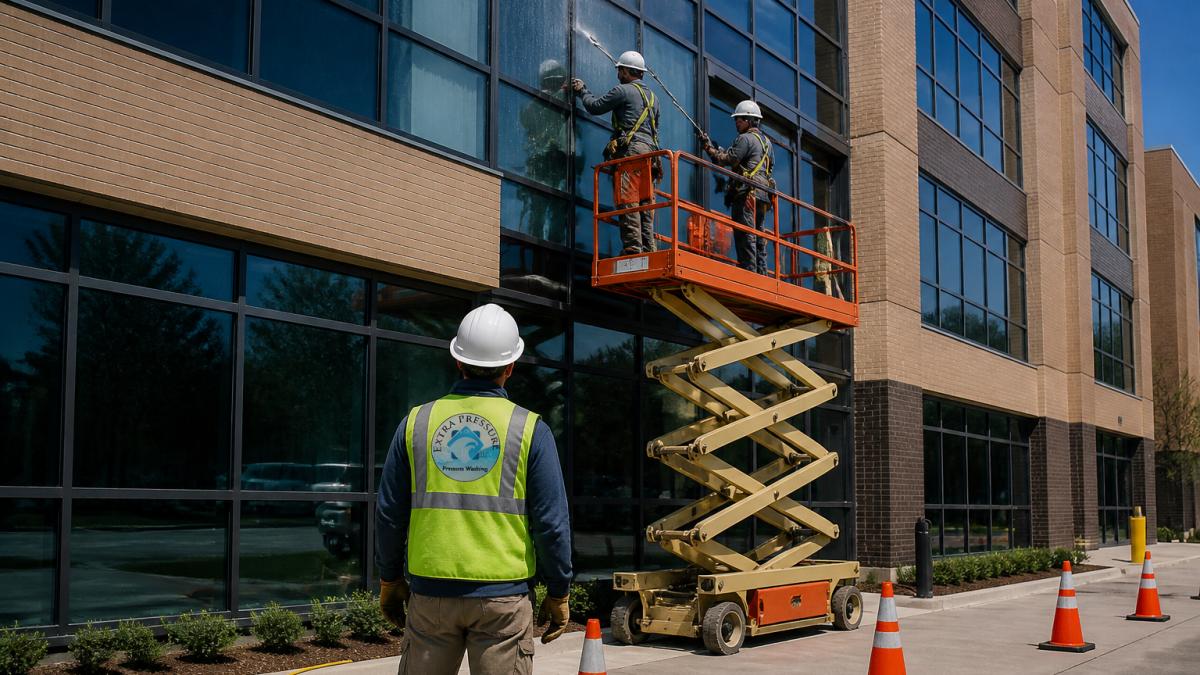
Under the general-industry walking-working surfaces rule, fall protection is required at four feet or more above a lower level for general industry work, and the construction standard triggers at six feet. Guardrail systems, safety-net systems, personal fall-arrest systems, and positioning systems are the recognized options; each has its own height, strength, and anchorage requirements.
For facade crews, the practical checklist is:
- Anchor points rated for the load and engineered or certified for the purpose, never a handrail, a pipe, or a roof vent
- Harness inspection before each use, with damaged units removed from service
- Lanyard and lifeline compatibility with the anchor and the fall distance, including swing-fall and clearance calculations
Access Equipment and the Competent Person
Lifts, scaffolds, and rigs must be inspected before each shift and after any event that could affect their integrity. The person directing that inspection and the work is typically a competent person, someone the employer designates as capable of identifying hazards and authorized to take corrective action.
Scaffold users also need fall protection and safe access (ladders or stairs, not cross-bracing), and scaffold platforms must be fully planked and rated for the intended load.
Chemical Handling and Training
Hazard communication is the section most cleaning crews under-document. Every chemical on site needs a current safety data sheet, a label that matches it, and training that covers the specific hazards, PPE, and first-aid measures for that product. Mixing bleach-based and acid-based cleaners, for example, can release chlorine gas, a hazard that training and labeling are designed to prevent.
Recordkeeping and Verification
Keep injury and illness logs as required, and retain training records and equipment inspection records. Before any contractor works at height, verify insurance and credentials. Our guide on hiring insured exterior cleaning services walks through the seven checks we recommend.
Exact requirements vary by equipment, building height, and whether the work is classified as maintenance or construction. Confirm the current rule text on OSHA’s official standards page before you mobilize, and check whether your state plan adds requirements on top of the federal rule.
Soft Washing vs Pressure Washing Commercial Buildings
Soft washing uses low pressure and a cleaning solution to kill organic growth.
A 2026 commercial cleaning guide recommends soft washing below 500 PSI for most commercial facades, per Carter’s Pressure Washing commercial exterior guide.
Pressure washing still has a place. It suits durable concrete, brick, and stone that can take the force.
| Method | Typical Pressure | Best For | Avoid On |
|---|---|---|---|
| Soft washing | Under 500 PSI | Most facades, painted surfaces, stucco | Heavy oil staining |
| Pressure washing | Above 500 PSI | Concrete, durable brick, stone | Painted, soft, or aged surfaces |
| Pure water cleaning | Low, water only | Glass, curtain wall, metal cladding | Heavy organic growth |
If you want the full case for low pressure, read why soft washing is better for delicate surfaces.
Match Cleaning Methods to Facade Materials
One method never fits a whole building. Materials behave differently under water, chemicals, and pressure, so match the technique to the substrate.
Glass, Curtain Wall, and Metal Cladding
Glass panels and curtain wall systems need pure water and a gentle touch. Deionized water dries spot-free without chemicals, which protects seals and frames.
Metal cladding scratches easily. Use soft brushes and low pressure, and test any detergent on an inconspicuous panel first.
Brick, Masonry, Stone, and Historic Surfaces
Brick and masonry tolerate low-pressure washing with a suitable detergent, according to Mid-Continental Restoration’s masonry guidance. Never blast mortar joints, which erode fast.
Historic and stone facades need the gentlest options. A Building Restoration facade cleaning overview lists low-pressure steam, gentle detergents, and laser cleaning as possible approaches for heritage buildings.
Choose Equipment and Control Runoff
Access equipment decides your whole approach, and runoff control decides whether the job is legal to run. Treat them as one planning step, because the equipment you pick determines how much water lands where and how you recover it.
Match the Access Method to the Building
- Telescopic poles and water-fed brushes: low-rise work from the ground, up to roughly three to four stories depending on pole length and water pressure. No fall exposure, but reach and control are limited.
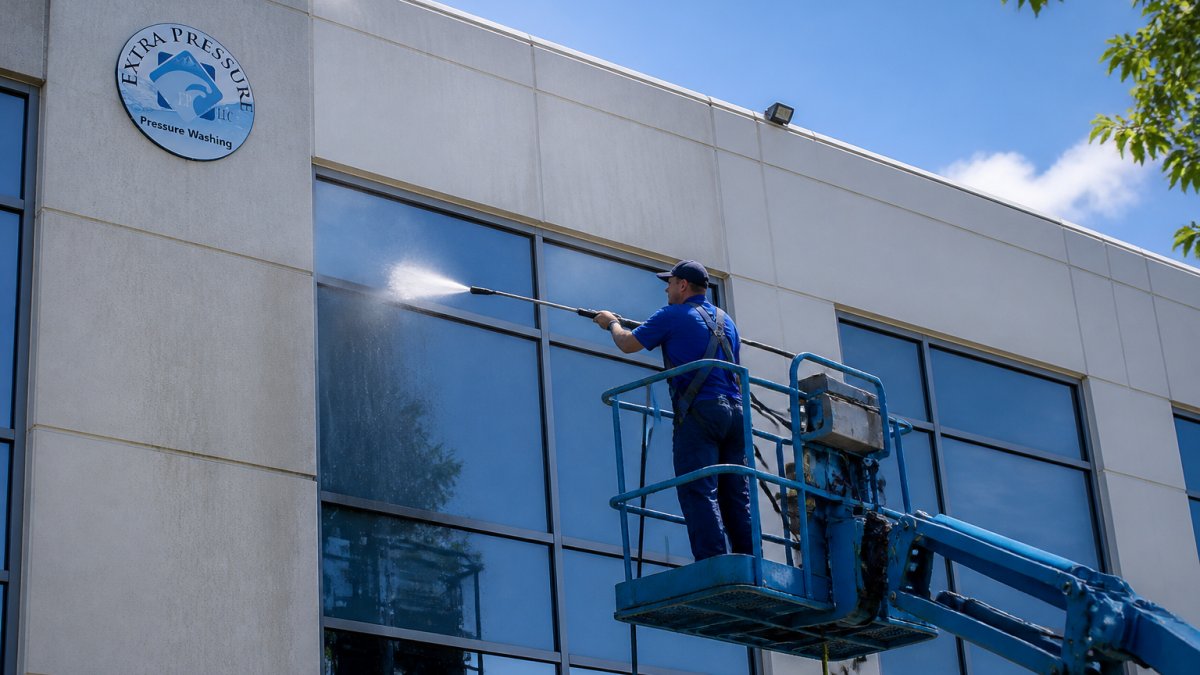
- Scissor lifts: mid-rise facades with firm, level ground. Best for flat surfaces directly in front of the platform; not for reaching over obstacles.
- Boom lifts (articulating or telescoping): mid- to high-rise work where the platform must reach over landscaping, setbacks, or entries.
Match the lift to the terrain. A scissor lift on soft ground is a tipping hazard, not a shortcut. Check ground-bearing capacity, slope, and overhead obstructions before the equipment arrives.
Weather and Site Go/No-Go Criteria
Set written limits before the first day, and give the crew authority to stop work when they are crossed:
- Wind: most lift manufacturers publish a maximum wind speed for operation; suspended platforms and pole work have their own limits. Gusts matter more than averages.
- Rain and active precipitation: washing in rain wastes chemical and can spread runoff past containment; lightning is an automatic stop.
- Temperature: below freezing, water freezes on the facade and on walkways; above roughly 85-90°F, cleaning solutions can dry before they dwell, and heat stress rises for the crew.
Runoff and Wastewater Control
Wash water carries dirt, detergent, and biological matter. In most jurisdictions it is classified as process wastewater or an illicit discharge if it reaches a storm drain, and storm drains typically discharge untreated to local waterways.
Control it with:
- Berms and containment mats at drain inlets, plus temporary covers over storm-drain grates in the work zone
- Vacuum recovery or wet-vac pickup for large volumes, especially on impervious surfaces
- Detergent selection that meets the discharge rules that apply to your site, some products are formulated for recovery, others for sanitary-sewer discharge only
Check your local stormwater rules and any state or municipal pretreatment requirements before the job. Fines for illegal discharge usually dwarf the cost of containment, and many commercial properties also carry tenant or lender requirements that prohibit uncontained wash water.
Photograph the containment setup and the drain protection before washing starts. It documents compliance and gives the property manager a record for their own environmental file.
Commercial Building Exterior Cleaning Cost and Scheduling
Commercial building exterior cleaning cost depends on square footage, height, material, access method, and how much biological growth has built up.
Pricing also shifts with frequency. Recurring preventive maintenance costs less per visit than a one-time deep clean, because growth never gets a foothold.
Watch out: the cheapest bid usually skips containment, testing, or insurance. That gap shows up later as damaged siding or a cleanup bill.
For a real number on your building, request a free commercial pressure washing estimate so you can budget and schedule before the work starts.
Inspect the Work and Set a Cleaning Frequency
Inspect the facade immediately after cleaning and again at 30 days. Look for missed streaks, new cracks, and any growth returning.
Set frequency by exposure, not habit:
- Annual: sheltered facades in low-pollen areas
- Twice yearly: shaded north walls and heavy tree cover
- Quarterly: humid climates and buildings near water
The mold question is the one we hear most. Growth returns when the underlying moisture source stays. Fix the drainage and shade problem, and the callbacks stop.
Book a Safe Commercial Facade Cleaning Assessment
Safety on a commercial facade comes down to sequence: assess, test, match the method, control access and runoff, then inspect.
That is exactly how we run commercial work at Extra Pressure LLC. We are licensed and insured, we use specialized soft washing for delicate surfaces, and we provide same-day estimates.
See our commercial exterior cleaning services to scope your building, then schedule your appointment and get a plan built around your facade.
Frequently Asked Questions
What is the safest method for cleaning a commercial building facade?
There is no single safest method for every building. A 2026 commercial cleaning guide recommends soft washing below 500 PSI for most commercial facades, while pressure washing is reserved for durable stone, brick, and concrete. The safe choice depends on the substrate, its condition, and the soil type. Test a small area first, confirm the material tolerates the method, and use the lowest pressure that removes the dirt without damaging the surface.
What are the OSHA requirements for facade cleaning safety?
OSHA facade cleaning safety standards require fall protection for workers on elevated surfaces, trained operators for aerial lifts and rigging, and hazard communication for cleaning chemicals. Employers must provide personal protective equipment, inspect access equipment before use, and follow lockout and rigging rules where applicable. Workers should never lean out of lifts or use improvised anchors. Confirm training records and insurance before any crew starts work on your building.
Can soft washing be used on all commercial building materials?
Soft washing works on most commercial facades, including brick, masonry, stucco, painted surfaces, and metal cladding, because it relies on low pressure and detergent rather than force. It is not right for every surface: some stone and historic facades need gentler detergents, steam, or laser cleaning. Always run a small test patch, check the detergent against the substrate, and confirm the method with a specialist before treating an entire elevation.
How does commercial building exterior cleaning cost get calculated?
Commercial building exterior cleaning cost depends on square footage, height and access method, facade material, soil level, and how often the building is cleaned. High-rise work with lifts or rigging costs more than a low storefront. Runoff control and after-hours scheduling also affect the quote. Ask for a written scope that lists the method, access equipment, and number of visits. Pricing varies by project, so request a same-day estimate for your property.
