
Last Updated: November 5, 2026
Quick Summary
The best biodegradable cleaners for outdoor landscaping are those that list their ingredients, state a clear dilution ratio, and give directions for plant contact and runoff. The word “biodegradable” has no strict regulatory definition for cleaning products, so it should not be used alone to compare options. Match a mild cleaner to light jobs like patios, and protect nearby plants with wetting and careful rinsing when using stronger products.
- The term biodegradable has no strict regulatory definition for cleaning products, so look for an official biodegradability designation.
- Choose a cleaner by matching its strength to the job, since stronger products are more likely to affect nearby vegetation.
- Wet the plants beside a patio with a garden hose before cleaning so any accidental contact is diluted.
- Rinse runoff toward the lawn or a gravel edge rather than across shrubs, and rinse until no soap film remains.
- For delicate surfaces, a soft-washing approach with low pressure and a detergent solution is often the safer choice.
Table of Contents
- Why “Biodegradable” Alone Doesn’t Tell You Much
- What to Look for in a Biodegradable Cleaner for Outdoor Landscaping
- Comparing Common Types of Biodegradable Outdoor Cleaners
- How to Clean a Patio Without Harming Plants
- Choosing an Eco-Friendly Patio Cleaner and Plant-Safe Outdoor Cleaner
- Using a Biodegradable Pressure-Washing Detergent Safely Around Plants
- Planning Your Next Outdoor Cleaning Project
- Frequently Asked Questions
Choosing a biodegradable cleaners option for outdoor landscaping starts with knowing what that label does and does not promise. Many products on the shelf carry the word “biodegradable,” but the term has no strict regulatory definition for cleaning products, so it cannot be used alone to compare options. For homeowners in Fannin, Union, Gilmer, Pickens, Murray, Polk, Bradley, and Cherokee counties, the practical question is which cleaner will remove grime from siding, patios, and walkways without damaging the plants beside them. The guidance below reflects what matters most when you are choosing a product for your own yard.
Why “Biodegradable” Alone Doesn’t Tell You Much
The word “biodegradable” is one of the most common claims on cleaning labels, and one of the least standardized. There are no strict regulations defining what qualifies as biodegradable in cleaning products, so shoppers should look for an official biodegradability designation rather than relying on the marketing word itself.
Treat these claims as a starting point. A product can break down over time and still be harsh on plants if it is used at high concentration or sprayed onto foliage. The useful comparison is between ingredient lists, dilution instructions, and how the product performs on the surface you actually need to clean.
What to Look for in a Biodegradable Cleaner for Outdoor Landscaping
Start by reading the full ingredient list and dilution directions. Look for a product that states its surfactant base and recommended dilution clearly, and avoid anything that claims to be safe for all uses without explaining how to apply it. Check whether the manufacturer provides guidance on plant contact, runoff, and rinsing.
Next, match the cleaner to the job. A light soap-based solution may be enough for patio furniture or outdoor grills, while a heavy mold or algae stain on concrete may call for a stronger detergent. Stronger products are more likely to affect nearby vegetation, so the more aggressive the cleaner, the more carefully you should protect the landscaping around it.
Finally, consider how you will apply it. Hand application with a bucket and soft brush gives you the most control. Pressure-washing detergents are formulated differently from other biodegradable cleaners and should be used with the same caution around plants, as discussed later .
Comparing Common Types of Biodegradable Outdoor Cleaners
Outdoor cleaners generally fall into a few categories, and each suits different tasks. Plant-based soap concentrates are gentle and versatile, which makes them a reasonable choice for general patio and deck cleaning. They usually need more dilution and more scrubbing, so they are not always the fastest option for heavy grime.
Enzyme-based cleaners work on organic buildup such as grease and food residue, using biological action rather than harsh chemistry. They tend to be slower-acting and work best when given time to sit on the surface. Oxygen-based or mild oxidizing cleaners can lift organic stains and mildew, but they need careful rinsing to keep residue away from plant roots and foliage.
For a clearer side-by-side view, the table below summarizes the trade-offs:
| Cleaner Type | Best For | Typical Strength | Plant-Safety Considerations |
|---|---|---|---|
| Plant-based soap concentrate | Patios, decks, outdoor furniture | Mild to moderate | Dilute well; rinse foliage |
| Enzyme-based cleaner | Grease, food residue, organic buildup | Mild, slow-acting | Low harshness; allow dwell time |
| Oxygen-based cleaner | Mildew, algae, organic stains | Moderate | Rinse thoroughly; avoid runoff onto beds |
| Biodegradable pressure-washing detergent | Siding, concrete, large flat surfaces | Moderate to strong | Pre-wet and protect plants; check dilution |
Pros and cons by type:
- Plant-based soap concentrate. Pros: gentle, versatile, easy to dilute. Cons: slower on heavy stains, more scrubbing required.
- Enzyme-based cleaner. Pros: effective on organic buildup, low harshness. Cons: needs dwell time, less effective on mineral stains.
- Oxygen-based cleaner. Pros: lifts mildew and algae well. Cons: must be rinsed carefully to avoid plant contact.
- Pressure-washing detergent. Pros: fast coverage on large areas. Cons: stronger formulation, greater risk to nearby plants if misapplied.
How to Clean a Patio Without Harming Plants
Protecting plants is mostly about controlling where the cleaner goes. Before you start, wet the plants next to the patio with a garden hose. Wet foliage dilutes any cleaner that lands on it and makes accidental contact less damaging.
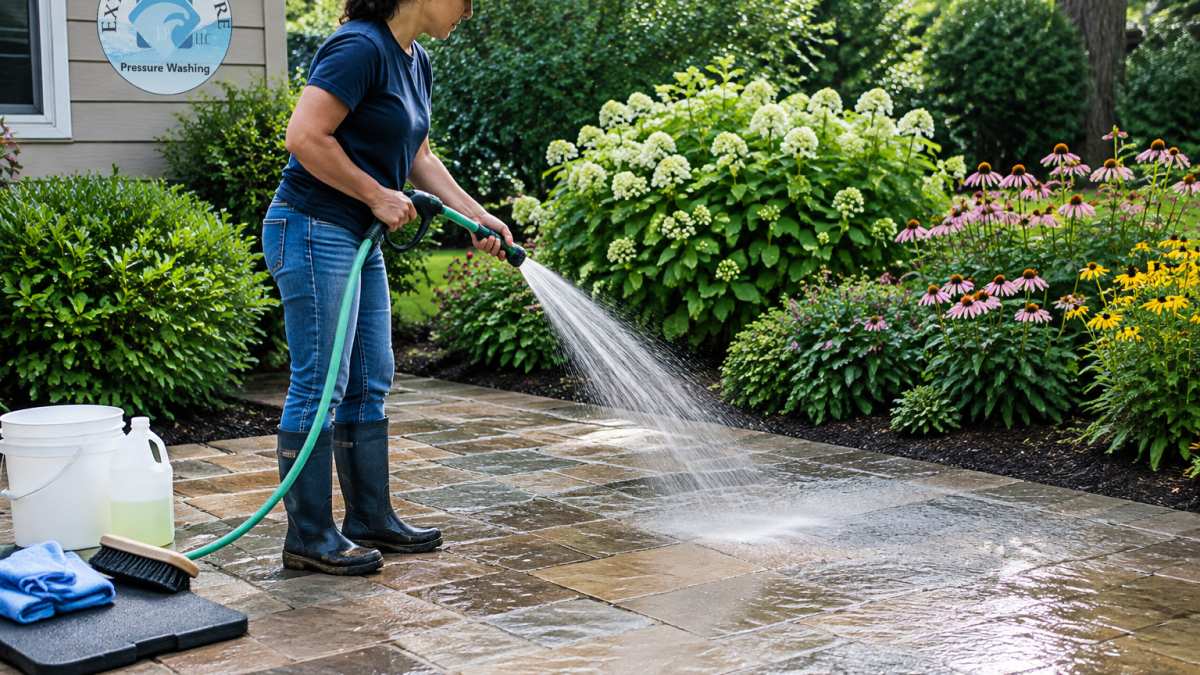
Next, sweep the patio to remove loose debris, then apply your diluted cleaner with a soft-bristle brush or a pump sprayer, working in small sections. Scrub gently, let the solution sit for the time the label recommends, and rinse away from garden beds, moving the water toward the lawn or a gravel edge rather than across shrubs. Rinse until no soap film or foam remains, since residue left behind can attract dirt and affect nearby soil.
Many homeowners find that a lower-strength cleaner used with more scrubbing gives better plant protection than a stronger product sprayed quickly.
Choosing an Eco-Friendly Patio Cleaner and Plant-Safe Outdoor Cleaner
When you are looking for an eco-friendly patio cleaner, the most useful signals are transparency and clear directions. A product that lists its ingredients, explains its dilution ratio, and says how to handle runoff is more trustworthy than one that relies on broad green claims. Be cautious with products that advertise “natural” or “non-toxic” without supporting detail, since these terms are not standardized either.
A plant-safe outdoor cleaner should be one you can use at the recommended dilution without rinsing it onto foliage. If a label does not address plant contact, assume it needs to be kept away from beds and test it on a small area first. Some homeowners also prefer to avoid cleaners that leave residue, because residue can build up on soil and surfaces over repeated use.
Keep in mind that a cleaner’s environmental profile depends on how much you use and where the rinse water goes. Using less product, diluting correctly, and directing runoff to lawn areas usually matters more than any single label claim.
Using a Biodegradable Pressure-Washing Detergent Safely Around Plants
Pressure-washing detergents are designed for large, flat surfaces such as siding, concrete, and driveways, and they are often stronger than hand-cleaning products. Before using one near landscaping, read the label’s dilution and application instructions, and confirm whether the product is approved for use around plants.
Protect the landscaping first. Pre-wet surrounding plants, cover sensitive shrubs with plastic sheeting where practical, and keep the spray pattern low and angled away from foliage. Apply the detergent from the bottom of the surface upward where possible, then rinse from the top down so that residue runs away from plant beds. Work in sections, and rinse each one before moving on.
Pressure can also damage delicate surfaces, so use the lowest setting that removes the grime and test a small area first. For siding, roofing, or older surfaces, a soft-washing approach that uses low pressure and a detergent solution is often the safer choice. Extra Pressure LLC. offers soft washing for delicate surfaces.
Planning Your Next Outdoor Cleaning Project
Before starting, walk the property and note which surfaces need cleaning, which plants are close by, and how water will drain. Group the work by surface type so you can use one cleaner for each job rather than switching products mid-project. Test any new product on a hidden area, and keep the label instructions on hand.
Timing also matters. Cleaning in mild weather, away from strong winds and heavy rain, reduces the chance of runoff and overspray. If you are preparing a home for sale or simply refreshing your curb appeal, plan the sequence so that the most visible surfaces are finished last, when your plants and rinse water are no longer a concern. You can also browse budget curb appeal projects that actually work to pair with the cleaning.
If the project involves large areas, multiple surface types, or plants you cannot easily protect, a professional crew may be the more practical option. Extra Pressure LLC. provides same-day estimates for residential and commercial exterior cleaning, and you can schedule an appointment to discuss the right approach for your property.
Frequently Asked Questions
Are biodegradable cleaners safe for plants and landscaping?
Biodegradable cleaners are generally gentler on plants than harsh chemical cleaners, but the label alone does not guarantee safety. Plants can still be damaged by high concentrations, long dwell times, or heavy runoff onto soil and roots. Check the product’s directions for plant safety, dilute it as instructed, and rinse nearby beds with clean water after cleaning. Testing a small hidden area first is also a practical step before treating a full patio or walkway.
What should I look for in an outdoor cleaner labeled biodegradable?
Look beyond the word biodegradable. Check the ingredient list for clear descriptions of surfactants, avoid products that list vague terms only, and look for any official biodegradability designation on the packaging. Read the directions for dilution rates and plant-safety notes. Because there are no strict rules defining biodegradable for cleaning products, comparing labels and directions is the most reliable way to choose a cleaner for outdoor use.
Can biodegradable cleaners remove algae and mildew from patios?
Many biodegradable outdoor cleaners can loosen algae, mildew, and light grime, especially when given time to work before rinsing. Heavy staining or thick growth may need repeated applications or a stronger treatment. Use the product as directed, scrub gently, and rinse thoroughly so residue does not sit on surfaces or soil. If results are poor, ask your provider or check the product for stronger formulas designed for organic growth.
How do you clean outdoor surfaces without harming nearby plants?
Wet the plants with clean water before and after cleaning to dilute any product that lands on foliage. Cover delicate plants with a tarp or drop cloth, avoid spraying directly at shrubs, and work from the surface toward the lawn so runoff stays on the hard surface. Keep dilution at or below label directions, and rinse soil and leaves with plain water when finished.
