Last Updated: November 6, 2026
Quick Summary
Soft washing can be safe for asphalt shingles when done correctly, because it uses a chemical solution and low pressure rather than force. Pressure washing is generally discouraged on shingle roofs since it can strip protective granules. Roof condition and the manufacturer’s guidance and warranty terms should be checked before any cleaning.
- Pressure washing is generally discouraged on shingle roofs because it can strip protective granules.
- Soft washing uses a chemical solution applied to the surface, then a gentle low-pressure rinse.
- Keep the surface wet during dwell time, which is typically measured in minutes, not hours.
- Avoid soft washing brittle, cracked, or curling shingles, or roofs with granules in the gutters.
- Check shingle manufacturer guidance and warranty terms before cleaning, since some exclude improper cleaning damage.
Table of Contents
- What Soft Washing Is and How It Differs from Pressure Washing
- How Soft Washing Works on Asphalt Shingles
- Soft Wash Roof Cleaning Chemicals: What Is Used and Why
- When Soft Washing Can Damage a Roof
- Shingle Manufacturer Guidance, Warranties, and Roof Condition
- Soft Wash Roof Cleaning Equipment and Cost Factors
- Pros and Cons of Soft Washing Your Shingle Roof
- Booking a Safe Roof Cleaning for Your Home
- Frequently Asked Questions
What Soft Washing Is and How It Differs from Pressure Washing
Soft washing is a low-pressure cleaning method that uses a chemical solution rather than force to remove dirt, algae, moss, and lichen. Pressure washing relies on high-pressure water to blast surfaces clean. For asphalt shingles, that difference matters a great deal.
Pressure washing is generally discouraged on shingle roofs. Shingles have a protective granule coating, and high-pressure water can strip those granules away and shorten the roof’s life.
How Soft Washing Works on Asphalt Shingles
On a roof, soft washing starts with the cleaning solution, not the spray. The solution is applied to the surface and given time to work on organic growth before a gentle rinse removes it. For a look at how the same soft-wash approach is applied and assessed on another exterior surface, see how soft washing handles vinyl siding.
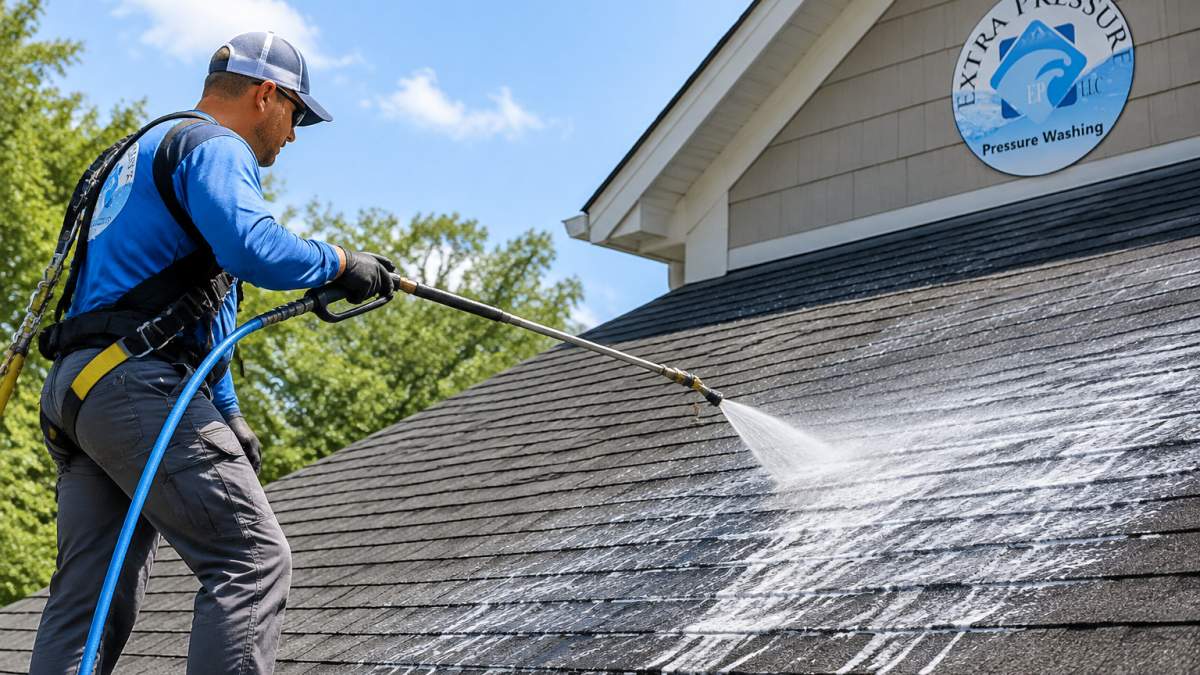
A common approach uses a diluted sodium hypochlorite mixture with a surfactant. Confirm the right mix for your roof before work begins.
The process generally looks like this:
- Inspect the roof for loose shingles, cracks, and worn areas
- Wet nearby plants and surfaces to protect them
- Apply the solution from the bottom up
- Allow dwell time for the solution to kill growth at the root
- Rinse gently with low water pressure
Watch out: rinsing too hard undoes the careful work of the solution and can still damage granules.
Soft Wash Roof Cleaning Chemicals: What Is Used and Why
Soft wash roof cleaning chemicals are chosen to kill organic growth at the root without harming the shingle surface. The two active components in most roof mixes are sodium hypochlorite, which oxidizes algae, moss, and lichen, and a surfactant, which helps the solution cling to sloped shingles instead of running off before it works.
Sodium hypochlorite is the same active ingredient found in household bleach, but roof mixes are diluted for exterior use. Treat any mixing guidance as a starting point, not a universal recipe: shingle age, growth severity, ambient temperature, and sun exposure all change how a mix behaves.
Concentration, Dwell Time, and Application
Concentration and dwell time decide whether the cleaning works without harm.
A few mechanics matter more than the exact ratio:
- Mix for the surface, not the stain. A roof with light algae film needs a weaker mix than one with established moss. Start weak and increase only if the first pass underperforms.
- Apply from the bottom up. Working upward prevents streaking and keeps fresh solution from running over areas that have already been treated.
- Keep the surface wet during dwell time. Dwell time is the period the solution sits on the roof before rinsing, and it is typically measured in minutes, not hours. Solution that dries on the shingle stops working and can leave residue.
- Rinse gently and completely. Low pressure is enough to carry away dead growth and spent solution. Rinsing too hard undoes the careful work of the solution and can still damage granules.
- Work in manageable sections. Treating a small area, letting it dwell, and rinsing before moving on gives more consistent results than coating the whole roof at once.
Watch out: letting solution dry on the roof is one of the most common causes of streaking and uneven results, and it is more likely on hot, sunny afternoons, so many crews prefer overcast conditions or early-morning work.
Follow the guidance from your cleaning provider or the product label for exact mixing ratios. If a provider cannot explain the concentration, dwell time, and rinse plan in plain terms, that is a reason to keep looking.
Protecting Plants, Property, and Runoff
Roof cleaning solutions run off into gutters, lawns, and gardens, and sodium hypochlorite is not harmless to landscaping at full strength. You can review the safe chemical practices used for exterior house cleaning to see how plants and runoff are handled.
Cover or wet landscaping before you start, and keep the runoff away from plants you care about.
Keep the area clear of pets and people while the solution works.
The article breaks down the key factors that decide whether a soft wash cleaning works without harm.
| Factor | What to do | Why it matters |
|---|---|---|
| Concentration | Mix for the surface, not the stain | A weak mix avoids bleaching and extra chemical load |
| Application | Apply from the bottom up | Prevents streaking and runoff over treated areas |
| Dwell time | Keep surface wet, typically minutes | Solution that dries stops working and leaves residue |
| Rinsing | Rinse gently and completely | Excess pressure can still strip granules |
| Work area | Treat in manageable sections | Gives more consistent results than coating the whole roof |
When Soft Washing Can Damage a Roof
Soft washing is not automatically harmless.
The label “soft wash” alone does not guarantee safety. Risk depends on the method and on the roof’s wear.
Avoid soft washing when:
- The shingles are brittle, cracked, or curling
- Granules are already visible in the gutters
- The roof is very old or has known leaks
- The method or provider cannot explain its process clearly
Shingle Manufacturer Guidance, Warranties, and Roof Condition
Before cleaning, check your shingle manufacturer’s guidance and your warranty terms. This is the step most homeowners skip, and it is the one that decides whether a cleaning protects your roof or puts your coverage at risk.
How to Check Manufacturer Guidance and Warranty Terms
Start with the shingle wrapper, the paperwork from your roofer, or the manufacturer’s website. Most major shingle makers publish care and maintenance guidance, and many publish warranty documents that list exclusions. Look for language about pressure washing, chemical cleaning, and damage from improper maintenance.
A common pattern in shingle warranties is to exclude damage caused by improper cleaning or by methods the manufacturer does not recommend, while still covering manufacturing defects.
Keep a record of the cleaning, the method used, the provider, and the date. That record can matter if you later file a warranty claim, and it is much easier to assemble before the work than after.
Roof Condition Checks Before You Clean
Roof condition is the other key factor. A healthy roof handles gentle cleaning far better than one that is already worn, and some roofs should not be washed at all until they are inspected or repaired.
Walk the property and look for these signs before booking:
- Granule loss. Piles of granules at downspout outlets or in gutters mean the shingle surface is already shedding its protective coating.
- Curling, cracking, or brittle shingles. These are signs the asphalt has aged past the point where gentle cleaning is low-risk.
- Soft spots or sagging. A spongy deck or a visible dip suggests moisture damage underneath, which cleaning will not fix.
- Active leaks or interior stains. Water stains on ceilings or attic sheathing mean the roof needs repair before it needs cleaning.
- Heavy moss with raised growth. Thick moss holds moisture against the shingle and often hides damage; it may need removal and inspection rather than a wash.
If your roof is near the end of its life, a cleaning may not be worth the risk. In that case, an inspection from a qualified roofer is a better first call than a cleaning crew.
What to Expect After Treatment
Dead algae and moss do not always disappear the day the crew leaves. Treated growth often dries, fades, and weathers away over the following weeks as rain and sun finish the job. That is normal, and it is one reason aggressive rinsing is a mistake: it can strip granules without speeding up the result.
Assess results after a few weeks rather than the same afternoon. If growth is still visible after that window, ask the provider whether a second, gentler pass is appropriate rather than reaching for a stronger mix or higher pressure.
Soft Wash Roof Cleaning Equipment and Cost Factors
Soft washing uses a low-pressure pump, a solution tank, and a wand designed for gentle application. Equipment quality and the crew’s experience both affect results. You can review the soft washing services and exterior cleaning offered in Georgia to see what is included.
Cost depends on the roof’s size, its pitch, the amount of growth, and the access it requires. Pricing varies widely by provider, so request written estimates that explain what is included. For current pricing and a quote on your home, contact Extra Pressure LLC. directly.
Pros and Cons of Soft Washing Your Shingle Roof
Soft washing has real advantages and real limits. Weigh both before you book. For a deeper cost-benefit breakdown, read the homeowner’s guide on whether roof cleaning is worth the cost.
Pros:
- Removes algae, moss, and lichen at the root
- Uses low pressure, which is gentler on shingle granules
- Can extend the visual life of a roof’s appearance
- Often costs less than repairs caused by pressure damage
Cons:
- Chemicals require careful handling and runoff control
- Results depend heavily on the provider’s skill
- Not every roof is a good candidate
- Growth may return without a prevention plan
Soft washing works best on a sound roof cleaned by an experienced crew. It is a poor choice for a worn roof cleaned with a high-pressure shortcut.
Booking a Safe Roof Cleaning for Your Home
If you are considering a roof cleaning, start by asking the right questions. If you are in the area, you can find a roof cleaning service in Fannin County, GA and compare local options. Ask what method the crew uses, what solution they apply, how they protect plants, and what the manufacturer’s guidance says about your shingles.
Extra Pressure LLC. offers licensed and insured soft washing for delicate surfaces, with same-day estimates for homes in the service area. Our team uses state-of-the-art equipment to remove stains, mold, and grime without harm. Contact us to schedule an appointment and get a clear plan for your roof.
Frequently Asked Questions
Is it safe to soft wash a shingle roof?
Soft washing is generally considered suitable for asphalt shingles when it is done at low pressure with an appropriate cleaning solution. Sources that discuss the method describe pressure below 500 PSI as the typical range, though that figure comes from practitioner guidance rather than an official standard. Safety depends on technique, the condition of the roof, and whether the shingles are already worn. Older or brittle shingles carry more risk, so an inspection before cleaning is a sensible first step. Shingle manufacturers’ guidance and warranty terms should also be checked before any treatment.
Can soft washing strip granules from asphalt shingles?
Soft washing is intended to avoid granule loss, which is one of the main reasons it is preferred over pressure washing. Pressure washing can strip the protective granule coating and expose the asphalt beneath, shortening the roof’s life. Some providers warn that improper technique, excessive pressure, or aged shingles can still cause granule loss even with a soft wash. Asking the cleaner how they control pressure and solution strength is a good way to reduce that risk.
What chemicals are used to soft wash a roof?
Soft washing roofs typically uses a diluted solution containing sodium hypochlorite, often with a surfactant that helps the mixture cling to the surface. The solution kills algae, moss, and lichen growth over time rather than blasting it away. Because chemical strength and dwell time affect both results and risk to plants and surfaces, homeowners should ask a cleaner to explain the mixture before work begins.
How much does it cost to soft wash a roof?
Pricing depends on the size and pitch of the roof, the amount of growth to be treated, access, and the chemicals and equipment required. Extra Pressure LLC. provides same-day estimates, so the most accurate figure comes from a quote for your specific home. Contact us through our website to schedule an estimate and get current pricing for your roof.
