
Last Updated: November 26, 2026
Quick Summary
A seasonal gutter maintenance checklist covers the cleaning and inspection tasks your gutters need in spring, fall, and winter, plus the tools and safety steps that make the work possible. Most homes need gutters cleaned at least twice a year, timed around leaf drop and spring seed fall, with extra checks in between.
- Clean gutters after leaf drop, between late October and mid-November, or December in the South.
- A second pass in May or early June clears maple helicopters, oak catkins, and pine pollen.
- Have a professional check slope, hangers, and seams every 3 to 5 years.
- Most manufacturers call for hangers every 24 to 36 inches on center.
- Never chip ice out of a gutter with a tool; use a roof rake from the ground.
Table of Contents
- What does a seasonal gutter maintenance checklist cover?
- Gutter cleaning schedule by season
- Gutter inspection checklist
- DIY gutter cleaning tools
- Professional gutter cleaning cost
- Book Your Seasonal Gutter Cleaning
- Frequently Asked Questions
What does a seasonal gutter maintenance checklist cover?
A seasonal gutter maintenance checklist covers the cleaning and inspection tasks your gutters need in spring, fall, and winter, plus the tools and safety steps that make the work possible.
Gutters protect your roof, siding, and foundation. When they clog, water backs up and finds the path of least resistance, which is usually your fascia boards or basement.
Here is the short version of what a full checklist includes:
- Clearing leaves, twigs, and debris from gutters and downspouts
- Checking water flow and drainage away from the house
- Inspecting for leaks, cracks, and loose fasteners
- Checking gutter slope and alignment
Below, we’ll walk through each season and give you a printable-style system you can track year after year.
Gutter cleaning schedule by season
Most homes need gutters cleaned at least twice a year, with extra checks in between. Regional maintenance guidance recommends cleaning gutters twice yearly, timed around leaf drop and spring seed fall, according to USA Superior’s exterior home maintenance checklist.
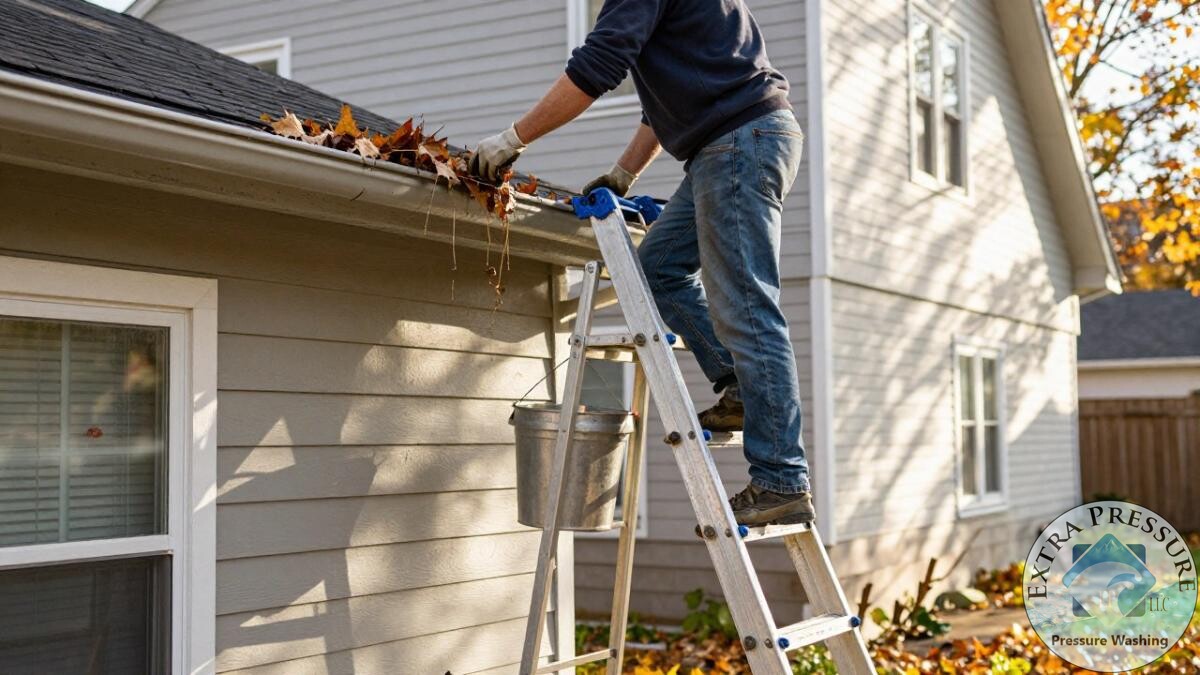
That twice-a-year baseline is a starting point, not a rule. The right schedule depends on what falls on your roof, how much rain or snow your area gets, and how close your gutters sit to trees.
Use these triggers to set your own calendar:
- After leaf drop: clean once the majority of leaves are down, not before. In most of the country that lands between late October and mid-November; in the South it can stretch into December.
- After spring seed fall: maple helicopters, oak catkins, and pine pollen collect in late spring and clog downspout openings. A second pass in May or early June clears them.
- Before the first hard freeze: a clean, dry gutter cannot form an ice dam as easily as a gutter packed with wet leaves.
- After any severe storm: wind-driven grit, shingle granules, and twigs land in the channel and should be flushed out.
- Every 3 to 5 years: have a professional check slope, hangers, and seams, even if the gutters look clean.
Spring: clear the winter debris
Spring cleaning removes what winter left behind. Snow, ice, and wind push grit, shingle granules, and twigs into the gutter channel, and freeze-thaw cycles open hairline cracks that were not there in the fall.
Do these tasks in spring:
- Scoop out debris by hand or with a gutter scoop
- Flush the gutters with a hose
- Check that water exits the downspouts freely
- Look for cracks that opened during freeze-thaw cycles
- Re-seat any downspout section that pulled apart under ice load
Late spring is also when maple seeds and pollen collect, so a second pass helps. In colder climates, wait until the last frost has passed and the roof is dry; walking a wet roof in early spring is a leading cause of falls.
Summer: the inspection season
Summer is less about debris and more about condition. Heat can expand aluminum and vinyl, which may loosen fasteners and open seams, so summer is a good time to check slope, hangers, and downspout extensions while the roof is dry.
Summer tasks:
- Check hanger spacing; most manufacturers call for hangers every 24 to 36 inches on center
- Confirm gutters pitch toward the downspouts
- Make sure downspout extensions discharge well away from the foundation
- Look for moss or algae growth, which signals standing water
Fall: the cleaning that matters most
Fall is the cleaning that matters most. Leaves drop fast, and one clogged stretch can send water under your shingles.
Time your fall cleaning for late fall, after most leaves have fallen.
Fall tasks:
- Remove leaves, twigs, and roof grit
- Clear downspout openings
- Check gutter hangers for sag
- Confirm downspouts direct water away from the foundation
- Trim overhanging branches so they do not drop directly into the channel
Winter: ice dams and freeze damage
Winter is when small problems become expensive ones. For the full prevention playbook, see the winter section below and 7 Ways to Prevent Ice Dams in Gutters Before Winter.
A practical winter routine is mostly observation, not ladder work:
- After a snow, look at the roofline. Uneven snowmelt or a band of bare shingles above the gutter often means heat is escaping and refreezing at the eave.
- Watch for icicles hanging from the roofline. They often mean water is backing up behind ice dams.
- Check the ground below downspouts after a thaw. Water dumping straight down instead of away from the house is a sign the extension is buried or disconnected.
- Keep the attic insulated and ventilated so the roof deck stays cold and snow melts evenly.
Watch out: Never chip ice out of a gutter with a tool. You can crack the gutter, tear the hangers off, or damage the roof edge.
Here are the seasonal triggers the article recommends for timing gutter cleaning.
| Trigger | When | Note |
|---|---|---|
| After leaf drop | Late October to mid-November; December in the South | Clean once most leaves are down |
| After spring seed fall | May or early June | Clears maple helicopters, oak catkins, pine pollen |
| Before first hard freeze | Before hard freeze | Clean, dry gutter resists ice dams |
| After severe storm | After any severe storm | Flush out grit, shingle granules, twigs |
| Professional structural check | Every 3 to 5 years | Checks slope, hangers, seams |
| Baseline cleaning frequency | At least twice a year | Extra checks in between |
Gutter inspection checklist
A gutter inspection checklist is a set of visual and hands-on checks that catch damage before it spreads to the roof, siding, or foundation. Run it twice a year, right after each cleaning.
Checking for clogs and proper drainage
Clogs show up as overflow, sagging, or water stains on siding. Test drainage by running a hose into the gutter at the high end and watching where the water lands.
Signs of a clog or drainage problem:
- Water spilling over the gutter edge
- Downspouts that trickle instead of flow
- Pools forming near the foundation
- Staining or mildew on siding below the gutter line
If water is pooling near your foundation, gutter care matters more than most homeowners realize. Our guide on how to prevent basement flooding with gutter care explains the connection. And if a downspout is already clogged, 7 ways to clear downspout clogs effectively walks you through it step by step.
Leaks, cracks, slope, and fasteners
Leaks start small. A pinhole in a seam becomes a rotten fascia board over a season or two.
Check these points:
- Seams and corners: look for drips and rust streaks
- Cracks: hairline cracks widen with freeze-thaw cycles
- Slope: gutters should pitch slightly toward the downspouts
- Fasteners: loose hangers let gutters sag and hold water
- Downspout extensions: make sure they carry water at least a few feet from the foundation
For a full structural walkthrough, read how to inspect gutters for structural damage.
DIY gutter cleaning tools
DIY gutter cleaning tools are the basic, safe items a homeowner needs to clear light debris from a one-story or low roofline.
A basic homeowner kit includes:
- Sturdy step or extension ladder rated for your weight
- Gutter scoop or a small plastic trowel
- Heavy work gloves
- Bucket with a hook to hang on the ladder
- Garden hose with a spray nozzle
Our guide to essential tools for safe gutter maintenance at home covers the full list, including ladder stabilizers.
Watch out: Higher pressure is not better. A pressure washer aimed into a gutter can bend aluminum, strip shingles, and force water behind the siding.
Professional gutter cleaning cost
Professional gutter cleaning cost depends on your home’s height, roofline length, debris volume, and how many stories the crew has to work around. Pricing depends on property details, and current prices are available from Extra Pressure LLC. through a quote.
Extra Pressure LLC. offers same-day estimates. We are licensed and insured, and we assess each property to recommend the safest, most effective method.
When to call a professional:
- Your gutters are on a second story or higher
- Debris is packed and heavy
- You spot sagging, separation, or water damage
- You have ice dams forming
- You want the job done safely and on a recurring schedule
Book Your Seasonal Gutter Cleaning
Clogged gutters are one of the cheapest exterior problems to prevent and one of the most expensive to ignore.
Extra Pressure LLC. handles gutter maintenance alongside pressure washing, soft washing, and window cleaning. We are licensed and insured, and we offer same-day estimates.
Get started with Extra Pressure LLC. and keep your gutters flowing and your home protected all year.
Frequently Asked Questions
How often should homeowners clean their gutters?
Twice a year is the baseline, and published maintenance checklists for homeowners recommend cleaning gutters at least twice yearly. In practice, your nearby trees decide the real frequency: homes under pines, oaks, or maples may need quarterly cleaning, and some properties need monthly checks during heavy leaf drop. Between cleanings, look at the gutters after storms. If water spills over the edge or downspouts stop flowing, debris has built up and the gutter maintenance schedule needs tightening.
What should I check during a gutter inspection?
Run through this sequence: clogs in the channel and downspouts, water flow at the outlet, leaks and cracks along seams, corrosion, sagging gutters, loose fasteners, and gutter slope so water drains toward the downspouts. Confirm downspout extensions carry water several feet from the foundation and check siding and fascia for stains or algae growth that signal overflow. Note every problem and the date, so you can track whether a repair keeps recurring.
When should I call a professional for gutter maintenance?
Call a professional when the work involves heights you are not comfortable with, a roof steeper than you can safely walk, or gutters that are sagging, pulling loose, or leaking at multiple seams. Recurring mold and algae on gutters and fascia is another signal to ask a professional about options. Licensed and insured providers also carry the liability coverage that protects you if something goes wrong on the ladder.
How much should gutter cleaning cost on a 1,500-square-foot house?
Professional gutter cleaning cost depends on the home’s height and roofline, the length of the gutter run, how much debris has built up, and whether downspouts need clearing. Extra Pressure LLC. provides same-day estimates, so you get a quote for your property.
