
Last Updated: October 22, 2026
Quick Summary
To soft wash stucco without damage, apply a mild cleaning solution at low pressure and let the chemistry do the work, using the lowest pressure that works. First assess your stucco type and condition, then test a small area, allow 10 to 15 minutes of dwell time, and rinse thoroughly from the top down.
- Check the finish first: EIFS is softer and more fragile than traditional cement stucco.
- A common soft-wash mix starts around a 1-to-3 ratio of bleach to water.
- Let the solution dwell roughly 10 to 15 minutes so it can kill organic growth.
- Never let the solution dry on the wall, because dry chemical leaves streaks.
- Most stucco homes need a cleaning every 12 to 24 months.
Table of Contents
- Step 1: Assess Your Stucco Type and Condition Before You Soft Wash
- Step 2: Choose the Right Stucco Cleaning Solution and Dilution
- Step 3: Apply Low Pressure with a Pump Sprayer or Soft-Wash System
- Step 4: How to Remove Mildew from Stucco with Proper Dwell Time
- Step 5: Rinse Thoroughly and Protect Plants, Windows, and Property
- Step 6: How to Clean Stucco Without a Pressure Washer
- Step 7: How Often to Clean Stucco and Inspect After Soft Washing
- Conclusion: Safe Soft Washing for Stucco Homes
- Frequently Asked Questions
Step 1: Assess Your Stucco Type and Condition Before You Soft Wash
Before you soft wash stucco, check what kind of finish you have and how sound it is, since a proper soft wash stucco job starts with that inspection. That five-minute inspection decides your pressure, your chemistry, and whether you should clean the wall at all.
Stucco is a cement-based exterior wall finish applied over a wood or masonry frame, usually in three coats over lath or sheathing. Newer homes often use EIFS, also called Dryvit, which is a synthetic stucco, a thin acrylic finish coat over foam board and mesh. EIFS is softer, thinner, and far more fragile than traditional cement stucco, and it traps water if the finish is breached.
Run this check before any water touches the wall:
- Identify the finish. Traditional cement stucco feels hard and gritty. EIFS feels slightly flexible and sounds hollow when tapped. If you are unsure, treat it as EIFS and use the gentlest method.
- Check the paint or coating. A painted stucco wall can chalk, blister, or peel under bleach and pressure. Look for flaking edges and test a hidden spot before you commit.
- Press a fingernail into a hidden spot. If it dents easily, treat it as a delicate surface and keep pressure at garden-hose level.
- Look for hairline cracks, chips, or hollow-sounding areas. Tap gently with a screwdriver handle; a dull thud can signal delamination.
- Check for water stains or soft spots near windows, the roofline, and penetrations. These suggest water intrusion behind the finish.
- Note the age and type of finish if you know it. Older cement stucco is generally more forgiving than thin-coat EIFS.
Any loose, crumbly, hollow, or actively cracking stucco needs repair first. Water gets behind failing stucco and causes water intrusion, and no cleaning method fixes that. Cleaning a failing wall can turn a cosmetic problem into a rot and mold repair.
This is where most DIY jobs go wrong. People skip the assessment, hit a fragile patch with too much pressure, and chip the finish.
Never clean stucco that is actively cracking or crumbling. Water forced into open cracks can lead to hidden rot and expensive repairs.
If the wall passes the inspection, move to chemistry. If it fails, stop and repair, cleaning comes after the substrate is sound.
Step 2: Choose the Right Stucco Cleaning Solution and Dilution
A mild stucco cleaning solution handles most jobs. For organic growth, a diluted sodium hypochlorite mix is the standard approach, but the strength and contact time matter as much as the chemical itself.
Sources disagree on pressure limits, but they agree on chemistry: keep it gentle. A common soft-wash mix uses a mild sodium hypochlorite solution applied at low pressure, then rinsed away.
Here is a practical starting point for a stucco cleaning solution:
- Mild detergent and water: for light dust, dirt, and surface debris. Use a few ounces of a neutral detergent per gallon of water.
- Diluted sodium hypochlorite: for algae, mildew, and organic staining. Many pros start around a 1-to-3 ratio of bleach to water and adjust from there. A weaker mix with longer dwell time is usually safer than a stronger mix with a short dwell.
- Vinegar or baking soda paste: for small, stubborn stains on test spots only. Never mix vinegar with bleach, it releases chlorine gas.
Always test a small area first. Apply your mix, wait a few minutes, and rinse. If the color holds and the surface stays firm, you are good to continue.
Dilution and dwell-time decision guide:
- Light dust or pollen: detergent and water, 5 minutes dwell, rinse.
- Green or black organic streaks: 1-to-3 bleach mix, 10 to 15 minutes dwell, rinse and re-check.
- Heavy algae or mildew: same mix, second light application rather than a stronger one, 10 to 15 minutes each pass.
- Rust, efflorescence, or paint overspray: do not treat with bleach. These are not organic, and repeated washing can worsen them. Identify the stain first and use a product labeled for that stain.
What most guides miss is compatibility. Strong acids and harsh solvents can etch stucco and stain surrounding trim. Stick to mild solutions and never mix bleach with other cleaners, ammonia, or acids.
Mix only what you need for the day. A diluted bleach solution loses strength over time, and a fresh batch gives you more predictable results.
If a stain does not lift after two gentle passes, stop. Repeated washing can drive residue deeper into porous stucco and make the stain harder to remove.
Step 3: Apply Low Pressure with a Pump Sprayer or Soft-Wash System
Apply your cleaning solution at low pressure, top to bottom, and let the chemistry do the work. Pressure is for rinsing debris, not for blasting the wall.
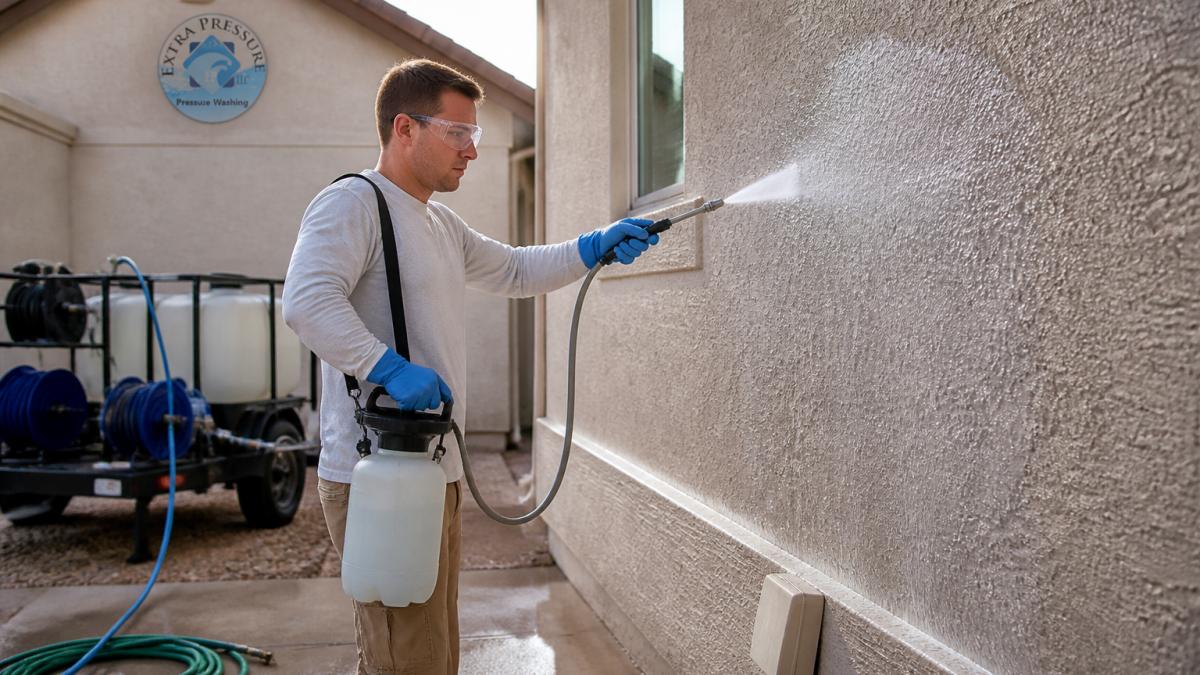
You have two solid options:
- Pump sprayer: cheap, simple, and easy to control on small areas.
- 12-volt soft-wash system: a small pump that pulls from a bucket and delivers a steady low-pressure stream. This is the tool most soft-wash crews use.
Keep the nozzle moving and work in sections you can rinse before the solution dries. Hold the low-pressure tip at a comfortable distance and let the spray fan out.
Pressure guidance varies by source. One retailer recommends staying under 100 PSI at the nozzle for soft washing, while a soft washing stucco guide from DD Home Services describes staying under 300 PSI. Treat both as source-specific advice, not a universal standard.
Step 4: How to Remove Mildew from Stucco with Proper Dwell Time
To remove mildew from stucco, apply your diluted solution and give it dwell time. Let it sit for roughly 10 to 15 minutes so it can kill the organic growth.
Mildew shows up as dark green, gray, or black streaks, usually on the shady side of the house. It feeds on moisture and organic dust on the surface. Killing it takes contact time, not force.
Watch the clock and the weather:
- Do not let the solution dry on the wall. Dry chemical leaves streaks.
- Work in shade or on a cloudy day when you can.
- Re-apply lightly if a section starts to dry before you rinse.
For heavy algae or mildew, a second light application usually beats a stronger mix. Give the first pass time to work, then rinse and check.
This is the part that separates a clean wall from a streaked one. Patience here saves you a callback later.
Step 5: Rinse Thoroughly and Protect Plants, Windows, and Property
Rinse from the top down with low pressure until the water runs clear. Then rinse again, because leftover residue keeps working after you leave.
Protection matters as much as cleaning. Bleach solutions damage plants and can spot glass and metal.
Cover or pre-soak these before you start:
- Shrubs, flower beds, and grass near the wall
- Windows, screens, and light fixtures
- Outdoor furniture, grills, and painted trim
Pre-soak plants with plain water, then rinse them again when you finish. Keep runoff away from storm drains where local rules apply.
A common mistake is skipping the window rinse. Solution dries on glass and leaves a film that is harder to remove than the original dirt. A quick pass with clean water protects the glass and your view.
If windows still look cloudy after rinsing, a professional window washing service can finish the job without scratching the surface.
Step 6: How to Clean Stucco Without a Pressure Washer
You can clean stucco without a pressure washer using a garden hose, a pump sprayer, and a soft brush. For most stucco homes, this is the safer path anyway.
Here is the simple method:
- Wet the wall with a garden hose.
- Apply your mild solution with a pump sprayer.
- Let it dwell for 10 to 15 minutes.
- Scrub light spots with a soft brush on a pole.
- Rinse thoroughly from the top down.
A garden hose delivers a low-pressure rinse that is gentle on stucco and EIFS. The brush does the work on bird droppings and stubborn dirt, not water pressure.
Skip the high-pressure wand entirely. High pressure on stucco can chip the finish, force water behind the wall, and damage window seals. The repair bill always costs more than the cleaning.
The best cleaning method for stucco is low pressure plus the right chemistry. A garden hose and a pump sprayer can handle most stucco homes without any risk of surface damage.
Step 7: How Often to Clean Stucco and Inspect After Soft Washing
Most stucco homes need a cleaning every 12 to 24 months. Homes with heavy shade, trees, or humidity may need it yearly.
How often to clean stucco depends on your conditions. North-facing walls stay damp longer and grow mildew faster. Homes under oak trees collect more organic debris.
After cleaning, do a walk-around inspection:
- Check for new cracks or chips.
- Look for water stains that suggest water intrusion.
- Confirm no solution residue remains on glass or plants.
- Re-caulk any joints that look worn.
A quick inspection after each wash catches small problems before they become repairs. It also tells you whether your cleaning schedule needs adjusting.
For larger properties or recurring maintenance, a professional soft washing plan takes the guesswork out of timing. Extra Pressure LLC. offers same-day estimates and licensed, insured service.
Conclusion: Safe Soft Washing for Stucco Homes
Cleaning stucco safely comes down to three things: low pressure, mild chemistry, and patience with dwell time. Get those right and your stucco stays intact while the algae and mildew disappear.
If you would rather hand it off, Extra Pressure LLC. specializes in soft washing for delicate surfaces. We bring state-of-the-art equipment, licensed and insured crews, and a 100% satisfaction guarantee to every job. Schedule a Appointment and get a same-day estimate for your stucco home.
Frequently Asked Questions
Can I soft wash stucco myself, or should I hire a professional?
You can soft wash stucco yourself if you use low pressure (under 300 PSI), a mild sodium hypochlorite solution, and a garden-hose rinse. However, stucco type and condition vary, and incorrect pressure or chemical strength can cause water intrusion or surface damage. If your stucco is older, has visible cracks, or you are unsure about dilution ratios, hiring a licensed and insured professional is the safer choice. Many companies offer same-day estimates to assess your stucco before cleaning.
What pressure is safe for cleaning stucco?
Safe pressure for stucco is lower than what you would use on concrete. Sources give different recommendations: some say under 100 PSI at the nozzle for soft washing, others describe under 300 PSI, and some suggest starting with water and never exceeding 2,000 PSI. Because there is no single universal standard, always start with the lowest pressure and test a small area first. A low-pressure tip and a soft-wash system help control output and avoid surface damage.
Will vinegar damage stucco?
Vinegar is acidic and can etch or degrade stucco over time, especially if left to dwell or used at full strength. For routine cleaning, a mild sodium hypochlorite solution is more commonly recommended for stucco because it targets organic growth like algae and mildew without attacking the surface. If you use vinegar for spot treatment, dilute it, test a small area, and rinse thoroughly. Avoid mixing vinegar with bleach, as it creates dangerous fumes.
How long should a cleaning solution sit on stucco?
Dwell time depends on the product and the severity of organic growth. A mild sodium hypochlorite solution typically needs 5 to 10 minutes of dwell time to break down algae and mildew, but you should not let it dry on the surface. Apply, allow it to work, then rinse thoroughly with low pressure. Always follow the manufacturer’s instructions and test a small area first to confirm compatibility and timing.