
Last Updated: November 23, 2026
Quick Summary
The clearest signs gutters are too small for roof drainage are water pouring over the front edge within minutes of heavy rain, streaks and rot on the fascia, and soil erosion below the downspouts. These symptoms on a clean, properly pitched system with clear downspouts point to undersizing rather than a clog.
- Overflow that starts within minutes of heavy rain suggests a capacity problem, not a clog.
- Rule out clogs, poor slope and loose hangers before assuming your gutters are undersized.
- Multiply roof footprint by a pitch factor of 1.0, 1.25 or 1.5 to get drainage area.
- Plan one downspout for every 30 to 40 feet of gutter run.
- Hangers are typically spaced 24 inches on center, closer in snow country.
Table of Contents
- Signs Gutters Are Too Small for Roof
- Gutter Overflow During Heavy Rain vs. Clogs
- Standard Gutter Size for Residential Homes
- Cost to Replace Gutters and What Drives the Price
- Schedule a Gutter Inspection and Cleaning
- Frequently Asked Questions
Signs Gutters Are Too Small for Roof
If your gutters spill over the front edge during a downpour while your neighbor’s stay dry, the most likely explanation is that the system is undersized for your roof’s runoff.
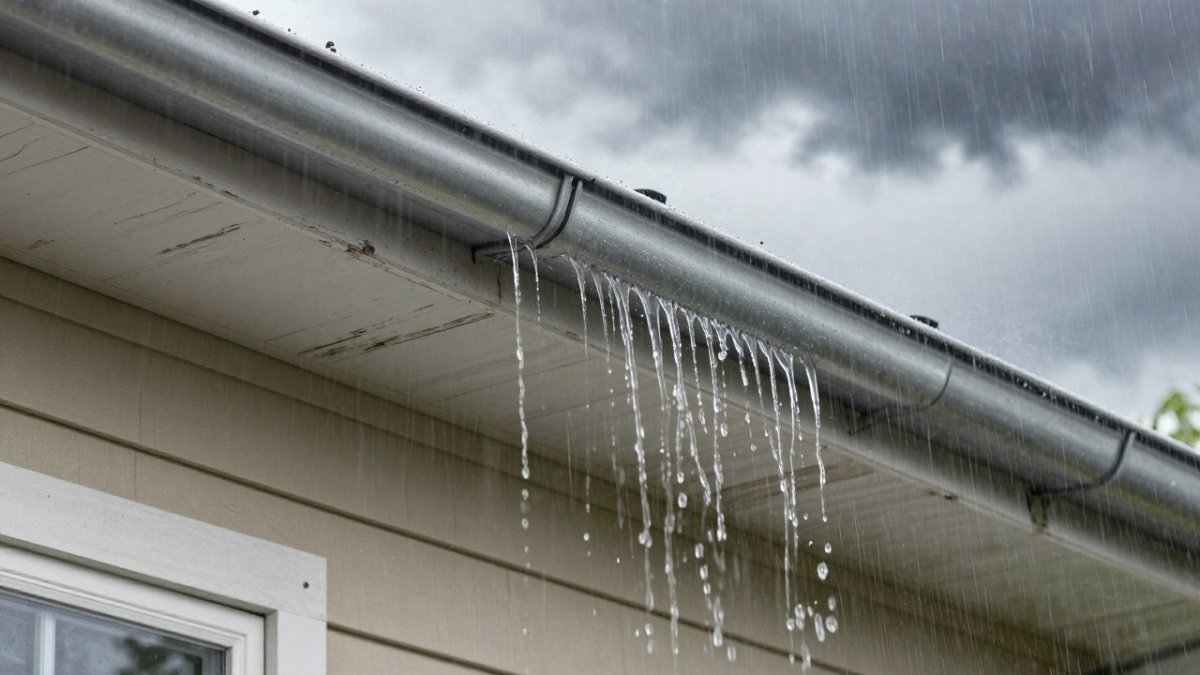
Overflow in a Downpour
Water that pours over the front edge of the gutter, not just at the corners, is the classic symptom. A properly sized system handles the peak flow from your roof and carries it to the downspouts. When the gutter fills faster than the outlets can drain it, the water has nowhere to go but over the lip. Watch during the heaviest ten minutes of a storm, not the drizzle.
Water Stains and Fascia Damage
Streaks down the siding below the gutter line, peeling paint on the fascia board, and dark staining along the soffit all point to chronic overflow. Water that repeatedly runs down the back of the gutter soaks the wood behind it. Left long enough, that wood softens, and the gutter hangers pull loose. For a step-by-step way to check for rot and separation before it spreads, see our guide on how to inspect gutters for structural damage.
Soil Erosion and Foundation Trouble
Look at the ground beneath your downspout outlets. Washed-out mulch beds, exposed roots, and soil carved into channels mean water is landing in the wrong place. That same water saturates the soil against your foundation. Splash blocks help, but they cannot fix a system that is dumping too much water too fast. If erosion is the main problem, our article on installing a downspout extension yourself covers the fixes that actually move water away from the house.
Gutter Overflow During Heavy Rain vs. Clogs
Gutter overflow during heavy rain does not automatically mean your gutters are too small. Clogs, restricted downspouts, poor slope, and installation errors all produce the same symptom. The distinction matters because cleaning a clogged system is a fraction of the cost of replacing an undersized one. Before you assume the worst, rule out the cheap explanations.
Run this checklist during or right after a storm:
- Water spills evenly along the whole run, not just at one low spot
- Downspouts flow freely when you run a hose into the gutter
- Gutters are pitched toward the outlets, not level or back-sloped
- No granules, shingle grit, or leaf debris packed in the channel
- Hangers are tight and the gutter is not sagging away from the fascia
Repeated overflow on a clean, properly pitched system with clear downspouts is a much stronger indication of undersizing. If you are unsure whether you are dealing with a clog or a capacity problem, compare cleaning versus repair costs before you spend anything. And if a clog is the culprit, our guide on clearing downspout clogs walks through the fixes.
Standard Gutter Size for Residential Homes
The size that fits your house depends on how much water your roof sheds and how fast it needs to leave.
How to Measure Roof Pitch and Drainage Area
Roof pitch is the rise over a 12-inch run. Hold a level against the roof slope, measure 12 inches along it, and check the vertical gap at the far end. A 6-inch gap means a 6/12 pitch. Steeper roofs shed water faster and concentrate flow, so they need more capacity. Next, measure the footprint of the roof, including overhangs, to get your drainage area.
The Sizing Math Most Guides Skip
Gutter capacity is rated in square inches of gutter cross-section per square foot of roof drainage area, adjusted for rainfall intensity.
Here is the step-by-step calculation:
- Measure the roof footprint in square feet, including overhangs.
- Multiply by the pitch factor (1.0 for low slope, 1.25 for 6/12, 1.5 for 9/12 and steeper).
- Look up the 100-year, 1-hour rainfall intensity for your location.
- Divide the adjusted roof area by the rainfall intensity to get the required gutter cross-section in square inches.
- Compare that number to the capacity of the gutter profile you have.
Gutter and downspout capacity ratings vary by profile and manufacturer, so check the rated capacity of the specific products being installed.
Watch out: pitch factor tables vary by source, and local codes may specify their own rainfall intensity values.
When a Steep Roof Needs a Bigger Gutter
A steep roof with a large drainage area is the most common candidate for an upgrade. Water velocity on a 9/12 or 12/12 pitch is high enough that a 5-inch gutter can be overwhelmed even when it is spotless. The same applies to long, unbroken rooflines with few downspouts. More outlets, or a jump to 6-inch gutters, usually solves it.
Downspout Count Matters as Much as Gutter Width
A 6-inch gutter fed by a single 2-by-3-inch downspout can still overflow, because the outlet becomes the bottleneck. As a rule, plan one downspout for every 30 to 40 feet of gutter run, and add outlets at inside corners and at the low end of every slope.
The sizing math comes down to a few measurable inputs and a pitch factor.
| Item | Value | Note |
|---|---|---|
| Roof pitch factor, low slope | 1.0 | Multiply roof footprint by this |
| Roof pitch factor, 6/12 | 1.25 | Steeper roofs shed water faster |
| Roof pitch factor, 9/12 and steeper | 1.5 | Highest factor listed |
| Gutter cross-section rule of thumb | 1 sq inch per 1 sq ft | At 1 inch rainfall per hour |
| Downspout spacing | One per 30 to 40 feet | Add outlets at inside corners |
| Hanger spacing | Typically 24 inches on center | Closer in snow country |
Roof pitch factors used to adjust drainage area
Cost to Replace Gutters and What Drives the Price
Replacement pricing depends on the length of the run, the material, the number of downspouts, and whether the fascia needs repair underneath. Pricing varies by project, so contact Extra Pressure LLC. for a quote on your specific roofline. What we can tell you is that routine maintenance is always cheaper than replacement, so it helps to know what residential gutter cleaning costs before you decide.
What the Line Items Look Like
A replacement estimate is usually built from four line items: the gutter run itself (priced per linear foot), the downspouts (priced per linear foot and per outlet), the hangers and hidden hangers (priced per piece), and labor. Fascia repair, soffit replacement, and disposal are add-ons. Seamless aluminum is the most common choice because it balances cost and durability; steel and copper cost more per foot and are usually chosen for appearance or for homes with metal roofs. Two-story homes add labor because of ladder time and safety equipment, and long runs with few corners are cheaper per foot than complex rooflines with many inside and outside corners.
How to Compare Bids
Ask each contractor for a line-item breakdown rather than a single lump sum. Confirm the gutter profile (5-inch or 6-inch), the downspout size, the hanger spacing (typically 24 inches on center, closer in snow country), and whether fascia repair is included or billed separately. A bid that is dramatically lower than the others usually means thinner gauge aluminum, fewer hangers, or fascia damage left unaddressed.
Repair vs. Replace
If the gutters are the correct size and the problem is a clog, a loose hanger, or a back-sloped section, repair is almost always the right call. If the sizing math shows the system is undersized, or if the fascia is soft and the hangers are pulling loose, replacement is the better investment.
Maintenance Is the Cheapest Line Item
Regular cleaning keeps a correctly sized system working and can delay replacement. If you are unsure whether you are facing a clog or a capacity problem, compare cleaning versus repair costs before you spend anything. And if a clog is the culprit, our guide on clearing downspout clogs walks through the fixes.
Schedule a Gutter Inspection and Cleaning
Before you spend money on new gutters, get a professional opinion on whether you actually need them. At Extra Pressure LLC., our licensed and insured team provides gutter maintenance alongside pressure washing and soft washing, and we offer same-day estimates.
Get started with Extra Pressure LLC. and find out exactly why your gutters are overflowing.
If your gutters spill every time it rains, the fix starts with a proper inspection rather than a guess.
Frequently Asked Questions
What are the signs that my gutters are bad?
Look for overflow during heavy rain, water stains or tiger striping on the fascia board, peeling paint near the roofline, soil erosion around the foundation, and sagging gutter hangers. If gutters are clean and pitched correctly but still overflow, they may be too small. Repeated overflow after cleaning is a stronger sign of undersizing than a single storm event.
How do I know if my gutters are too small or just clogged?
Clean the gutters and check downspout flow first. If water still spills over the front edge during a steady rain, the problem is capacity, not debris. Clogs usually cause overflow at one spot or near a downspout. Undersized gutters overflow along the entire run, especially on long roof sections or steep pitches where water velocity is highest.
Can undersized gutters cause foundation damage?
Yes. When gutters overflow, water lands next to the foundation instead of being diverted away. Over time, that saturates the soil, causing erosion, cracks, and basement moisture. Properly sized gutters with downspouts and splash blocks move water at least 4 to 6 feet from the house. If you see pooling or washed-out mulch beds after storms, have the gutter capacity checked.
What size gutters do I need for a steep roof?
Steep roofs shed water faster, so they need more capacity. Most homes use 5-inch K-style gutters, but a roof with a pitch above 8/12 or a large drainage area may need 6-inch gutters or extra downspouts. Measure the roof area feeding each gutter run and compare it to the gutter’s capacity rating. A professional inspection can confirm whether an upgrade is needed.
